




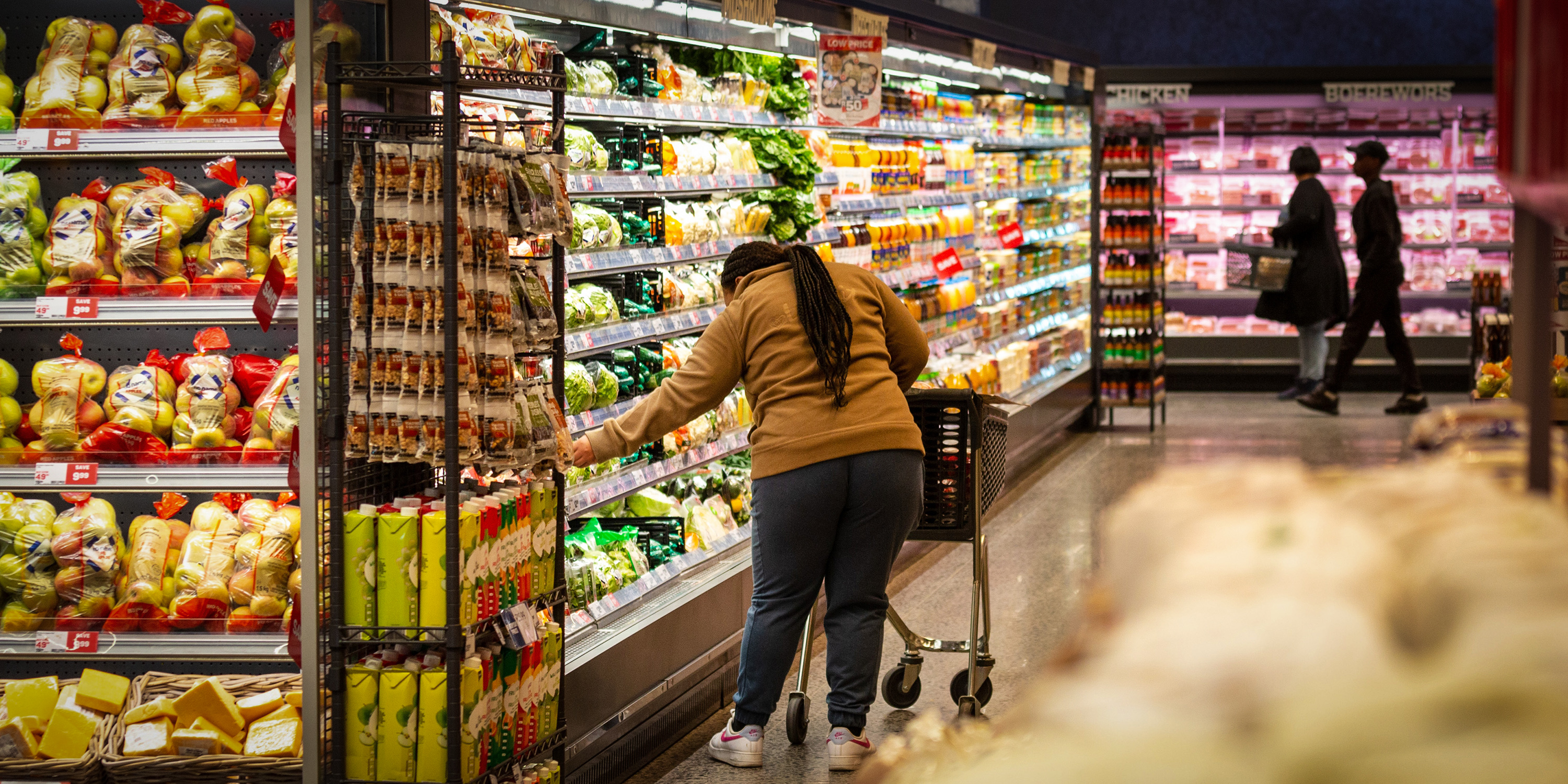
 A customer shops in a Cape Town supermarket. Food inflation was 4.4% year-on year, which may ease over the course of this year, says Dr Elna Moolman, Standard Bank Group head of South Africa macroeconomic research (Photo: Dwayne Senior / Bloomberg via Getty Images)
It seems that South Africa is entering a long-overdue period of economic panelbeating, though the current pace of recovery suggests we are in for a painstaking restoration.
Data released by Statistics South Africa (Stats SA) on Tuesday and Wednesday this week paints a picture of an economy that is finally catching its breath. Headline consumer price inflation (CPI) dipped to 3.5% year-on-year in January 2026, down from 3.6% in December 2025. On the labour front, the official unemployment rate decreased by 0.5 of a percentage point to 31.4% in the fourth quarter of 2025.
While these numbers may trigger a celebratory mood, the underlying structural fault lines suggest the foundation remains brittle.
“The modest decline in unemployment is incremental rather than transformative,” said Nolan Wapenaar, co-chief investment officer at Anchor Capital. “Overall, output conditions continue to improve, but the pace of expansion remains gradual rather than cyclical, indicating a repair cycle rather than a boom.”
The divergent price basket
The easing of inflation to 3.5% brings the figure within the South African Reserve Bank’s target range, opening the door for further interest rate cuts this year.
The aggregate number hides a divergence in the consumer basket. In January 2026, the annual inflation rate for goods was 2.7%, down from 3.0% in December 2025, while services inflation remained sticky at 4.2%.
“Food inflation was 4.4% year-on year, which may ease over the course of this year, supported by ample stocks and strong supply in many food types both domestically and globally,” said Dr Elna Moolman, Standard Bank Group head of South Africa macroeconomic research.
Johann Els, group chief economist at PSG Financial Services, told Daily Maverick that the specific basket of goods for the average consumer is showing deflationary trends in key areas.
“Consumers are actually doing very well,” he said and cited the deflation of essential tech items. Els pointed out that tablet computers have seen an almost 24% price drop compared with last year, while the cost of laptops and cellphones has retreated by 11.3% and 16.3% respectively.
Read more: Latest dose of Huawei consumer tech decline the toughest pill to swallow
“The point of inflation is; our baskets are all different. I often get people telling me ‘That’s not a good number’, but your own number is different from the average, because it’s the average of 63 million people,” he said.
Read more: Why your personal inflation rate matters
From pumps to pantries
The most dramatic relief for the broader economy came from the pump. Stats SA reported that the fuel index contributed significantly to the cooling headline, as petrol prices fell for a third straight month.
For most South Africans, however, the till tells a bleaker story as meat prices spiked 13.5% in January. This surge follows the national foot-and-mouth disease outbreak, which President Cyril Ramaphosa declared a national disaster during last week’s State of the Nation Address.
Read more: Amid foot-and-mouth hysteria, experts stress need for state-controlled vaccination
“Foot-and-mouth disease poses a risk to meat prices, although there seems to be encouraging progress with procuring vaccines,” Moolman said. On Tuesday, 17 February, Minister of Agriculture John Steenhuisen announced that the first batch of one million vaccine doses from Argentina is scheduled to arrive in South Africa this weekend.
Housing and utilities remained the largest contributor to the annual inflation rate, adding 1.2 percentage points to the 3.5% total. Electricity, gas and other fuels rose by 7.5%, while insurance and financial services increased by 6.8%.
Formal gain, informal pain
The Quarterly Labour Force Survey data revealed a mixed bag for the final months of 2025. While the economy added 44,000 jobs quarter-on-quarter, the gains were unevenly distributed. The formal sector saw robust growth of 320,000 jobs, but the informal sector shed a significant 293,000 positions.
/file/attachments/2988/Screenshot2026-02-18at123505_950902.png "Graph: Stats SA")
Stats SA reported that quarterly job increases were recorded in seven of the 10 industries surveyed, with community and social services gaining 46,000 jobs and construction adding 35,000. Conversely, the trade sector (which includes wholesale trade, retail trade, motor trade, accommodation and food services) lost 98,000 and manufacturing shed 61,000.
How the numbers changed in different sectors
Daily Maverick took the fourth quarter unemployment stats over the past three years and collated the information to show how job opportunities and losses have moved in different sectors.
/file/attachments/2988/bm_employment_infographic_285150.png "Graphic by Neesa Moodley using ChatGPT")
As you can see from the chart above:
🟦 Finance proved to be a consistent job engine, with a monster spike in the middle year (2024);
🟥 Trade (which includes wholesale trade, retail trade, motor trade, accommodation and food services) showed a steady deterioration across the three periods;
🟥 Manufacturing had a brief bounce, then a sharp drop in the latest period;
🟩 Construction and community services (health and social work, public administration, police, courts) showed a swing from losses to gains most recently;
🟨 Private households were an oddly steady little metronome;
⛏️ Mining employment numbers were up, then down, and then down by a little less.
Analysis by Neesa Moodley
Els suggested that these shifts might be influenced by how workers identify themselves during surveys. Because workers might not know exactly which sector their employer falls under, he said, a quarterly snapshot can be misleading, especially during festive seasons when temporary hiring should normally boost retail numbers.
Agricultural employment provided a silver lining. Wandile Sihlobo, chief economist at Agbiz, highlighted the resilience of the sector, which reached its highest employment level since late 2023.
Read more: There is robust employment in South African agriculture, and more growth is possible
“The number of farm jobs in South Africa increased by 3% year-on-year in the last quarter of 2025 to 950k,” Sihlobo said. “Notably, the jobs of 950k are far above the long-term average of 799k jobs, signalling that, while the sector faces challenges such as animal diseases, wage pressures in some industries, and inept municipal service delivery, among other issues, employment conditions remain encouraging.”
How this affects you
📉 Cooling inflation signals likely interest rate cuts, which will reduce monthly costs for home loans, car finance and credit cards;
📉 Successive petrol and diesel price cuts are leaving more cash in your pocket after the daily commute;
📉 Due to the foot-and-mouth disease crisis the cost of meat remains high, keeping your grocery bill under pressure despite lower headline inflation;
📉 Electricity and water tariffs continue to rise faster than the average inflation rate, squeezing disposable income; and
📉 While formal jobs are growing, losses in other sectors mean employment remains a mixed bag for many households.
The lost generation
Despite the marginal improvements in the headline figures, the crisis of youth unemployment remains a national emergency. For those aged 15 to 24, the unemployment rate is a staggering 57%.
“For many young South Africans, unemployment is not just an economic statistic – it is a daily lived reality,” Dr Memuna Williams, CEO of Empowering Sustainable Change, said. “We cannot measure success only by small movements in national aggregates while so many young people are still waiting for their first real opportunity.”
/file/attachments/2988/Screenshot2026-02-18at124419_444505.png "Graph: Stats SA")
Ravi Naidoo, CEO of the Youth Unemployment Service (YES), told Daily Maverick that high unemployment level creates lower demand and thus lowers price pressures.
“Unemployment is structural due to a dismal education system and a highly concentrated economy. Young people are poorly prepared for employment or starting their own businesses, and the concentrated economy means it is hard for new businesses to break into the market,” Naidoo said.
Read more: Mashatile declares South Africa’s youth unemployment crisis a ‘moral emergency’
The correlation between education and employability remains the most predictive factor in the South African market. The unemployment rate for those with less than a matric is 37.6%, compared with 10.3% for graduates.
Traction at a slow pace
As the 2026 Budget looms, experts agree that the current momentum requires deliberate policy intervention.
“Important steps have been taken to address long‑standing constraints in energy and logistics, and those efforts are starting to show results,” Williams said. “The task now is to build on this foundation – by sustaining these reforms and pairing them with equally focused investments in skills, entrepreneurship and local ecosystems.”
Over the next few years Els predicts better growth, driven by infrastructure development and a bigger role of the private sector in the economy. “SA is arguably entering one of its more constructive macro backgrounds in a decade,” Wapenaar said. “Provided reform momentum is sustained, and policy discipline holds firm, we expect to see measurable economic traction, albeit at a slow pace.” DM
Comments
Scroll down to load comments...