




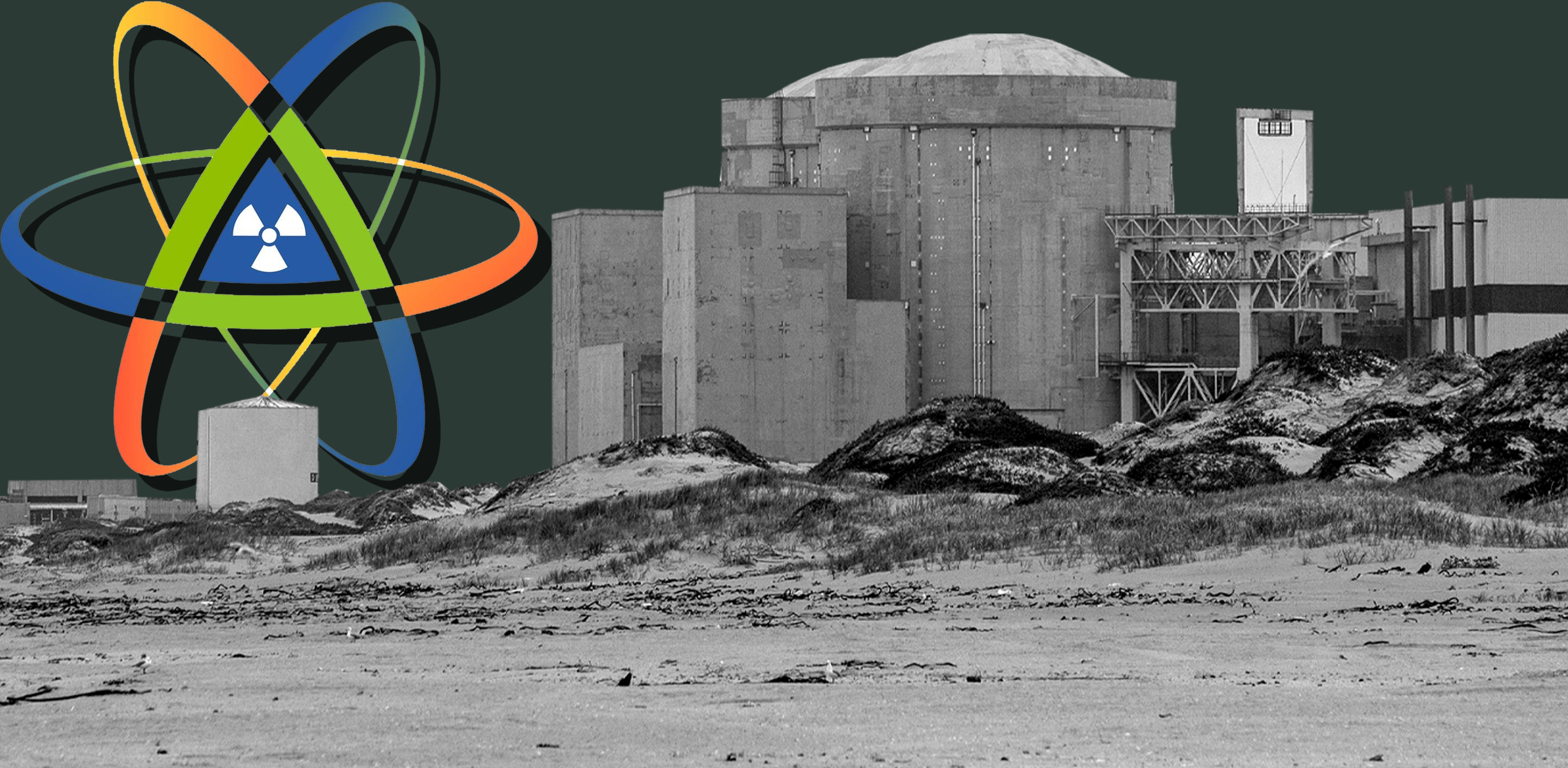
 Illustrative image: The Koeberg nuclear power station. (Photo: Dwayne Senior / Bloomberg via Getty Images)
 By the time our country’s coal plants begin their retirement, the country needs something to put in their place. Not wind farms. Not solar panels. Something that runs around the clock and in the rain.
The answer, according to Eskom, Necsa, and Ramokgopa’s Integrated Resource Plan 2025, is nuclear. Specifically, a 5.2GW programme anchored by four Pressurised Water Reactors (PWR) of about 1,200MW each, supplemented by a fleet of Small Modular Reactors (SMR) deployed across those retiring coal towns in Mpumalanga and Limpopo.

Oh, and the ambition doesn’t stop at South Africa’s borders – the vision that was explained multiple times at last week’s Africa Energy Indaba in Cape Town is for the country to become the technological and industrial anchor of the southern part of the continent.
A shift from “atoms for peace” to what the movement’s loudest supporters are now calling “atoms for development”.
In your head
Eskom has secured the immediate future of the Koeberg Nuclear Power Station, with the National Nuclear Regulator (NNR) granting a 20-year life extension for Unit 2 in November 2025, authorising operation until 2045.
However, the expansion plan, specifically the 4,000MW Nuclear-1 site designated for Duynefontein, adjacent to Koeberg, is now tied up in a high-stakes legal battle.
Following the then Minister of Forestry, Fisheries and the Environment’s (Dion George) August 2025 decision to uphold the site’s environmental authorisation, a coalition of civil society groups, including Southern African Faith Communities’ Environment Institute (Safcei) and Greenpeace Africa, launched a high court review in early 2026.
The litigation attacks the fundamental rationale of the state’s plan:
Outdated data: The coalition argues the authorisation relies on obsolete demographic and economic data collected between 2007 and 2010.
The envelope of data critique: Because Eskom has not yet selected a specific reactor vendor, civil society argues it is impossible to accurately model severe accident scenarios or finalise emergency evacuation logistics for the densely populated Cape Town corridor.
The no-go alternative: Applicants assert the state failed to assess the alternative of abandoning the nuclear project for an equivalent capacity of renewable energy paired with battery storage.
Francesca de Gasparis, executive director of Safcei, characterised the Duynefontein push as a “zombie” revival proceeding without economic justification or transparency.
This is an immediate roadblock because the Koeberg expansion is the frontrunner for the first large PWR and is expected to start reaching the pointy end of development plans by next year.
The Nuclear Energy Corporation of South Africa (Necsa), meanwhile, is pushing ahead with plans for a new multi-purpose reactor to replace the ageing Safari-1 research reactor, which currently supplies to global markets life-saving medical isotopes, including Molybdenum-99 used in cancer and cardiac diagnostics.
The economics being constructed around the programme are deliberately broad. Necsa projects up to 16,500 direct jobs at peak construction across its various growth programmes. Eskom argues that replacing retiring coal plants with SMRs could transfer up to 77% of existing coal plant jobs directly into the nuclear sector – a number it deploys explicitly as a rebuttal to the “just transition” framing used by renewable energy advocates.
/file/dailymaverick/wp-content/uploads/2024/06/GettyImages-1229796647.jpg "The Koeberg nuclear power station photographed from Melkbosstrand in Cape Town. (Photo: Dwayne Senior / Bloomberg via Getty Images)")
The hype cycle
Necsa is another key player because, in late 2025, Cabinet doubled down on this SMR ambition by transferring the defunct locally developed pebble bed modular reactor (PBMR) company and its intellectual property from Eskom to Necsa, aiming to revitalise the technology for process heat and industrialisation.
However, global nuclear experts are pouring cold water on the SMR hype. Dr Yves Guenon, chairman of the French South African Chamber of Commerce and Industry, a prominent voice in the sector, told Daily Maverick in an interview ahead of the indaba that while SMRs are theoretically ideal for Africa’s limited grid infrastructure and water constraints, their current commercial readiness is an illusion.
“Yes, SMR … for me today is still a dream... small is beautiful, but it is [also] a joke,” pointing out that the true price of SMRs remains unknown among all the – his words – “industry blah blah”.
He warns that the price per megawatt-hour for SMRs is significantly higher than that of large, traditional reactors.
SMRs will actually face more difficult licensing hurdles because they lack a proven track record, and regulators will absolutely not compromise on the stringent rules surrounding nuclear fuel.
To bridge this massive commercial and developmental gap, the 2025 strategic revival of the PBMR relies entirely on forging international partnerships with nations such as China or the US. Without foreign capital and technology transfer, manufacturing the highly complex TRISO fuel domestically remains a massive challenge.
Why Small Modular Reactors may be a fool’s errand
Small Modular Reactors are the technology that everyone in the industry talks about and almost nobody has actually built at commercial scale. They are theoretically ideal for a continent such as Africa — most African nations lack the massive transmission grids and large water bodies required for gigawatt-scale conventional reactors.
An SMR of 200MW can theoretically be cooled with a cooling tower similar to those used at coal plants. It can plug into a smaller regional grid. It can, in theory, be deployed at the exact inland sites where coal plants are being retired.
Not a single SMR vendor can today offer South Africa — or any country — a fixed price and a guaranteed delivery date backed by a signed contract.
“If you decide to license [an SMR], it is more difficult... because it has not been done before,” Guenon explains. Safety authorities in South Africa can draw on established international precedent for PWRs. For SMRs, particularly novel designs, that precedent doesn’t exist.
And crucially, the fuel problem doesn’t shrink with the reactor. “The problem of a nuclear reactor is the fuel... the fuel is the same for a big and a small one. As soon as you have nuclear fuel, you have to respect the same rules.” No safety authority, Guenon argues, will take the risk of lowering standards simply because the marketing says the technology is simpler.
South Africa is only formally qualified to license PWRs. Everything else (including SMRs, Boiling Water Reactors, or any revival of the Pebble Bed Modular Reactor concept) starts from a significantly longer regulatory runway.
Running on fumes
Even if Eskom and Necsa can secure the capital and survive the courts, the ultimate bottleneck is regulatory capacity. The National Nuclear Regulator (NNR) has historically been highly competent, with an institutional history dating back 78 years. However, the regulator is presently unequipped to handle the impending tsunami of licensing applications.
NNR CEO Ditebogo Kgomo was refreshingly candid about the organisation’s readiness. While the legal framework is in place, the physical capacity is lacking. “Do we have the people and the resources to be able to do it? We have, but it is not enough,” she told the Nuclear Forum (another indaba side event).
The NNR relies on government grants, which have been perpetually declining, and authorisation fees. The start-stop nature of South African government planning (remember the abandoned 9.6 GW build from 2014-2016?) has made it impossible for the regulator to pre-emptively hire and retain expensive nuclear skills without formal applications already in hand.
As South Africa charts its path from 2027 onward, the ambition is clearly documented. But ambition neither pours concrete, nor does it survive high court scrutiny – or balance the books of a cash-strapped regulator.
South Africa’s nuclear roadmap is more detailed than it has been in a decade. Whether it leads somewhere real depends less on the ambition, which is considerable, than on the sequencing, which is, at present, still largely aspirational.
The country has been here before. DM