



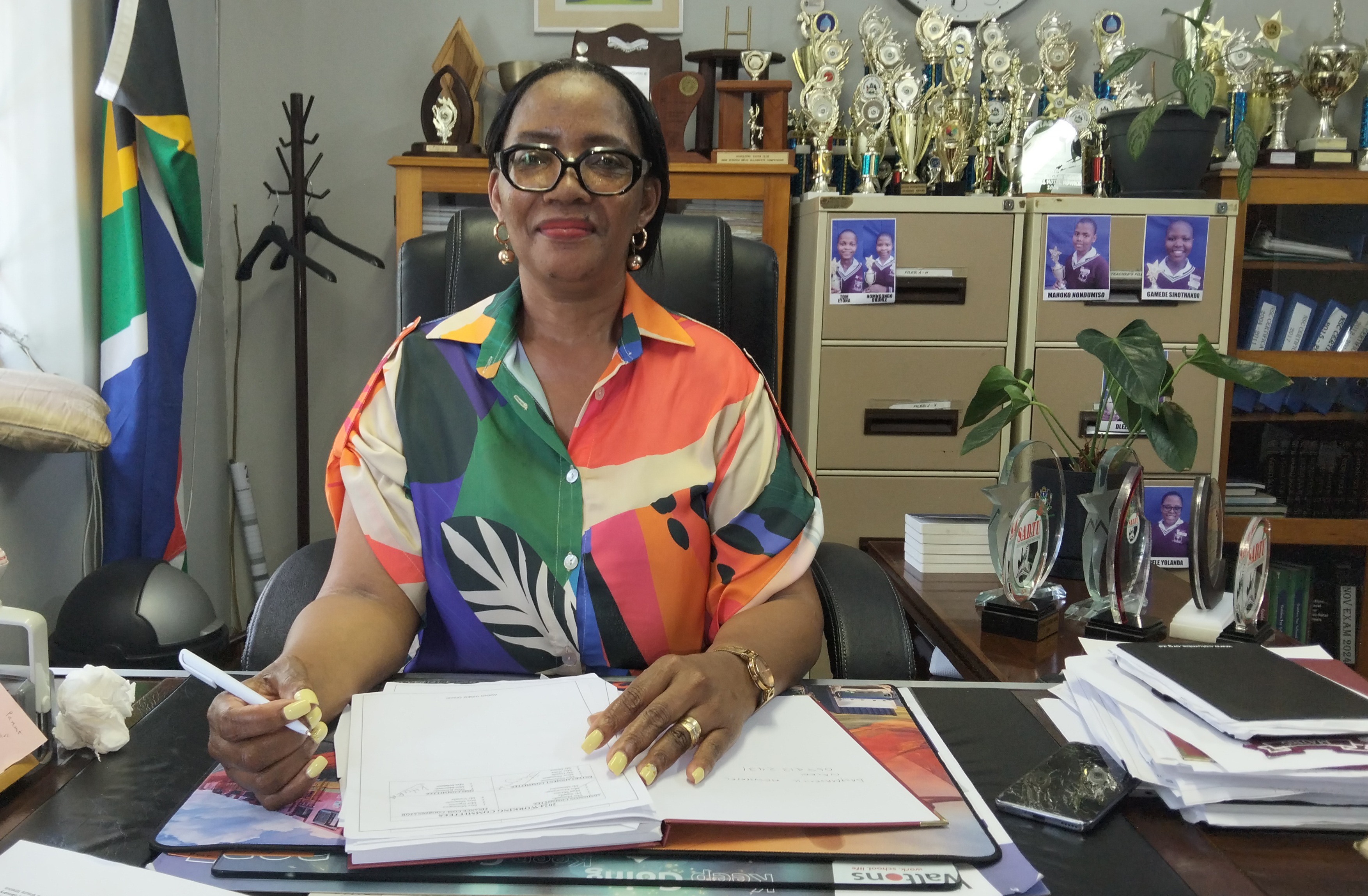
 Sithengile Senior Secondary School principal Sibongile Shabalala in her office in Claremont, KwaZulu-Natal, on 13 January 2026. (Photo: Naledi Sikhakhane)
 Sithengile Senior Secondary School in Claremont township, KwaZulu-Natal, achieved a 96.8% pass rate, with more than 176 bachelor’s passes out of 248 pupils and a number of distinctions in maths and science. This is an improvement from a 90.6% pass in 2024.
Principal Sibongile Shabalala applauded the dedication of pupils and teachers in overcoming significant socioeconomic inequalities, noting that achieving these results was “very strenuous and difficult”.
Shabalala described how the school helped a small group of pupils overcome learning challenges through a targeted “adoption strategy”, in which the school management team decided to take personal responsibility for 22 pupils who were struggling with personal challenges.
“I don’t know how to explain this, but we felt like some of the learners in Grade 12 were not fully prepared for Grade 12; they couldn’t finish an isiZulu novel, for example, and struggled with reading and understanding,” Shabalala said.
/file/attachments/orphans/1000172883_874281.jpg "Star Sithengile Senior Secondary pupils Lukhanyo Nonzanga (18, left) and Bongumusa Nonkula (17) achieved five distinctions. (Photo: Naledi Sikhakhane)")
These pupils had challenges, including smoking cigarettes, weed or what Shabalala called incika, an isiZulu word for “lean”, a mixture of cough syrup and soft drinks that has a sedative effect.
“They were struggling, drowning in the work, which led them to being absent out of frustration and discouragement. We called parents in so much to intervene; some parents asked us to stop calling them because it became hard for them to regularly attend to the students.”
Shabalala added that after dedicating time to figuring out the root of the problem, pupils became cooperative and dedicated themselves to cross-nighting (overnight study sessions) at the school, being taught by their peers.
The initiative was supported by teachers, who were at the school to observe the pupils during night sessions, and the school hired extra security to ensure pupils’ safety. Only the boys stayed overnight, while the girls attended the regular extra classes for the entire grade.
To motivate the matric class to take part in the extra lessons, the school provided a second meal, courtesy of its nutrition programme, which made the pupils feel special, Shabalala said.
“We fundraised to be able to provide the second meals. We would add chicken, make biryani and other well-balanced meals that they would look forward to.”
She recalled with a chuckle that, when the matric results were released, a pupil waved his certificate as she walked into her office and joked: “See, ma’am, your biryani helped, I passed.”
Shabalala said the school pursued many streams of fundraising, including fines for confiscated phones and asking the circuit manager and student governing body for help. They had also approached local businesses and even pursued donation drives, but these avenues had not come to fruition on time.
/file/attachments/orphans/1000172889_203769.jpg "The 2025 matriculants at Sithengile Senior Secondary form a line to collect their Grade 12 statements on 13 January 2026. (Photo: Naledi Sikhakhane)")
Collaboration for success
Shabalala attributed the school’s six percentage point improvement in the matric pass rate to the dedication of the Grade 12 teachers.
“We spent all our time here, we basically lived here, all the Grade 12 teachers. Our families barely saw us.”
They had pulled out all the stops, calling on teachers from lower grades to help observe study sessions, roping in teachers’ assistants and even recruiting specialist teachers from outside the school to give classes on challenging subjects.
“I do have to note the support from the circuit manager and school governing body, who listened to all our calls for interventions, such as extra security, and helped us access school funds, especially for food for the children,” Shabalala said.
She added it would be remiss to ignore the strain this dedication had placed on the teachers’ personal lives.
“You can end up losing friends and family because you don’t have time for anything else, which can make them feel like you do not care. Even with things around the house, you get home exhausted after extra classes and monitoring cross-night sessions. You can see you need to replace a curtain in your home and keep postponing because there is no time to take care of it.”
Asked what motivated her as a leader and her teachers, she said: “I have a great love for an African child, and I never thought I would end up being a principal of a school, so I, and I think the teachers here, all take the duty seriously, to do something to contribute to help develop an African child. This is how I serve because I don’t have the money to assist in other ways. That is what motivates me more than anything.”
Parental involvement
The principal said getting parents involved in their children’s schooling was challenging because some pupils live in child-headed households, or by themselves in rented rooms to be closer to school. Some parents live as far as Eastern Cape.
Asked what she thought contributed to the lack of parental involvement, she said it was partly as a result of life circumstances, but also parents shifting the responsibility onto the teachers.
In Shabalala’s office, a pupil interrupted our interview, eager to show her statement to the principal. Shabalala hugged her, congratulating her on how well she did.
The pupil was in tears as she expressed gratitude, saying she didn’t believe she would make it.
Shabalala told Daily Maverick that the pupil had wanted to quit in the middle of the year, but her teachers convinced her and her parents that she would be able to make it.
“Some students really struggle with the pressure of the matric year. Teachers have to become social workers, councillors and parents, take personal responsibility for the child to help them get to the finish line.”
Shabalala said that even though schools similar to hers achieved positive results, community involvement, such as donations from local businesses, parental involvement and other forms of help, would help her school achieve more of their goals.
For example, they do not have sports facilities which could aid holistic learning by helping children who are not academically gifted to explore their talents.
Reframing resilience
An associate professor at the Ali Mazrui Centre for Higher Education Studies at the University of Johannesburg, Mlamuli Nkosingphile Hlatshwayo, said on Monday, 19 January 2026, that although schools in underresourced communities are achieving great results, more work is needed to alleviate the socioeconomic challenges faced by students and teachers.
/file/attachments/orphans/1000172972_104115.jpg "The entrance to Sithengile Senior secondary school that achieved a 96.8% pass mark for it's class of 2025. Claremont township, KwaZulu Natal. 13 January 2026 (Photo: Naledi Sikhakhane)")
He acknowledged that these circumstances can be crippling, resulting in schools that don’t achieve great results.
“Students often walk long distances (15km to 20km) to school, lack conducive and safe shelters, and the school meal is frequently the only nutritious food they receive. Teachers are forced to take on parental and psychological responsibilities, ensuring children are fed, clean and have necessary supplies (sometimes dipping into their own pockets), and engaging with community issues like gangsterism.”
Hlatshwayo said the context should not be glamourised, because before teachers can teach the learning material they have to deal with underfunding, geographical barriers, security issues (break-ins) and the persistence of basic infrastructure problems such as pit latrines.
Accountability
“So, what teachers now have to do is take on parental responsibilities to make sure that the kids are fed, to make sure that the kids are clean, to make sure that there are sanitary pads... So, these schools, they are very, very vulnerable schools,” Hlatshwayo explained.
“Even before they engage with the curriculum, even before they sit down at that desk and engage with the topic, they already have this huge background that I’ve just outlined to you. And now we’re expecting the very same learners to be enthusiastic, to be dedicated, to be committed, and to have the mental space to concentrate and focus properly in the classroom.”
Hlatshwayo said there has to be a sober reflection on the current state of education in the country, especially in previously disadvantaged areas.
“We have to be very, very careful because we don’t want to make it as if these are succeeding despite the overwhelming challenges they are facing. So, therefore, to cope with similar challenges, it’s their fault. They should pull up their socks, and they need to try harder.
“I think it’s a cruel and perverted discourse that we are creating, especially on social media in this country that we need to be careful of.
“It reframes the debate away from accountability and trying to fix the structural challenges, and we begin to normalise them as normal, as acceptable, as something that we can navigate and negotiate.”
Foundation first
Hlatshwayo said he noted an obsession with matric results and believes a budgetary and policy shift is needed towards early childhood development (ECD) and primary school phases (grades 1 to 3) to strengthen basic literacy, numeracy and cognitive skills.
“I hope at some point South Africa will stop being obsessed with the Grade 12 results, and we start looking at ECD and the early career education phases, because this, for me, is where some of the challenges that we’re facing stem from. If we can finish the foundation, if we can strengthen the foundations, then I think it gets easier for us.” DM