




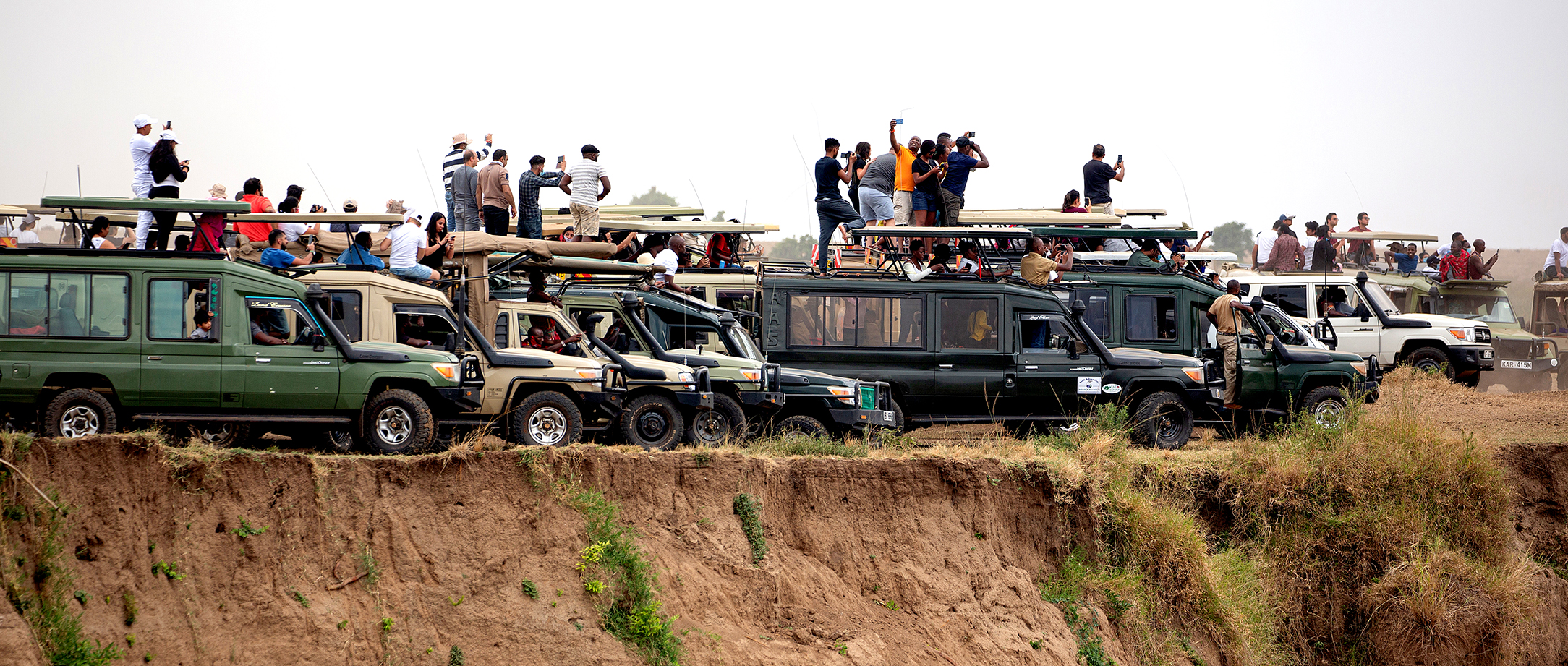
 Crowds of tourists gather and wait at 'Miti Moja'/single tree crossing point. This is where much of the worst tourist behaviour has taken place over the years. On this occasion cars line the banks to watch the wildebeest cross. The park authorities have got better at controlling the standing on the roofs — but the sheer number of cars continues to grow year after year. It is not uncommon to have over 200 cars at a crossing point. (Photo: Adam Bannister Wildlife)
 /file/dailymaverick/wp-content/uploads/2025/10/label-Op-Ed.jpg)
On a recent trip to one of my favourite places on this beleaguered planet, the Kruger National Park (KNP), a few sightings niggled me.
One was a tourist with an enormous camera lens, standing on a riverbank, photographing a giant heron.
/file/attachments/2984/WhatsAppImage2025-11-06at122005_48751779_688206_85159289b3103d2bfa3adeea00386a1f.jpg "Code of misconduct: tourists in the Kruger National Park push the limits with their irresponsible behaviour at a game sighting. (Photo: Kruger Sightings / David Botha)")
Another was a merry band of travellers at a close lion sighting with one young woman perched on the vehicle’s window ledge, camera at the ready, her back to the bushveld behind her.
And, of course, in both instances it was All About The Photo (and it is illegal and potentially dangerous, with both miscreants completely unfazed by us law-abiding killjoys).
Consider recent footage on social media.
Kruger-Park-related Facebook groups are awash with photos of tourists engaging in irresponsible, often illegal, behaviour such as getting out of their cars, driving off-road, speeding or cramming around sightings.
A furious Nick Kleer, professional safari guide and wildlife photographer, vented on Instagram at the sight of dozens of open safari vehicles crowding the banks of the Mara River in the Serengeti, blocking the crucial migratory and escape path of wildebeest crossing the crocodile-infested waters (some of them, with nowhere to go, fell back into the river). And, crammed in front of and on top of the vehicles, were dozens of camera-wielding tourists excitedly waiting to film the carnage.
/file/attachments/2984/O4A8775-Edit_207316_1fcabf248843ca1c91794465f3f17262.jpg "A famous crossing point along the Mara River called 'The Peninsula', or 'U'. It sees some dramatic and dusty crossings — in each direction — each year. It is also one of the crossing points that has historically been really badly affected by cars from the Maasai Mara National Reserve side. (Photo: Adam Bannister Wildlife)")
Other footage, by professional guide, photographer and guide trainer, Adam Bannister, shows a huge number of game-viewing vehicles thundering across the Mara plains in an insane race for prime parking at a river crossing, so guests can witness the legendary Great Migration.
And then, who has not seen the astonishing footage from Botswana of the enraged elephant bearing down on tourists in a too-close mokoro? That is not the astounding part. Rather, it is the surreal sight of tourists filming the incident as the tusker literally bore down on them, upending the vessel in protective fury. And still they filmed…
This is where we are now — wildlife viewed as entertainment. The ultimate goal? Content creation — often accompanied by bad behaviour — to garner ever more “likes” and “shares” on social media.
Bannister laments the trend where anyone with a camera or smartphone either wants to mimic or better the photos of wild animals that flood social feeds.
“Social media has badly damaged wildlife, and our appreciation and respect for wildlife. And there are a handful of wildlife photographers who have also played a large part in destroying ethical wildlife viewing. Social media has changed animals from sentient beings that were to be respected, into Instagram cannon fodder. They are objects that are there for likes and shares; things that get you noticed.”
He says the original African safari bucket list, the Big Five, is no longer about just sightings of animals.
“It has now evolved from seeing a lion into now seeing a lion doing something that you know Instagram and TikTok will respond to, something that will trigger the algorithm.”
/file/attachments/2984/pic_272582_cae7d2f48e77a509535589ba2fdfd22b.jpg "An off-road tourist brazenly engages with a lioness by sticking his arm out his open window for a close-up photo opportunity in the Kruger Natioal Park. (Photo: Kruger Sightings / Facebook)")
South African National Parks (SANParks), the governing body of the Kruger National Park, has noted with concern the increase in unlawful behaviour. Rey Thakhuli, general manager of communications, told Daily Maverick: “We have seen this irresponsible behaviour by visitors, and this is a worrying factor, which we discourage. This is more like one signing their death warrant, particularly those getting out their vehicles in an area full of wild animals.
“The importance of responsible behaviour cannot be overemphasised. Those who would like to report unbecoming behaviour should be willing to write a statement and provide photographic or any type of evidence, if possible, so action can be taken.”
There is no denying it: wildlife tourism in Africa is a multibillion-dollar industry, and the dollar-wielding tourists keep on coming on trains, planes and automobiles (and yes, even Uber Safaris are now a thing). More and more of them are flocking to areas that are increasingly under strain from overtourism, greed and lack of respect.
They also bring with them huge expectations, as glossy websites tempt them with magnificent pictures of magnificent animals in magnificent settings. Many are beguiled into believing that the game sightings will be exclusively theirs to witness.
The clamouring for footage of wild animals is also just part of the multi-layered, complicated issue that is conservation, which needs a multi-pronged approach to resolve. At the heart of it is land management, which is crucial for the protection of wilderness areas by balancing human use (local communities, poaching, development, tourism etc) with conservation goals.
/file/attachments/2984/ROBYN_809370_c97e7fd6f9fbd8aed02948046993a0ad.jpg "Three’s a crowd, four’s a traffic jam. Users rave about motorhomes and their inbuilt comfort, coffee on the go and elevated viewing, but it’s a less positive experience for others whose views are blocked by the large frames. (Photo: Robyn von Gesau )")
Conservationists and developers are no doubt paying close attention this month to a David vs Goliath scenario playing out in a Kenyan courtroom where a conservation activist will hear whether his bid to stop the controversial luxury Ritz-Carlton, Maasai Mara Safari Camp’s scheduled opening is successful.
Meitamei Olol Dapash, from the Maasai Education, Research and Conservation Institute, argues that the development obstructs a vital migration corridor between Maasai Mara and Tanzania’s Serengeti.
An online petition platform says the development would “irreversibly damage critical wildlife pathways and disrupt the delicate balance that has existed for centuries between the Maasai people and the animals they have protected”. It accuses this project of prioritising “luxury profits over ecological survival and cultural sovereignty”.
Dave Hamman, a concession owner and operator at Botswana’s Chitabe Camp, likens the current situation in the safari industry to “a whirlpool”.
“Gone are the days when most people who came to the bush were interested in the bush, when they were birders and adventurers. Now the most important thing is whether there is a coffee machine and what the menu is. Everything has changed.”
/file/attachments/2984/DSC03727_763758_6662877e8f5cace1af68293e70cbba4b.jpg "Adam Bannister and members of the guiding team at ‘The Hilldana’, a small lodge in the Taita Hills of southeastern Kenya. (Photo: Adam Bannister Wildlife)")
And with it so has, in many places, the quality of guiding.
“As more and more people head to wilderness areas, marginal operations spring up. But often, these in turn employ less experienced guides, many of them also in search of more ‘likes’, and so the whirlpool starts — and it is hard to get off. One thing pushes the other, and you get lower and lower and closer to the drain.”
It’s no secret that many guests place immense pressure on safari guides — with offers of huge tips as leverage — to deliver more and more, to go off-road, to chase game, always in pursuit of footage.
“I get it all the time,” said Bannister. “I've now been a guide for almost 20 years, and I feel confident in myself and my role as a professional to be able to say no. I believe I can get myself out of almost all situations. However, in my time with guide training and with guides, especially those who are new, that’s where the real issue starts because they don’t yet have that confidence and ability to say ‘no’ to a guest. That takes time to develop and instil.”
He adds that a big problem in a lot of reserves are private guides who accompany tour parties. They rely on social media for business and deliberately seek out the least experienced local guides — someone that they can manipulate or pressure. They don’t want someone who is strong enough to say ‘no’.
And all too often it is money that talks, where guests will offer to pay any fines the reserve guides may be subject to, even offering to “speak to the owners of the camp, we’ll make it our fault”.
Hamman says they have strict protocols in place at Chitabe with their guides, all of whom have a deep sense of ethical game viewing, and why, in the long run, it is for the benefit of all.
“We’ve always said to our guides: you are in charge of that vehicle. And we will support you 100% if a guest complains that you refused a request.”
For Hamman the number one rule for a guide is “respect” — primarily for the animal and the environment. And if that means a guide feels a vehicle is disturbing a sighting — particularly where cubs are involved — the guides will make a “do not disturb” call.
Respect, however, does not start and end with the guides. It starts with each person who encounters a wild animal or enters a wilderness space.
As ethical game viewing becomes ever more topical, part of Bannister’s mission is to encourage more honest footage.
“I find a very bizarre scenario unfolding whereby people are no longer really telling the truth on social media. They are trying to just encapsulate this idea of ‘Oh well, I’m the only one with this tiger; I’m the only one watching this crossing,’ but they’re not. They are trying to give the perception that they are there alone, so no one is really showing the truth.
“My big drive is to try to start encouraging people, especially those with influence from a social media point of view, to start showing the truth, instead of showing just the leopard sitting on the rock. Zoom out and show the hundred cars looking at the leopard on the rock. Because, although it doesn’t make a great image of a beautiful leopard, it makes a very realistic image of what is going on in the year 2025.”
A fingers-crossed byproduct of the social media exposure has been announcements by both Kenyan and Tanzanian authorities for action plans to streamline park regulations, improve visitor management, enforce disciplinary action against tour operators and guides violating rules, and launch awareness campaigns. It remains to be seen how this plays out.
Decades ago, at a distant high school desk, I had the words of Wordsworth, who loved to wander among daffodils, drilled into me: “The world is too much with us”, where he mourns the modern world’s obsession with “getting and spending”, materialism over nature. That was in 1802.
It is 223 years later. We need to stop and smell the grassy scent of elephant dung instead of careening over it and killing the dung beetles. We need to feel the thrill of the steady gaze of a wild animal through our eyes and not a camera lens. And we need to educate, through and with respect, that less can mean a whole lot more when it comes to game viewing and safaris. DM
*Rey Thakhuli of SANParks says: It is unfortunate our law enforcement officials cannot always be everywhere due to the size of the Kruger Park. To assist us, people must make use of our emergency numbers 013 735 0197 or 076 801 9679 to report any infringement of rules. Staff will alert the closest law enforcement so offenders can be caught in the act. Alternatively, report the matter to the nearest camp reception/ranger station.
Robyn von Geusau is a Cape Town-based writer who heads north to the bushveld as often as possible.