




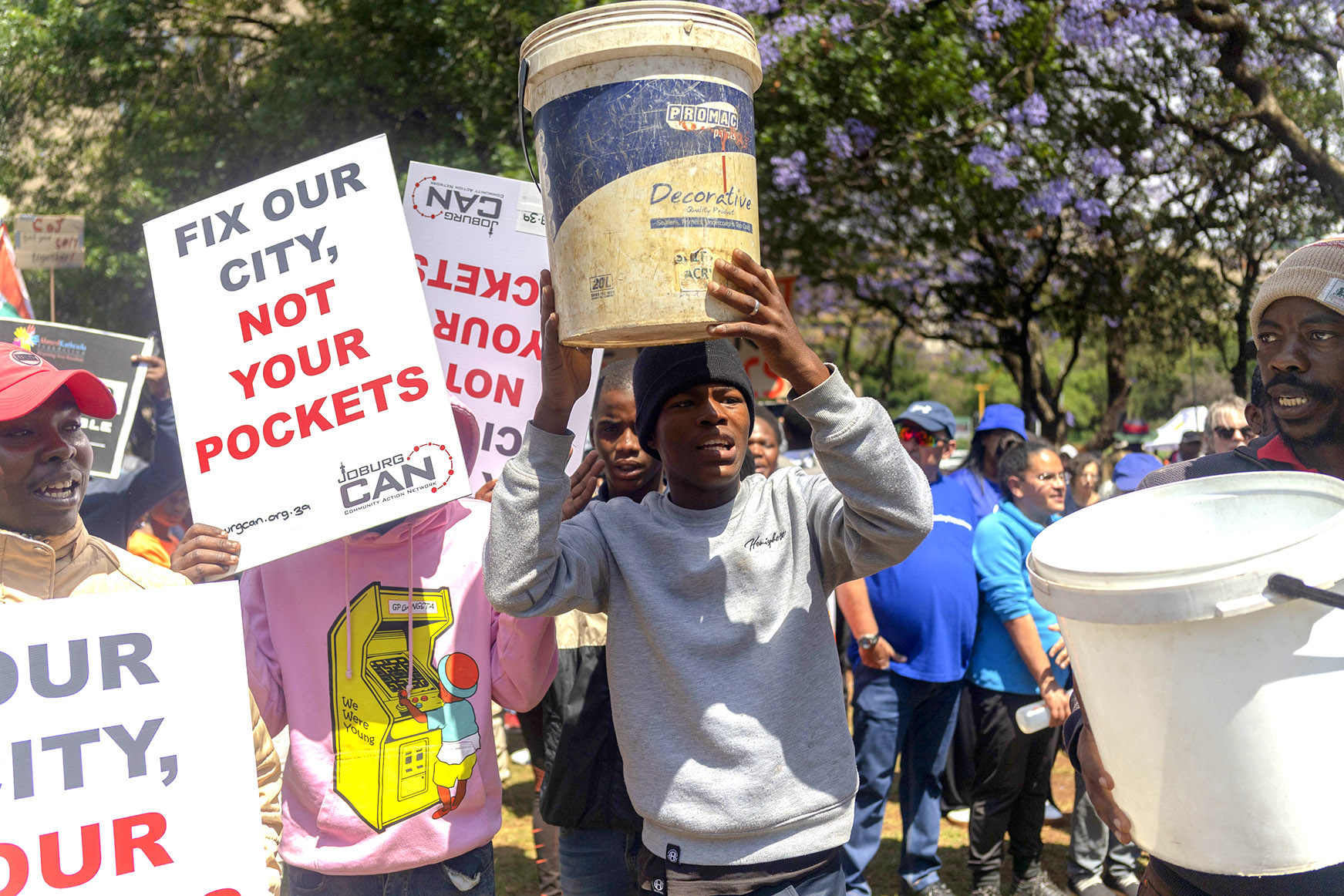
 People protest against the water crisis outside the Johannesburg Council Chambers on 1 November 2025 in Johannesburg, South Africa. The group demanded an urgent action to end what they describe as a ‘human rights and economic emergency’ caused by the worsening water crisis. (Photo: Gallo Images / Alet Pretorius)
In his 2026 State of the Nation Address, President Cyril Ramaphosa made an important acknowledgement: water has become one of the most urgent concerns facing South Africans. It has been for some time. From Johannesburg to Knysna to Giyani, communities are expressing deep frustration over unreliable access to a basic service that is constitutionally guaranteed.
The announcement of a National Water Crisis Committee, to be chaired by the president, signals that water has finally been elevated to the highest level of national priority. The commitment of R156-billion over three years for water and sanitation infrastructure, together with stronger accountability measures and legislative reform, indicates recognition that the status quo is untenable.
This moment matters.
But whether it becomes a turning point rather than another episode in a long cycle of reform efforts will depend on the design of the response.
The legislation is largely in place. Amendments have been proposed. Yet legislative refinement alone will not resolve the service delivery crisis confronting the country.
/file/attachments/orphans/WhatsAppImage2026-02-12at2224511_979301.jpeg "President Cyril Ramaphosa’s new National Water Crisis Committee and a R156-billion investment boost aim to address SA’s water challenges, but success hinges on effective governance reform and accountability. (Photo: Phando Jikelo / Parliament of SA)")
The crisis is institutional before it is hydrological
The president was correct to note that the central challenge lies not in the availability of water, but in getting water to people’s taps.
South Africa is a water-scarce country. Climate variability and rising temperatures intensify pressure on the system. However, framing water scarcity purely as a biophysical inevitability obscures governance failures and asymmetrical access.
Recurring outages in townships and suburbs alike, growing tanker dependence and infrastructure breakdowns are not explained by hydrology alone. They reflect accumulated maintenance backlogs, corruption, maladministration, skills shortages and fragmented governance – all contributing to what can properly be described as anthropogenic water scarcity.
Non-revenue water remains alarmingly high. According to the National Treasury’s 2023/24 State of Local Government Finances and Financial Management report, overall water losses in the eight metropolitan municipalities amounted to R8.66-billion, with an average loss of 35% – well above acceptable benchmarks. Ethekwini recorded losses of 53.8% and Mangaung 49%, meaning that nearly half the water purchased cannot be billed. These losses point to ageing infrastructure, frequent pipe bursts, illegal connections and weak monitoring systems.
Lost water is lost money. Johannesburg alone loses more than 40% of its treated water, much of it through physical leaks.
Infrastructure decay is extensive. Rand Water’s distribution network spans more than 3,300 kilometres of pipeline, some dating back to 1907. Designed for a very different demographic and industrial context, it now serves the greater part of Gauteng and sections of the Free State, Mpumalanga and North West provinces.
Municipal debt compounds the crisis. Water boards are carrying approximately R28-billion in unpaid municipal debt, forcing deferred maintenance and creating fiscal instability. This cascading debt structure weakens the entire value chain, from raw water abstraction to household delivery.
These are structural governance failures. They cannot be resolved through emergency coordination alone.
Learning from the energy response — carefully
The comparison with the National Energy Crisis Committee, established in 2022, is understandable. The committee demonstrated the value of high-level coordination, measurable benchmarks and sustained oversight.
Recent Eskom performance data indicators show measurable improvement – the best in the past five years. The Energy Availability Factor has risen from about 56% to 65%, with the fleet surpassing the 70% benchmark on numerous occasions since April 2025. Following an intensive maintenance phase, unplanned breakdowns have declined significantly, while diesel usage has reduced, generating substantial savings. These gains illustrate what is possible when maintenance is prioritised, performance is measured and systems are managed against clear operational targets.
Water, however, presents a fundamentally different governance architecture.
Electricity supply is relatively centralised. Water services are constitutionally and operationally dispersed. There are 144 designated Water Services Authorities, comprising eight metropolitan municipalities, 21 district municipalities and 115 local municipalities, alongside 15 water boards. Capacity varies dramatically across this landscape.
/file/attachments/orphans/6I1A3319_672651.jpg "Minister of Water and Sanitation, Penny Majodina, Cooperative Governance and Traditional Affairs (Cogta) Minister Velenkosini Hlabisa, Deputy Minister of Water and Sanitation David Mahlobo, Deputy Cogta Minister Dr Namane Dickson Masemola and Johannesburg Executive Mayor Dada Morero conduct an oversight visit at the New Road Reservoir in Midrand on 12 February 2026. (Photo: Felix Dlangamandla)")
Coordination, therefore, must be paired with structural reform.
A national committee can align efforts. It cannot, on its own, rebuild municipal engineering capacity, resolve billing failures or upgrade thousands of kilometres of ageing distribution networks.
The real test will be whether this initiative strengthens the institutions responsible for daily water service delivery.
Funding is necessary — but not sufficient
The R156-billion infrastructure commitment is substantial and necessary. SA’s water systems require investment at precisely this scale.
But funding without institutional safeguards risks repetition.
Past initiatives, from the “War on Leaks” to the Giyani Bulk Water Project and phases of the Lesotho Highlands Water Project, illustrate how large-scale programmes can falter under weak oversight, procurement failures and coordination breakdowns.
Ring-fencing must be transparent and enforceable. The proposal to ring-fence water revenue as a mechanism to address Johannesburg’s water crisis was advanced nearly a year ago. In a subsequent media statement, Minister of Water and Sanitation, Pemmy Majodina, affirmed that municipalities must ring-fence revenue generated from water sales and reinvest those funds directly into reducing non-revenue water and upgrading distribution infrastructure.
/file/attachments/orphans/ED_591916_291584.jpg "Residents fill up water from water tankers in Dube, Soweto, on 7 January 2026. (Photo: Gallo Images / Fani Mahuntsi)")
/file/attachments/2987/GroundUp-water-protestinset1_621013.jpeg "Water tankers fill up at a fire hydrant in Midrand. (Photo: Ihsaan Haffejee)")
/file/dailymaverick/wp-content/uploads/2025/09/ED_572801.jpg "Residents protest against water shortages in Westbury, Johannesburg, on 11 September 2025. Residents called for a permanent solution to the water crisis after the area had no supply for weeks. (Photo: Gallo Images / Fani Mahuntsi)")
The principle is sound. Its effectiveness will depend on implementation.
Without routine public reporting on maintenance expenditure, measurable non-revenue water reduction targets and transparent monitoring of infrastructure backlogs, ring-fencing risks remaining declaratory rather than transformative.
Investment without accountability entrenches inefficiency.
Why composition matters
For the National Water Crisis Committee to succeed, its composition will be critical.
Water governance cannot be sustained through executive coordination alone. It requires the integration of technical experts, municipal finance specialists, labour representatives, civil society organisations, research institutions and community stakeholders within an ongoing collaborative framework.
Civil society organisations have elevated water accountability nationally. Researchers at universities and centres have developed technical and governance proposals. Municipal engineers possess institutional memory that must be retained and strengthened. Communities need representation as well.
A genuinely multi-composed structure can harness this expertise and create distributed accountability. Without this, coordination risks becoming centralised oversight without distributed capability.
Recognising the unequal geography of crisis
Recent protests in Johannesburg’s middle-class suburbs demonstrate that water insecurity is spreading across class lines. Prolonged outages have understandably prompted mobilisation.
Yet it would be analytically incorrect to treat this as a new crisis simply because it now affects previously buffered areas. Many marginalised communities have endured unreliable supply and tanker dependence for years.
Apartheid hydrology – the racially structured allocation of infrastructure and investment – continues to shape spatial disparities. Rural areas and urban townships frequently experience inferior service reliability and quality.
A national response must therefore stabilise bulk supply while consciously addressing inherited inequalities embedded within distribution networks.
Water security is both a technical and a social justice issue.
From crisis management to institutional resilience
SA does not lack legal or policy frameworks. The Constitution guarantees access to sufficient water. The National Water Act vests custodianship of water resources in the state. The Water Services Act provides the statutory framework for service delivery. The Municipal Systems Act defines municipal obligations. The National Development Plan outlines long-term objectives.
The challenge has been institutional capability.
If the National Water Crisis Committee evolves into a technically competent, transparent and multi-stakeholder structure with measurable targets and sustained oversight, it could catalyse institutional renewal.
Water security will not be achieved through announcements alone.
It will be realised when maintenance becomes routine, accountability becomes embedded and institutions are structurally capable of delivering what has long been promised. DM
Dr Anthony Kaziboni is a senior researcher at the Centre for Social Development in Africa (CSDA), University of Johannesburg.
Comments
Scroll down to load comments...