




 Workers prepare spekboom seedlings for planting, a key step in restoring 800,000 hectares of damaged thicket in SA. (Photo: Todd Brown / UNEP)
 South Africa’s thicket biome, once a dense, green tapestry of plant life and thriving wildlife, has been degraded so extensively over the past century that most people alive today have never seen it in full.
More than 80% of this ecosystem has been lost, much of it cleared for agriculture or overgrazed during the wool boom of the late 20th century. What remains is a patchwork of fragmented thicket, bare earth and exposed rock stretching across the Eastern and Western Cape.
However, this neglected yet biodiverse landscape and the people working tirelessly to restore it were thrust into the spotlight on Thursday, 4 December, when the United Nations Environment Programme (UNEP) named South Africa’s thicket restoration as one of its World Restoration Flagships.
The award recognises the country’s multidecade effort to revive 800,000 hectares of degraded land by 2030. The initiative involves more than 60 organisations, including conservation NGOs, carbon developers, scientific institutions and community-led programmes.
/file/attachments/orphans/20250608_UNEPDecadeonEcosystemRestoration_SouthAfricanThicket_ToddBrown_2_149197.jpg "A team of restorers stand in the middle of a spekboom cluster thriving in formerly degraded land, an indicator of successful thicket restoration. (Photo: Todd Brown / UNEP)")
The World Restoration Flagships are UNEP’s highest recognition for large-scale, long-term ecosystem restoration efforts. They are the centrepiece of the UN Decade on Ecosystem Restoration (2021–2030) — a global movement mobilising countries, communities, scientists and civil society to revive the natural systems that sustain life.
Each flagship is chosen not only for its ecological importance but for its social impact, its grounding in local and indigenous knowledge, and its potential to act as a model for restoration worldwide.
While the award brings international visibility, to the people leading restoration efforts on the ground, it represents something far more urgent: an opportunity to bring life back to the land while creating green jobs for communities that desperately need them.
A landscape forgotten, reimagined
When driving through the Karoo or the semi-arid valleys of the Eastern Cape, the landscape appears sparse: low shrubs, vast dry plains and little shade. But according to Nick Hamp-Adams, the landscape is a far cry from the ecosystem it once was.
/file/attachments/orphans/20250609_UNEPDecadeonEcosystemRestoration_SouthAfricanThicket_ToddBrown_10_823590.jpg "A patchwork of restored and degraded thicket in South Africa. (Photo: Todd Brown / UNEP)")
Hamp-Adams is a programme manager at Return to Thicket, one of the 60 organisations leading the restoration in the Eastern Cape.
“People don’t understand what has been lost because most of it disappeared generations ago. It used to be a closed canopy — a micro forest of unique plant species supporting birds, insects and small mammals,” he explained.
Hamp-Adams said that few living memory accounts remain of what the thicket looked like before it was transformed for livestock production. Much of the degradation predates satellite imagery, leaving conservationists to piece together its historical richness through scattered records and remnant patches.
But even in its fragmented state, the thicket still holds a powerful ecosystem booster in one plant: the spekboom.
The power of spekboom
Spekboom is a hardy, drought-resistant succulent tree with a multiplicity of abilities. Hamp-Adams described it as “an ecosystem engineer” capable of reshaping the land around it.
Its functions are significant, including:
- Heat regulation: By forming a dense canopy, spekboom keeps soil temperatures low, a crucial function in regions where exposed soil can reach 50–60°C in summer.
- Soil protection: Its complex roots anchor fragile, sandy soils, reducing erosion and retaining moisture.
- Carbon storage: A single hectare can sequester roughly six tonnes of CO₂ a year.
- Biodiversity revival: Its shade, leaf litter and microclimate give other plants a chance to germinate, while providing food and habitat for wildlife.
- Cultural and practical value: Spekboom is edible, medicinal and deeply embedded in indigenous knowledge and heritage.
The irony is that its value also contributed to its decline.
“It’s highly palatable. Goats love it, and hence, they ate it all. When spekboom disappears, there’s nothing else in the veld to support animals. The whole system collapses,” said Hamp-Adams.
Bringing it back requires far more than planting a few cuttings. It calls for large-scale, labour-intensive restoration rooted in community engagement and sustainable land use.
Read more: Limpopo reserve wants something no one else in SA wants — elephants
Restoration drives green jobs
While the ecological benefits of restoring 800,000 hectares of thicket are profound, the initiative’s social dimension is equally significant. Both UNEP and South African partners have emphasised that the restoration is not just an environmental project — it is an economic lifeline.
“The Eastern Cape struggles economically. Unemployment in some districts is over 60%. On our first farm, every single person we hired was previously unemployed,” said Hamp-Adams.
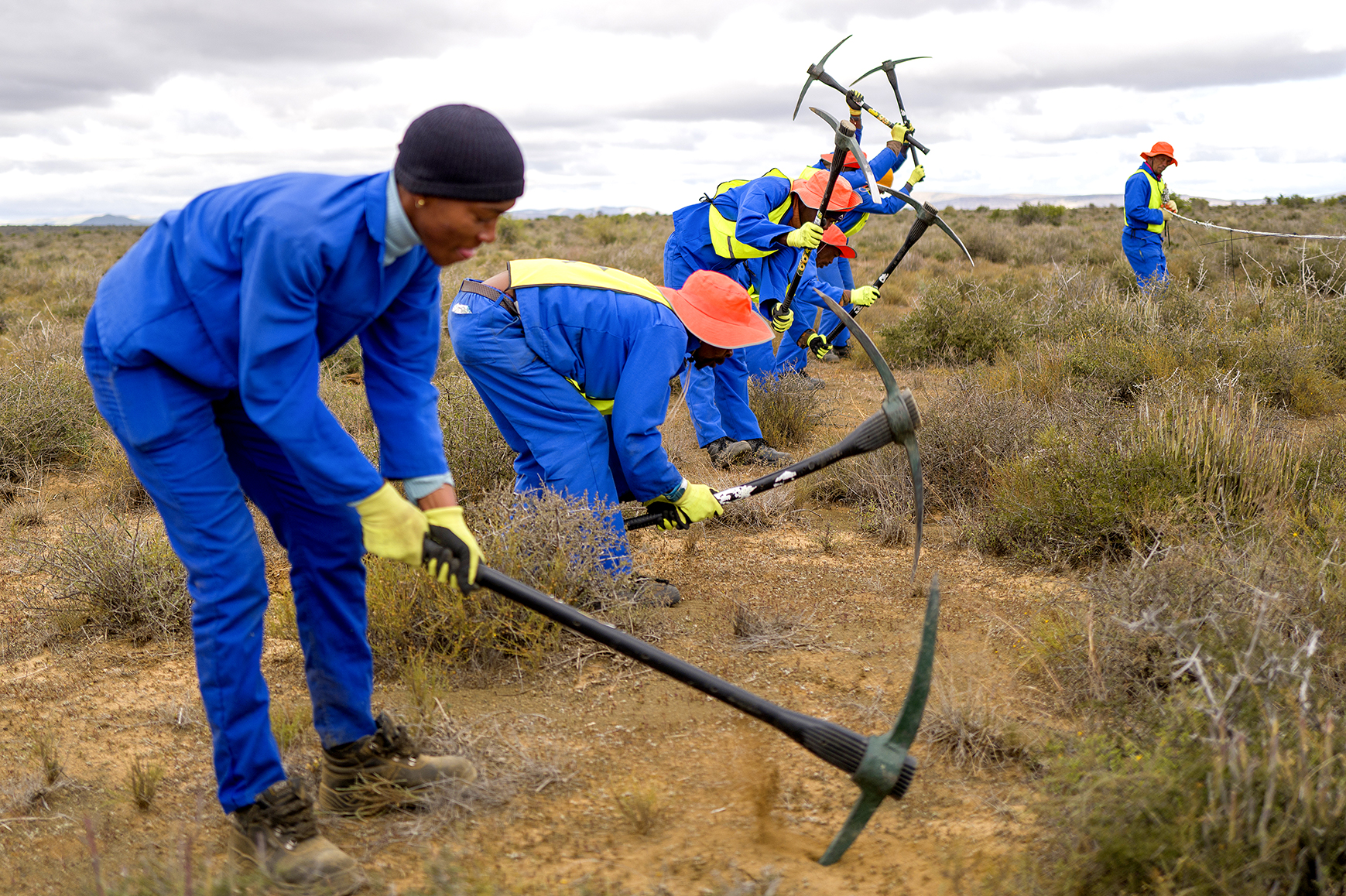
The restoration of the thicket is labour-intensive. From teams collecting cuttings, planting them by hand, monitoring survival, mapping biodiversity recovery and tracking carbon sequestration, the opportunities for employment are extensive. Hamp-Adams also noted that the work was expected to stretch across decades: some projects have 60-year lifespans.
“It’s creating green jobs, jobs that are sustainable and that can last many, many years,” he says.
/file/attachments/orphans/20250610_UNEPDecadeonEcosystemRestoration_SouthAfricanThicket_ToddBrown_13_466578.jpg "Community restoration teams prepare the soil to plant spekboom seedlings as part of South Africa’s new UNEP World Restoration Flagship. (Photo: Todd Brown / UNEP)")
These jobs cut across skill levels:
- General labourers for planting and land preparation;
- Field officers, who manage restoration blocks;
- Scientific teams that monitor carbon, soil quality and biodiversity;
- Community educators who lead awareness campaigns; and
- Small-scale nursery entrepreneurs supplying cuttings.
For many young scientists from local universities, this is the first time meaningful environmental employment has existed in their home province.
“The fact that we can now create well-paying professional jobs in the Eastern Cape is exciting,” said Hamp-Adams.
UNEP’s target is even more ambitious. According to Doreen Robinson, the Deputy Director of UNEP’s Ecosystems Division, the flagship aims to create 100,000 jobs and train 80,000 people in sustainable land management over the next 10 years
“We invest in the environment not just for the environment’s sake. It’s because of people and sustainable development. This flagship isn’t only about restoring thicket — it touches all facets of life,” Robinson told Daily Maverick.
Restoring ecosystems, reviving knowledge
A key part of UNEP’s restoration philosophy is bringing together modern science with indigenous and community knowledge. In the case of South Africa’s thicket, that knowledge is both vital and endangered.
“The history of spekboom removal is directly tied to colonialism,” said Robinson. “Much of the thicket was cleared because settlers didn’t see the landscape’s value or understand how it functioned.”
Today, many landowners do not realise the extent of the damage that was caused by overgrazing generations ago. Hamp-Adams said community education was a central pillar of Return to Thicket’s work.
“We partner with schools, farmer associations, municipalities and local leaders. We raise awareness about what’s happened to the thicket, how spekboom works, and why sustainable grazing is essential,” he said.
This is critical not just for restoration, but for preventing future degradation. After all, if people don’t know what was lost, they cannot protect what is being rebuilt.
Robinson emphasised that indigenous knowledge was also a source of solutions.
“It’s not an exploitative consulting process,” he said, “it’s a real engagement to understand where that know-how sits and how it can be married with modern science.”
In other restoration flagships around the world, this has produced dramatic improvements. In Canada, salmon survival rates soared when scientists incorporated First Nations’ knowledge about sacred release sites. In Australia, rebuilding shellfish reefs has drawn on indigenous coastal stewardship traditions.
South Africa’s thicket restoration is part of this global rebalancing, an acknowledgement that local communities are not passive beneficiaries but co-restorers.
A carbon sink with social benefit
The scale of South Africa’s restoration target, 800,000 hectares, is enormous. But so too is its climate potential. Using modest averages, Hamp-Adams estimated that restored spekboom thicket could lock away around eight million tonnes of CO₂ per year.
“That’s equivalent to the annual emissions of 800,000 average South Africans,” he explains. “Every hectare can offset one person’s emissions.”
While he is quick to caution that restoration is not a substitute for emissions reduction — “we have to reduce, we have to decarbonise our energy grid,” he stressed — thicket revival offers a powerful adaptation measure that brings tangible benefits to communities.
And as carbon markets gain traction, spekboom restoration may eventually generate revenue through high-integrity carbon credits. “That’s where the economics can really kick in. It can make these long-term projects financially viable and scalable,” he said.
For communities in the Eastern Cape, this could unlock an entirely new green economy — one rooted in ecological recovery rather than extractive agriculture.
Recognition, hope and the road to 2030
For both UNEP and restoration leaders on the ground, the flagship designation is more than a badge of honour.
“It’s really exciting. There’s huge potential here to showcase South Africa’s beautiful landscapes, to leverage carbon markets and to bring international support to where it’s most needed,” said Hamp-Adams.
Robinson agreed that the flagship is intended to accelerate momentum. UNEP’s goal is not only to support individual projects but to cultivate a global Generation Restoration, a movement in which ordinary people, policymakers, scientists and communities all participate.
“We’re not on track to meet our climate or biodiversity goals. We need to accelerate action. But initiatives like this show what’s possible when sectors work together,” Robinson said. DM