



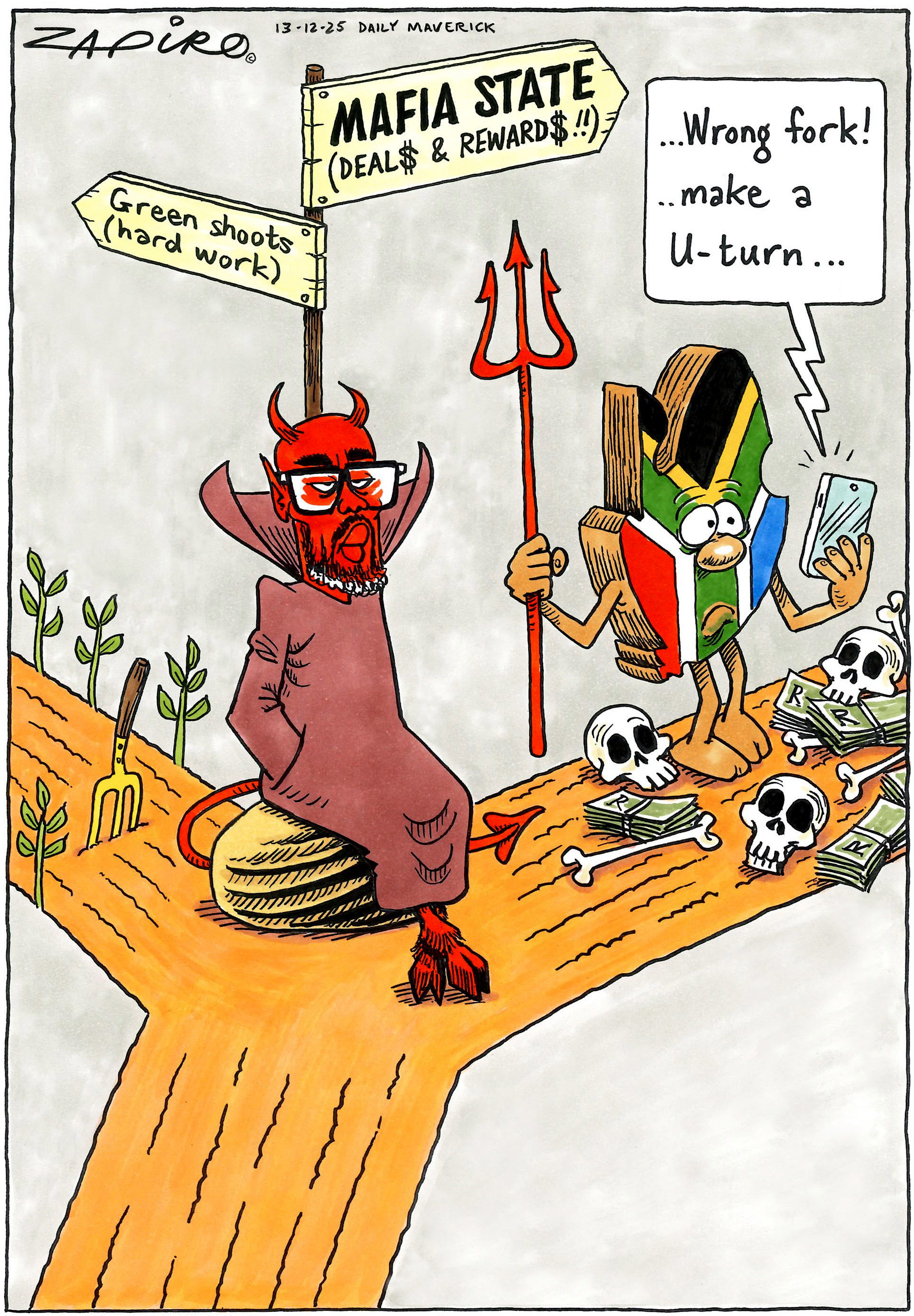
 South Africa is at a crossroads (again). Will 2026 be the year we reverse the deal with the devil? (Cartoon: Zapiro)
An unscheduled press conference by KwaZulu-Natal Police Commissioner Lieutenant-General Nhlanhla Mkhwanazi on 6 July 2025 set the stage for 2026 and even 2027, when the ANC and South Africa will face crossing a churning Rubicon. Right now, though, our Rubicon still smells more like S**t Creek.
But 2026 is the year we reach for the paddles, shove off for the rapids of what will be highly contested local government elections (on a date yet to be determined), and hope for clearer water ahead.
The day Mkhwanazi confirmed the suspected nexus between organised crime syndicates, law enforcement, drug cartels and government officials, everything changed in South Africa.
Prompted by an apparent order from Minister of Police Senzo Mchunu to shut down the Political Killings Task Team (PKTT), the lieutenant-general went ballistic and in the process shot up the Most Handsome Uniformed Strongman in Africa charts (with Ibrahim Traoré still at No 1).
Nhlanhla “Lucky” Mkhwanazi named names and things, and the country has not been the same since that press conference.
/file/attachments/2986/ED_574102_625466.jpg "KZN Police Commissioner Lieutenant-General Nhlanhla Mkhwanazi at the Madlanga Commission of Inquiry on Day 3 at Brigitte Mabandla Judicial College on 19 September 2025 in Pretoria, South Africa. (Photo: Gallo Images / Lefty Shivambu)")
Local government elections: the ANC
The ANC and President Cyril Ramaphosa are limping into local government elections after having lost the overall majority in 2024, and being forced to form a multiparty government while bleeding wards to former president Jacob Zuma’s MK party in by-elections, particularly in KwaZulu-Natal.
The ANC will go into its 56th elective conference in 2027 having just emerged from a National General Council to discuss “party renewal” and its “back-to-basics” ethos.
Ramaphosa threw down the gauntlet to his comrades, saying: “Those whose conduct conflicts with our values and principles, the criminals, the corrupt, the careerists, extortionists, factionalists and those who actively work against the organisation should find themselves outside the African National Congress.”
Speaking of which: the MK party
As the official opposition, the MK party (or the “old ANC” as it is known in some parts), will be burdened with multiple brushes with the law, not that this appears to concern its supporters.
It will be carrying the weight of outstanding legal bills and other debts, with Zuma due to face charges relating to the Arms Deal, depending on the weather in Stalingrad.
MK’s former very own flaming umkhonto (spear), Duduzile Zuma-Sambudla (43), is headed for a torrid year as she faces the law for her alleged key role in the recruitment of 17 young South Africans deployed by the mercenary Wagner group to the Russia-Ukraine war zone.
Although she resigned as an MP and the party has distanced itself from her Russia mission, its members’ footprints are all over the sand.
After her resignation, Zuma parachuted in another daughter, Brumelda Zuma (35), to replace her in Parliament.
Brumelda was a member of the Musa Dladla region ANC Youth League leadership before defecting to MK. Her mother Agnes was romantically involved with Zuma around 1994.
Leadership churn and political infighting have dogged Zuma’s personal political project since its establishment in 2023, and 2026 will be no different.
/file/attachments/2986/ED_585728_724724.jpg "Duduzile Zuma-Sambudla at KwaZulu-Natal Division of the High Court in Durban on 10 November 2025 in Durban, South Africa. (Photo: Gallo Images / Darren Stewart)")
Working it: the DA
It is too early to tell whether Helen Zille’s campaigning as an informal traffic attendant out on the streets of Joburg in a DA-blue floppy hat will hit paydirt after the 2026 local elections.
Meanwhile, the DA, a major partner in the Government of National Unity (GNU), will have to find some room freshener to deal with the smell of fast food hovering around leader John Steenhuisen.
He has had a good year as minister of agriculture, signing a record number of export deals, but his takeaway bills have tripped him up. This could pave the way, perhaps, for Cape Town Mayor Geordin Hill-Lewis to move one step closer to the throne.
The DA does enjoy widespread support across the country, but it mostly governs in coalition, apart from in the Western Cape.
However, for now, all eyes are on the prize – the Joburg Metro – with Gogo Zille cracking the whip.
/file/attachments/2986/ED_587794_102744.jpg "Minister of Agriculture John Steenhuisen speaks at Netwerk24’s studio during Day 1 of the G20 Johannesburg Summit at Nasrec on 22 November 2025 in Johannesburg, South Africa. (Photo: Gallo Images / Beeld / Deaan Vivier)")
The EFF
EFF leader Julius Malema is the last celebrity politician left standing in his party, but he might very well find some MK members jumping ship next year when too many relatives clamber onto the already overloaded Papa Zuma MK showboat.
Former ally Floyd Shivambu first found himself tangled in a Zuma Gordian knot, and later his political project, Afrika Mayibuye, looked like a revolving door in a gambling joint at month end.
The PA
Gayton McKenzie’s PA continues to make inroads, with his anti-immigrant, pro-Israel rhetoric endearing him to those open to populist persuasion.
Expect no different next year as McKenzie bulldozes ahead.
The FF Plus
Corné Mulder’s conservative party has endeared itself through Minister of Correctional Services Pieter Groenewald, who was appointed after the party joined the GNU. Groenewald is visibly trying to deal with the country’s prisons.
With right-wing rhetoric blowing like an ill wind across the globe, the FF Plus is your bog standard, old fashioned home for a grumbly cultural and linguistic minority.
Unite for Change
Build One South Africa (Bosa), Good and Rise Mzansi have looked to the future and have merged to form Unite for Change before next year’s local elections.
/file/attachments/2986/ED_505801_191924.jpg "Songezo Zibi, the leader of Rise Mzansi. (Photo: Gallo Images / Darren Stewart)")
Smaller centrist parties have understood that united they stand, divided they get gobbled up by the big fish.
All in all, the elections are going to be “lit”, as they say, perhaps even literally so.
Research by the Global Initiative Against Transnational Organized Crime has shown a higher number of political assassinations and spikes during local government elections in South Africa.
Commissions aftershock
Mchunu, who was rumoured to be in the running for the next ANC president, almost instantly voluntarily stepped down after Mkhwanazi’s press conference in July.
Then Ramaphosa set up a Judicial Commission of Inquiry into Criminality, Political Interference and Corruption in the Criminal Justice System, to give the Madlanga Commission its full and weighty title. This was followed by a parliamentary ad hoc committee inquiry.
Never before have so many high-profile South Africans been cross-examined with such fire and brimstone while bouncing between the commission and the inquiry. All this was watched daily by millions of citizens.
As the year drew to a close, those glued to podcasts and live broadcasts joined so many dots we began to imagine visual auras.
The implications of these serious allegations that have emerged at the two inquiries are seismic and will ripple through the next 12 months and beyond.
/file/attachments/2986/ED_589748_818082.jpg "Suspended Police Minister Senzo Mchunu at the Madlanga Commission of Inquiry on 4 December 2025 in Pretoria, South Africa. (Photo: Gallo Images / Lefty Shivambu)")
Stable and secure?
All signs are that the metaphorical gunboats and crews are sort of preparing, willing and able to mop up the massive mess. But the journey will not be a funfair ride and is bound to be knuckle-clenching.
Next year will be an all-hands-on-deck year for law enforcement agencies, the GNU, civil society, journalism as a profession and society at large.
Shortly after Mkhwanazi sliced open the underbelly of the beast, Minister in the Presidency Khumbudzo Ntshavheni released the country’s National Security Strategy report for 2024 to 2028, proclaiming the outlook to be “stable and secure”.
Never mind an increase in “organised crime, terrorism, extortion, and violent extremism”. And then there are the rumours of a coup and training camps in the country, which, combined with the Russia mercenary scandal, looks suspiciously like an operation.
Pieter Mulder, the former leader of the FF Plus, said the saga reminded him of Operation Vula, the establishment of underground ANC cells in 1990.
“What would happen if 17 AfriForum members dressed in camouflage left for Russia for military training?” he asked.
Well, presumably they would be arrested just like the bunch of South Africans who have been linked to mercenary recruitment.
Roubles and rands
The Russia mercenary training scandal was exposed with Shakespearean aplomb when Jacob Zuma’s oldest daughter, Nkosazana Bonganini Zuma-Mncube, lodged a criminal complaint against her half-sister, Zuma-Sambudla.
Zuma-Mncube said eight of the recruits were members of her family. She lodged criminal charges against Zuma-Sambudla and two others, Siphokazi Xuma, Zuma’s alleged romantic partner, and Blessing Rhulani Khoza, “for their key roles in this tragedy”.
In a shock move, SABC announcer Nonkululeko Mantula was arrested and charged alongside co-accused Xolani Ntuli, Sfiso Mabena, Siphamandla Tshabalala and Thulani Mazibuko under the Foreign Military Assistance Act earlier in December.
Mantula is accused of coordinating the recruitment of southern Africans to join the Wagner Group. It is not yet clear whether Zuma-Sambudla is linked to this group. The matter has been postponed to February.
Bodies pile up
Between January and December, bodies piled up all over the country as the filaments linking crime syndicates, security companies, information pimps, illegal mining, drug cartels, police chiefs, Cabinet ministers, politicians and tenderpreneurs were partially exposed.
/file/attachments/2986/ED_587036_198683.jpg "More than a thousand students and staff lay down for 15 minutes in protest against gender-based violence and femicide (GBVF) at the University of Cape Town on 21 November 2025 in Cape Town, South Africa. (Photo: Gallo Images / Brenton Geach)")
Vusimuzi “Cat” Matlala, Hangwani Maumela and Katiso “KT” Molefe, who is out on bail, have all been charged and are awaiting trial on serious charges. Meanwhile, whistleblowers, forensic auditors and liquidators have been murdered in front of family and other witnesses.
Babita Deokaran, Marius van der Merwe, Armand Swart, Thomas and Cloete Murray, Zenzele Benedict Sithole, Lieutenant-Colonel Frans Mathipa and Bouwer van Niekerk were all killed.
Are the National Prosecuting Authority’s (NPA) Investigative Directorate Against Corruption (Idac), the Special Investigating Unit, South African Police Service, South African Revenue Service, Directorate of Priority Crime Investigation (DPCI) and judiciary up for it?
In the meantime, who will be the new head of the NPA and which candidate will replace Lieutenant-General Godfrey Lebeya, who retired as head of the DPCI in May?
Some say Mkhwanazi is angling for the post (his contract ends in March), while the suspended deputy national police commissioner, Lieutenant-General Shadrack Sibiya, allegedly also had his eye on the job.
/file/attachments/2986/ED_588170_153997.jpg "Vusimuzi ‘Cat’ Matlala testifies at the Parliamentary Ad Hoc Committee inquiry into alleged corruption and political interference in the criminal justice system at Kgosi Mampuru Correctional Facility on 27 November 2025 in Pretoria, South Africa. (Photo: Gallo Images / Lefty Shivambu)")
Rubicon moment
The last time South Africa faced a “Rubicon moment” was in 1985 when then state president PW Botha was expected to deliver far-reaching reforms in a speech delivered on 15 August in Durban.
Botha wrote in the last paragraph that, like Julius Caesar crossing the Rubicon River, “I believe that we are today crossing the Rubicon. There can be no turning back.” But when the moment came, the crocodile turned back.
In 2026 there is no turning back. The country hovers on the brink of promising economic recovery and growth with future prospects looking better.
South Africa’s removal from the Financial Action Task Force grey list in October means we are making progress in combating money laundering and the financing of terrorism. Borrowing costs are expected to drop and reduced transaction costs are expected to “improve investor confidence”.
A national disaster
The recent declaration of femicide and gender-based violence as a national disaster has elevated the scourge to a code red priority.
The inclusion of the term “femicide” recognises also that women are the target of violence by simply presenting as female.
This could trigger swift action across the health, justice and social development sectors next year, unlocking funding and uniting fragmented efforts. The Department of Justice directive is evidenced in the number of NPA victories, convictions and long-term jail terms that have been meted out to rapists and sexual offenders.
So, compatriots, pack the life vests, grab a stick or a paddle and some waterproof gear, and let’s paddle off into 2026 and a new horizon. DM
This story first appeared in our weekly DM168 newspaper, available countrywide for R35.