




 (Photo: iStock and Vecteezy)
 /file/dailymaverick/wp-content/uploads/2025/10/label-Op-Ed.jpg)
A dispute between two of Johannesburg’s most prestigious religious private schools ended with Roedean High School head Phuti Mogale and its board chair, Dale Quaker, resigning, following a controversy over the school’s failure to honour a tennis fixture against King David Linksfield High School. King David Linksfield is a Jewish co-ed day school established in 1955. Roedean is a prominent Anglican-affiliated independent girls’ boarding and day school, founded in 1903.
The incident centred on a private phone call on 2 February between the two school heads in which Mogale revealed to the principal of King David High School, Lorraine Srage, that she was under pressure from Roedean parents to avoid playing against a Jewish school.
/file/attachments/orphans/LS-New4_420305.jpg "The principal of King David High School, Lorraine Srage. (Photo: King David High School / Website)<br>")
Despite Mogale’s stated intention to honour the fixture, the Roedean team was absent when King David learners arrived to play on 3 February. Roedean communicated that the reason for the cancellation was a clash with academic timetables, which the leaked phone conversation disproved.
/file/attachments/orphans/190524120319DSC_6109-scaled_377588.jpg "King David Linksfield High School. (Photo: King David High School / Website)")
In the recording, Mogale says Roedean parents did not want their daughters playing against King David girls because this did not align with the ANC-led government’s stance on Israel.
Srage asks whether the parental objection is because the King David girls are Jewish, and Mogale replies, “Yes.”
Irwin Manoim, the national chair of the Jewish Democratic Initiative, observed that King David was a “besieged community”. While surrounded by a culture of homogeneity and communal pressure, the school not only emphasises an allegiance to Zionism (i.e. the right of the State of Israel to exist) but also strongly discourages criticism of the Israeli government, including any atrocities committed in its name. Roedean, on the other hand, emphasises social justice as a core value in its manifesto, and some choose anti-Zionism in their call for justice. We thus have a competition of victimhood: the Jews or the Palestinians. Against this cultural gulf of rigidly opposing political stances, talking past each other seemed inevitable.
Disagreement is unavoidable in pluralistic societies. But the tragedy is that this disagreement immediately hardened into rigid certainty. Public statements escalated, and media debates intensified. The Israeli historian Yuval Noah Harari recently grieved how “false moral certainties produced by oversimplified historical narratives” fuel conflicts. And in this conflict between the two schools, historical narratives were wielded like weapons, each side anticipating the other’s worst intentions.
Talking past each other
Marshall Rosenberg, the founder of the Center for Non-Violent Communication, said: “Enemies are people whose story we haven’t heard.” Renowned for facilitating dialogues between people who were expected to hate each other, he taught others to acquire such facilitating skills. Part of his success was that he helped so-called enemies to truly listen to each other.
Allow us to imagine the options available to the two schools. Srage and Mogale might have supported each other in bringing these pupils who regard each other as enemies into dialogue with one another. They could have arranged a series of facilitated dialogues between the different voices in the conflict. Pupils from each school might have been brought into conversation, to speak, and to listen, to the other side. Parents from each school might have been brought into similar sessions with each other.
Let’s accept that arranging such conversations might just be too difficult. But surely on the home front, it isn’t too difficult for the Roedean team to engage with their protesting pupils, helping them to hone their views? They might have invited different sectors of their pupil population to express their views, and to invite the various parties to genuinely listen to each other. Is the project of facilitating a healthy dialogue not the obligation of a good school?
As an aim of the national curriculum, teachers are asked to teach their students to “recognise different viewpoints”, to “understand that history is contested”, to “distinguish between fact and opinion”, and to “detect manipulation” in the media. Was this incident not the ideal teachable moment for these curriculum objectives?
Finding a way forward
In Jerusalem, there is a long-standing set of initiatives where Jewish and Arab schoolchildren explore their own family traditions before meeting each other to share food, stories and culture, and discover common ground. Educator Ittay Flescher takes this further through Seeds of Peace, running long-term programmes for Jewish and Palestinian teenagers that build empathy and dialogue across deeply divided communities. His recent book, The Holy and the Broken, affirms commitment to shared existence. His work challenges entrenched narratives by bringing young people face to face with “the other”, developing genuine skills for listening and critical reflection.
King David and Roedean would benefit from an Ittay Flescher facilitating conversations around their respective pupil’’ views about Israel. But Ittay Flescher himself is not required, obviously. What is needed is the willingness to engage children in constructive dialogue. Many people in South Africa have extraordinary skills in managing difficult conversations. We’re famous for it.
But sadly, out of fear, adults are often not able to conceive of such conversations. On one side here are activists who believe the Israeli government has committed grave injustices and who support boycotts in solidarity with Palestinians. Their arguments are carefully constructed, morally serious and deeply felt. On the other side stand Jewish communities aligned firmly with the Israeli government — careful, historically grounded and deeply conscious of existential threats to Jewish identity and safety.
On the one side are the anti-Zionists, on the other side the Zionists. One side calls the decimation of Gaza a crime against humanity, a genocide. At the other end are the majority of the world’s Jews who, while bereaved by yet another Israeli war, rationalise that it was a defensive war against the 7 October Hamas-led attack on Israel, in which 1,195 Israelis and foreign nationals were killed and 251 were taken hostage.
But these views are seldom shared openly with the other side, and certainly not in person, face to face. They are communicated via lawyers, proofread by boards and shared with a laager mentality of self-insulating defensiveness, or weaponised as vicious sarcasm in the comments sections of social media platforms.
The anti-Zionists (except for a very few dissenters) don’t want to communicate any sympathy for the victims of the 7 October attack or confront the actions of Hamas in case it is received as support for the war. The message must be that the Israeli government is bad, and any soundbite that might communicate something to the contrary must be avoided at all costs.
Meanwhile — again, except for the tiny minority of dissenters — Jews fear communicating criticism of the Israeli government in case their words are used to mean that Israel’s right to exist is questioned. They subsume all opinions against the Israeli government into those stating that Israel has no right to exist.
When they chant Am Yisrael Chai (an Israeli song meaning “The nation of Israel lives”), they fear that maybe the nation of Israel will die. And they believe that the protesters believe that Israel should not exist, that the population of Israeli Jews, almost all of whom descend from refugees from Europe and the Middle East (mostly the latter), having experienced centuries of persecution in those countries, should return there and recreate the shtetls and Jewish mahallas from where they were chased.
In moments of political and moral crisis, schools become microcosms of the wider world.
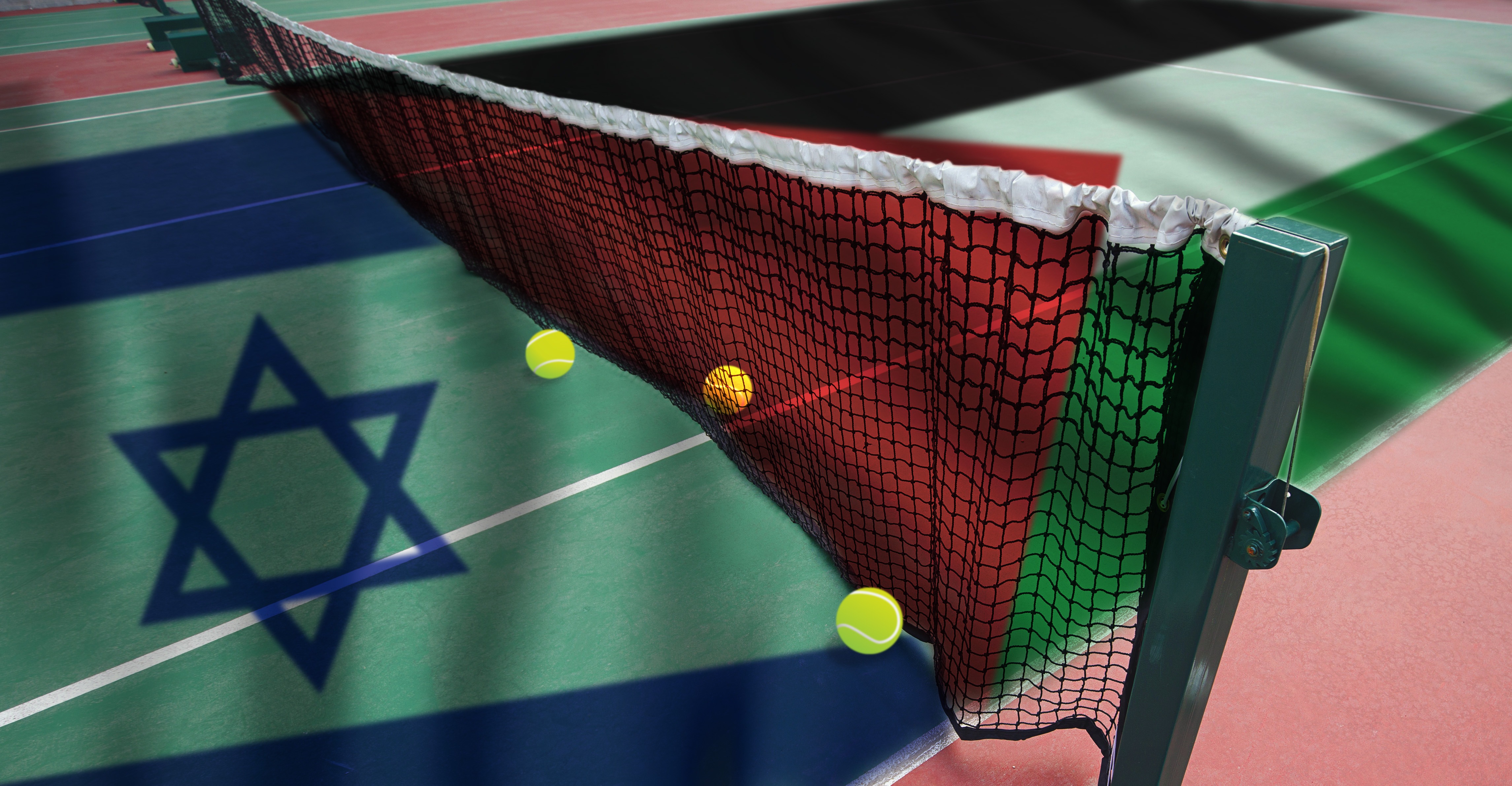
The current tensions between strongly pro-Israeli communities and strongly pro-Palestinian activists are not only playing out as a global tennis match in media headlines and public statements.
We see them here unfolding in classrooms, school corridors and tennis courts. Unfortunately, while the adults talk past each other, the children in their care are left unheard.
Harari believes that generosity, empathy and a willingness to see the other’s humanity are not naïve ideals but practical tools. When we are less fixed in our certainties, we might discover that by listening to an enemy, she becomes a friend. DM
Mark Potterton is a former school principal. Marc Loon is the principal at Kairos School of Inquiry.