




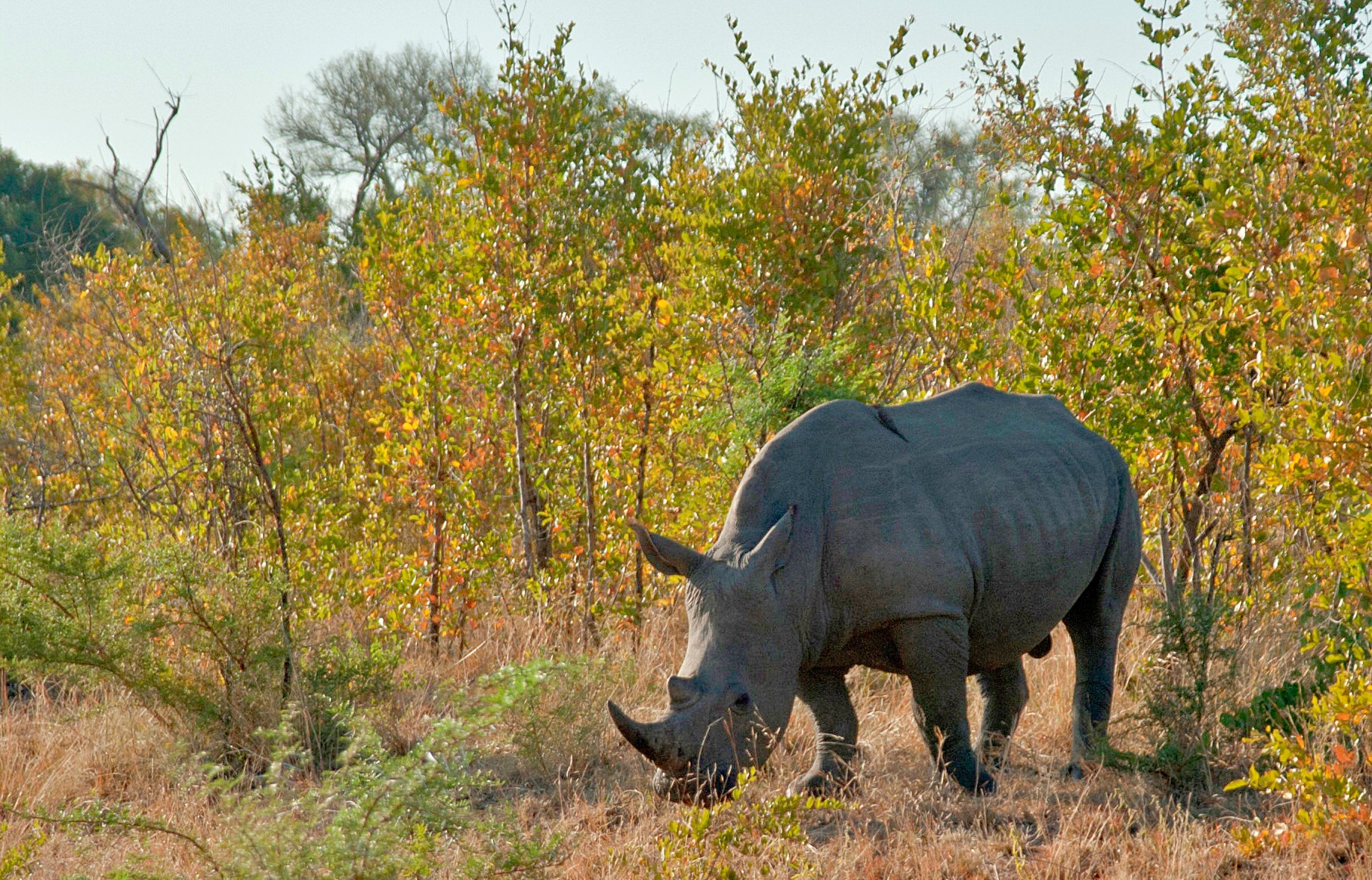
 New findings open the door to trade in rhino trophies. (Photo: Don Pinnock)
 South Africa has reopened the door to international trade in rhino trophies and other wildlife products, marking a clear shift in conservation policy under the country’s new environment minister.
A new government assessment concludes that the hunting and export of several iconic species – including southern white and black rhinos, elephants and lions – does not threaten their survival in South Africa.
The assessment, issued by the Department of Forestry, Fisheries and the Environment and signed by Minister Willie Aucamp, appears in newly published non-detriment findings (NDFs) required by the Convention on International Trade in Endangered Species (CITES).
Non-detriment findings underpin the government’s ability to issue export permits for wildlife products. Without them, international trade in CITES-listed species cannot legally take place.
The new findings justify issuing export permits for wildlife products, including hunting trophies. For rhinos, the report concludes that legal international trade in live animals and the export of hunting trophies pose a low risk to the species’ survival in South Africa.
The document argues that protecting rhinos from poaching is extremely costly and that private landowners maintain significant rhino populations. Trade in live animals and hunting trophies, it says, can actually incentivise conservation by providing income to those owners.
In a sweeping statement of support for legal trade, the report says: “The ongoing CITES prohibition on the trade in rhino horn has, however, been detrimental to the survival of the species in South Africa.”
The move represents a sharp change in tone from the approach taken by Aucamp’s predecessor, Dion George.
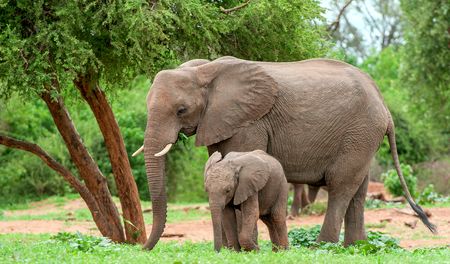
Dr Audrey Delsink, senior wildlife director at Humane World for Animals South Africa, said the overall picture was troubling.
“The summarised NDFs are as concerning as they are contradictory. For many species, legal international trade is described as ‘moderate to high risk’ and in some cases even ‘detrimental to the survival of species in the wild’. Yet trade is still recommended – often in the absence of adequate monitoring or population data.”
Examples she gave include the leatherback sea turtle, listed as “critically endangered” in South Africa, the striped hyena, which has no resident breeding population in the country, and the Knysna seahorse, an endangered species found in only three estuaries.
/file/attachments/orphans/Elly6_272058.jpg "Elephants are considered low-risk for export purposes. (Photo: Don Pinnock)")
“When endangered and critically endangered species such as this appear on a ‘low-risk watchlist’, it becomes difficult to understand how any trade can be justified,” she said.
Delsink also raised concerns about the export of live elephants, noting that, under CITES, animals may be sent only to in situ conservation programmes or secure areas in the wild within the species’ natural and historical range in Africa. She said this had not always been met in past exports.
According to Taylor Tench, a senior wildlife policy analyst at the Environmental Investigation Agency, “the assertion that legal international trade in horn from captive breeding operations is unlikely to have a detrimental impact on wild populations ignores the fact that legal trade would increase demand and therefore exacerbate poaching pressure on wild rhino”.
/file/attachments/orphans/elephant-love_665468.jpg "Regulations could support transport of elephants beyond Africa. (Photo: Don Pinnock)")
He said the NDF relies on the estimated amount of illegal trade in rhino horn to claim that dehorning South Africa’s white rhinos would be sufficient to meet consumer demand. But illegal trade data is not an appropriate proxy for the level of true demand, and the NDF conveniently ignores the potential impact that latent demand in end-use countries would have on legal and illegal trade.
“A legal trade will allow illegal traders to capitalise on increased demand,” he said, “by providing opportunities to launder illegal horn onto the market.”
From freeze to reopening
While George did not oppose hunting outright, he effectively halted trophy exports of several key species.
In September 2025, he announced that the department would not publish new CITES export quotas for elephant, black rhino and leopard hunting trophies while a court case challenging the quota-setting process was under way. Without those quotas, trophy exports could not legally take place.
No new export quotas had been issued since 2021, effectively freezing parts of South Africa’s trophy-hunting trade.
At the time, the department said the pause was intended to ensure that quotas were scientifically sound and legally compliant and supported both conservation and sustainable use. However, hunting organisations and wildlife ranchers accused the minister of paralysing the industry.
/file/attachments/orphans/ElephantinthegrassDonPinnock_115037.jpg "New findings justify the issuing of export permits for wildlife products and hunting trophies (Photo: Don Pinnock)")
They argued that foreign hunters were shifting their business to other African countries where trophy exports continued, costing South Africa hundreds of millions of rands every year.
Supporters of George’s approach saw the pause differently. They argued that the quota system needed to withstand legal scrutiny before further wildlife exports were authorised.
George also stated that South Africa would not support reopening international trade in rhino horn or ivory, positions aligned with recommendations from the government’s high-level panel on wildlife policy and the resultant white paper.
Answering a parliamentary question, he noted: “The conditions are not currently favourable to enable consideration of the international commercial ivory trade.” He said that significant constraints remained, including “limited financial and human resources, inconsistent legislation, weak partnerships, knowledge gaps regarding ecological roles and population dynamics, as well as negative international perceptions and reputational risks”.
He set the lion-bone export quota to zero for 2025, effectively halting the commercial export of skeletons from captive-bred lions.
Together, those decisions put him at odds with wildlife ranchers, trophy-hunting organisations and sectors of the wildlife industry – and reportedly also with leadership in his own party, the DA.
After George was removed from office in late 2025 and Aucamp took over the environment portfolio, the department moved quickly to restart the quota process.
Proposals published this year include export quotas of 150 elephants (300 tusks), 12 black rhino trophies and 11 leopards from designated hunting zones, signalling a return to issuing hunting trophy export permits. The new non-detriment findings reinforce that shift.
The economics of conservation
Supporters of hunting and wildlife trade argue that regulated use is essential to conservation in South Africa, where a large proportion of wildlife lives outside national parks.
Private landowners maintain large populations of animals such as rhinos on game ranches and private reserves. Protecting these animals – particularly from poaching – can be extremely expensive. The rhino findings reflect that argument directly, noting that trade in live animals and hunting trophies can provide economic incentives for landowners to continue conserving rhinos on their properties.
Critics dispute that logic. A senior wildlife specialist at Humane World for Animals South Africa, Dr Matthew Schurch, said the findings raised serious concerns about how wildlife trade risks were being assessed.
“For example, the department’s finding that the export of male cheetah hunting trophies is ‘non-detrimental’ is highly concerning,” he said, noting that cheetahs are listed as “vulnerable” on both the IUCN Red List and South Africa’s 2025 Red List.
“This effectively endorses the hunting of a species whose population should instead be safeguarded and strengthened through conservation.”
/file/attachments/orphans/St_Lucia-31_493422.jpg "For rhinos, the report concludes that legal international trade in live animals and the export of hunting trophies pose a low risk to the species’ survival in South Africa. (Photo: Don Pinnock)")
Schurch said the lack of a national cheetah management plan meant there was no clear framework for managing the species’ metapopulation, yet the NDF allowed up to 30 “surplus” male cheetahs to be exported as trophies. He also said the rhino findings appeared internally contradictory.
While the minister has publicly opposed a recent court ruling permitting rhino horn exports from rhinos bred for conservation purposes on the grounds that it could harm wild populations, Schurch noted that the NDF suggests that trade in live animals or horn from captive-breeding operations is “unlikely to be detrimental”.
“That effectively opens the door to future horn exports,” he said. “This inconsistency raises serious concerns about policy coherence and the implications for rhino conservation.”
Wider concerns
In addition to rhinos, the findings evaluate a wide range of species, including elephants, lions, giraffes, bontebok, Cape mountain zebra and serval, as well as threatened plants such as cycads and succulents.
By publishing findings that support continued trade in rhinos and other high-profile species, Aucamp’s department has effectively reinforced the much-contested policy of “sustainable use” of wildlife – the idea that if wildlife pays, it stays.
What this shift means for processes already under way to shut down South Africa’s captive lion breeding and lion bone export industry is unclear.
Delsink noted that the NDFs themselves were first gazetted for comment under George in 2024, suggesting that the findings reflect a broader departmental position rather than a purely political shift. But the contradictions within the rhino findings, she said, showed how contested the future of wildlife trade is.
“The policy signals are mixed, and that raises important questions about the future direction of wildlife conservation in South Africa.”
Concerns
Veterinarian Dr Mark Jones, head of policy at the Born Free Foundation, listed his concerns over the findings:
• Cheetah: Hunting off-take from wild populations would probably be detrimental given the species’ vulnerable and declining status;
• Southern white rhino: Trophy quotas should be reconsidered, given declining populations and disputed claims that horn trade bans harm conservation;
• Bontebok: Claims that international trophy import restrictions hinder conservation lack supporting evidence;
• Black rhino: As a critically endangered species, any trophy hunting should follow a strictly precautionary approach;
• Cape mountain zebra: Despite population growth, numbers remain low, and claims about trophy restrictions harming conservation are unsupported;
• Giraffe: The findings provide no supporting data for claims about the impacts of trade;
• Hippos: The conclusions on trade impacts are presented without supporting evidence;
• Serval: Given the NDF’s own finding of moderate to high risk, export quotas should be set at zero;
• African elephant: Trophy hunting and live exports may disrupt social structures and should be treated cautiously;
• Lion: Exports from captive-bred lion facilities risk stimulating demand for lion products;
• Blue duiker: Exports should cease, given the recognised risk to the species’ survival;
• Grey-headed and Cape parrots: Trade poses a high risk to these subspecies, and exports should be banned. DM


Comments
Scroll down to load comments...