



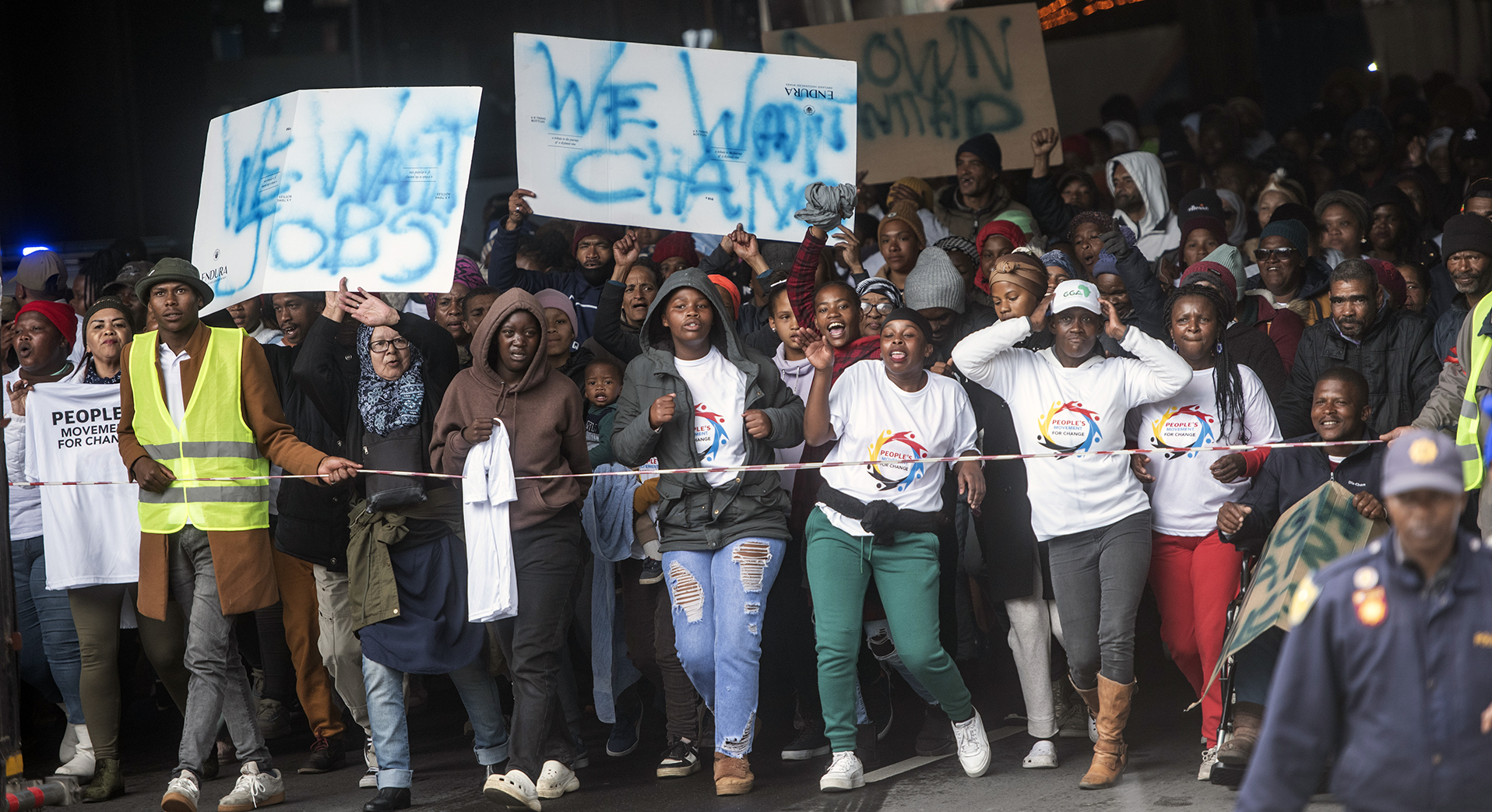
 The People's Movement for Change during a protest march to the Cape Town Civic Centre. The group were protesting against a lack of service delivery, unlawful evictions, high electricity tariffs, unemployment, unfair treatment of informal traders, and housing issues. (Photo: Gallo Images / Brenton Geach)
 President Cyril Ramaphosa touched on everything from the water crisis gripping many parts of the country to the organised crime that is terrorising communities during his highly anticipated 2026 State of the Nation Address (Sona) on Thursday, 12 February 2026.
/file/attachments/orphans/WhatsAppImage2026-02-12at222452_123066.jpeg "President Cyril Ramaphosa delivers his 2026 State of the Nation Address. (Photo: Phando Jikelo / Parliament RSA)")
Now that the red carpet has been rolled up and the echoes of the 21-gun salute have faded, various civil society groups have welcomed some parts of the address but have, in tandem, offered some sobering reality regarding Ramaphosa’s address.
Water security
The water crisis that has plagued Johannesburg has populated newsfeeds for the better part of the past two weeks. Naturally, water security, not only in Johannesburg but across the country, was one of the most detailed and hard-hitting sections of Ramaphosa’s address, with the president elevating the crisis to the same level of priority as the energy crisis.
/file/attachments/orphans/XARWaterMelville-21_702587.jpg "Susan Jobson (63) sits on a street barricade to protest against water shortages, on the corner of Main and 4th Avenue, Melville, Johannesburg, on Wednesday, 11 February 2026. (Photo: Our City News / Alaister Russell)")
Taking a page from the load-shedding playbook, Ramaphosa will now personally chair the National Water Crisis Committee to coordinate technical experts and resources.
He also announced the following interventions:
- Infrastructure Spend: R156-billion has been committed over the next three years for water and sanitation.
- Accountability and Prosecution: In a significant move, he announced that the government has laid criminal charges against 56 municipalities for failing to deliver water. He further directed that municipal managers be charged in their personal capacities for violating the National Water Act.
- Legislative Change: The Water Services Amendment Bill will be used to strip licences from failing providers and allow the national government to intervene directly when a municipality is unwilling or unable to provide water.
These interventions have been welcomed by many, but Dr Ferrial Adam, the executive director of WaterCAN, was left questioning whether the Sona was an election speech to appease the people.
“The interventions are insufficient… It is the pressure that civil society across the country has put on this issue that placed it high on the agenda, but words are not going to solve it. Throwing more committees and money alone is not going to solve the issues. So I feel that the president’s speech is just a speech – we need an indication of action,” Adam told Daily Maverick.
She added that despite ring-fencing finances to address the water crisis in 2025, the nation was still in the “starting blocks”, but Ramaphosa “mentions it again as if it’s a new revelation”.
/file/attachments/orphans/Water_outage_62a_400133.jpg "A man waits for water in Johannesburg on Wednesday, 11 February 2026. (Photo: Our City News / James Oatway)")
Read more: A Sona for (almost) all — Ramaphosa’s masterclass in political crowd-pleasing
Unemployment and jobs for the youth
Ramaphosa also struck a cautiously optimistic tone regarding SA’s stubborn unemployment challenge. While acknowledging joblessness remained a “national concern”, the president pointed to the marginal decline in unemployment as evidence that the economy was finally turning a corner.
Key highlights from the speech:
- Ramaphosa celebrated the 2.5 million opportunities created through the Presidential Employment Stimulus, describing it as a vital lifeline for young people and women.
- He committed to expanding and better coordinating the Expanded Public Works Programme and the Community Work Programme to provide more pathways into permanent work.
- With 200,000 young people already placed in work experience roles, the president announced upcoming regulatory changes designed to lower the barrier for private sector participation, making it easier for businesses to hire first-time job seekers.
- The state is doubling down on equity, mandating that 7% of public service roles be filled by persons with disabilities by 2030, supported by a 7% preferential procurement target.
While the president’s figures suggest a scaling up of opportunity, analysts working directly in community development warned that numbers do not always equal livelihoods.
/file/dailymaverick/wp-content/uploads/2025/08/Paul-Berkowitz-Analysis_Labour-Force-Survey.jpg "Men hold placards offering temporary employment services in Glenvista, south of Johannesburg. (Photo: Reuters / Siphiwe Sibeko)")
Speaking to Daily Maverick, Dr Siphesihle Qange, the programme manager at Seriti Institute NPC, said that while the 2.5 million opportunities showed “ambition and impact”, there was a risk of these programmes becoming a temporary fix.
“Recovery remains hollow if it does not reach communities still trapped in unemployment and exclusion. Short-term placements risk becoming a revolving door of temporary relief rather than a pathway to durable livelihoods. Extending the duration of programmes is non-negotiable to convert short-term exposure into real capability in communities like Standerton and Deelpan,” Qange said.
Zama Zulu, the executive director at Masinyusane Development Organisation, expressed specific concern regarding the lack of detail on one of the stimulus’ most successful branches – the Basic Education Employment Initiative.
“We’re concerned about the lack of focus on the largest youth intervention. Our work shows the powerful model of training education assistants to support literacy while gaining experience. The president mentioned expanding the Presidential Employment Stimulus, but if this means reducing the duration of opportunities for young people to fit more people in, it wouldn’t support our true socioeconomic needs,” Zulu said.
Record matric results masking a deepening crisis
Ramaphosa dedicated a portion of his address to the 88% pass rate of the Class of 2025, the highest matric pass rate in SA’s history, the formalisation of Early Childhood Development (ECD) and the fact that Grade R is now compulsory.
/file/attachments/orphans/6I1A1942_143304.jpg "Learners follow their teacher to class on the first day of school at Mikateka Primary School in Ivory Park on 14 January 2026. (Photo: Felix Dlangamandla)")
However, education advocates argued that the speech failed to confront the structural decay of the schooling system. They pointed out that while the president celebrated 30 years of the Constitution, the actual time spent on basic education in his address – less than three minutes – felt disproportionate to the scale of the challenges faced by learners.
Leading education rights organisations warned that the president’s “rosy” picture ignored chronic underinvestment and hazardous learning conditions.
Daniel Peter Al-Naddaf, a legal researcher at the Equal Education Law Centre, cautioned against equating high pass rates with a healthy system.
“While we join the president in congratulating the matric Class of 2025, we know that their achievements are in spite of a deeply unequal education system, not because of it. We must not romanticise hardship. There was no mention of solving the massive infrastructural backlog that puts learners’ lives at risk daily, or the 15,371 unfilled educator posts pushing learner-teacher ratios to unsustainable levels. Furthermore, while the president celebrates compulsory Grade R, the Treasury has not provided the necessary funding for it.”
Zeenat Sujee, the head of Education Rights at SECTION27, highlighted the absence of urgent environmental and logistical issues in the president’s plan.
“It is disappointing that the president did not address the ongoing education crisis in the State of the Nation Address. Critical issues such as overcrowded classrooms, inadequate infrastructure and the growing impact of climate change on basic education were absent. Many learners continue to face unsafe or unreliable transport, further compromising their right to quality education. We hope the minister of finance will address these gaps in the upcoming Budget Speech and allocate the necessary resources decisively.”
Health: infrastructure vs access
President Cyril Ramaphosa positioned health as a cornerstone of the constitutional promise to “progressively realise the right to healthcare”. The address centred on massive infrastructure upgrades as a necessary precursor to the full implementation of National Health Insurance (NHI).
Key highlights from the speech:
- The president announced substantial investment in health infrastructure, with a priority on constructing and revitalising academic hospitals. He specifically cited a visit to George Mukhari Hospital, using it as a catalyst for a new financing model involving public and private institutions to fix dire infrastructure.
- In the fight against HIV/Aids, Ramaphosa announced the massive rollout of Lenacapavir, a highly effective six-monthly injection intended to eliminate transmission. He also committed to a society-wide mobilisation to ensure girls aged nine to 15 receive the HPV vaccine to end cervical cancer.
- Notably, the president took an unequivocal stance against the unlawful barring of foreign nationals from public facilities, stating: “No foreign national should be unlawfully barred from accessing... health facilities.”
SECTION27 welcomed the infrastructure focus but warned that the “big-ticket” hospital projects must not come at the expense of primary healthcare and local accountability.
The organisation welcomed the focus on building a capable and ethical state, given that its “absence has created fertile ground for the many ills plaguing SA”.
“While academic hospitals were given a specific mention, health infrastructure across the country, from clinics to district hospitals, needs dedicated attention and investment if we are to improve access for all. Further investment will also be required to meet the stated goal of the end of Aids. We look forward to seeing the president’s focus mirrored in the Budget,” SECTION27 cautioned.
The organisation also specifically lauded the president’s stance on foreign nationals, seeing it as a long-overdue correction of recent local practices.
“We welcome the president’s unequivocal stance that ‘no foreign national should be unlawfully barred from accessing public facilities’. This is leadership that has been missing from Gauteng Health and SAPS, and has necessitated litigation. We trust that the right of everyone to access healthcare services will be protected, in line with the promise of our Constitution,” said SECTION27. DM