




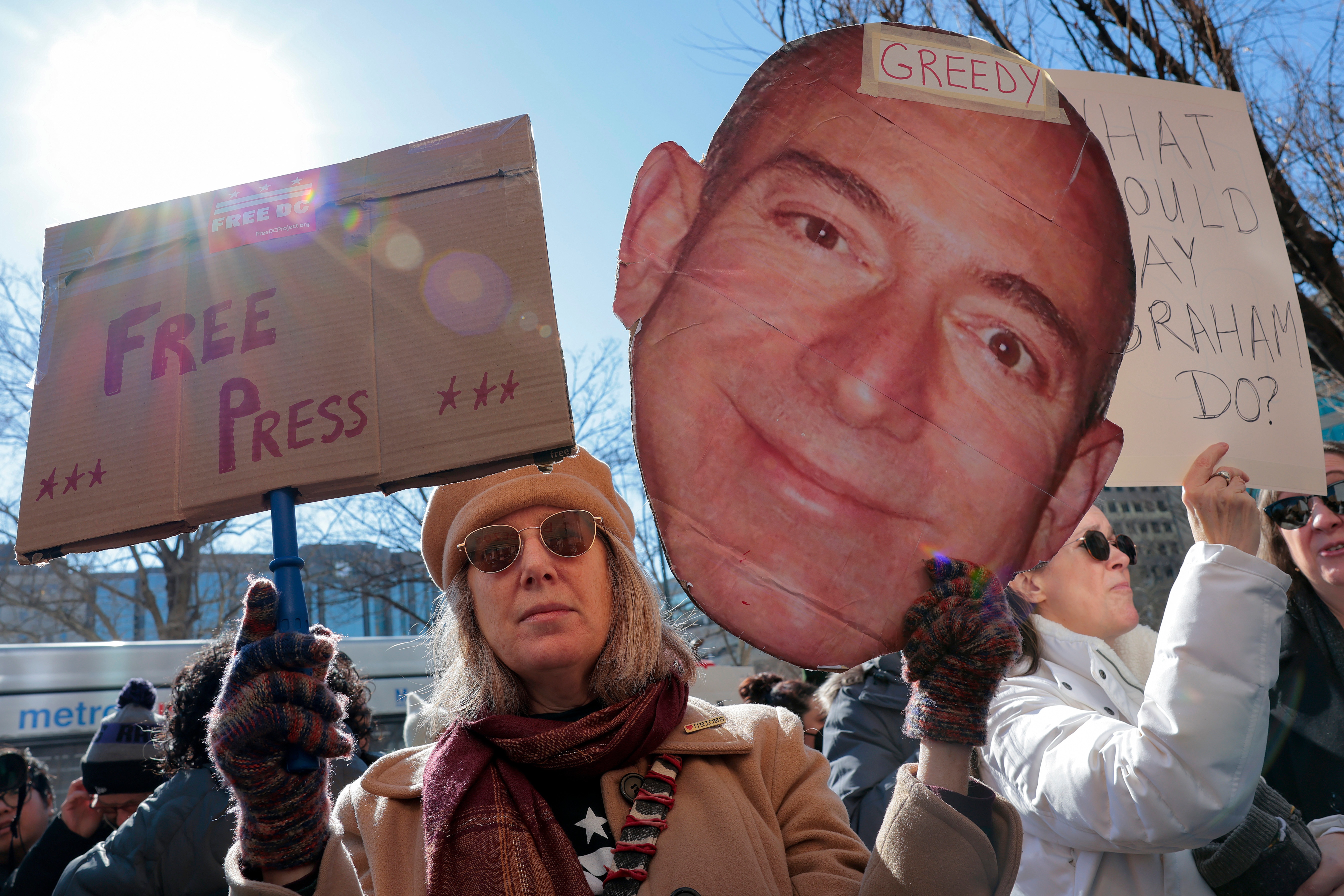
 Washington, DC, readers of the Washington Post join a protest during a rally outside the Washington Post office building on 5 February 2026. The Washington Post, owned by billionaire Amazon founder Jeff Bezos, announced major job cuts on 4 February, laying off more than 300 journalists. (Photo: Heather Diehl / Getty Images)
 There was a time, not so long ago, when the Washington Post, per its self-congratulatory television commercial, had asserted that it was “one of the world’s great newspapers” While this was true some years ago, its newest owner, billionaire Jeff Bezos, now appears determined to destroy it and its reputation, piecemeal.
Bezos has become — as one leading foreign journalist in the US told me — “not the paper’s saviour, but its saboteur.” The destruction since Bezos purchased the paper has now culminated in the wholesale firing of a third of its reportorial workforce and the effective elimination of whole sections of the paper.
At the paper’s apogee, it was virtually on top of the heap, just as it said in those lyrics written for John Philip Sousa’s famous The Washington Post March. That march had been written for the paper back in the 1880s when it was just one of many daily papers published in the capital — and not its most important or influential.
Sousa had been commissioned to compose the march to honour a student essay competition sponsored by the paper in order to boost sales in a contentious, highly competitive media environment.
The march has gone on to become one of Sousa’s most popular compositions and is frequently performed around the world.
Sadly, the way things are going now, it’s possible the march may outlive the paper it is named for.
The lyrics were added many decades later for a television commercial campaign trumpeting the paper’s virtues and its growing local and national importance. Its rise was in contrast to long-time cross-city rival, the Evening Star. However, the latter, like so many other evening newspapers, eventually folded as circulation and advertising melted away as changing news consumption saw readers switching to nighttime television broadcast news. The Star’s demise left the field wide open for the Post to become the biggest paper in Washington, DC.
Watergate scandal
In its glory years, under the leadership of a flamboyant yet extraordinary editor-in-chief, Ben Bradlee, and owner-publisher Katherine Graham (probably the only newspaper publisher in American history to have been threatened with intense bodily harm by a former attorney general, John Mitchell, who had become Richard Nixon’s reelection campaign head), the paper was buoyed by its success through fearless reporting on the Watergate scandal.
/file/attachments/orphans/GettyImages-53267547_731395.jpg "Former Washington Post editor-in-chief Ben Bradlee speaks at the question-and-answer session at the screening of All The President’s Men at the Tribeca Cinemas in New York City on 19 July 2005. (Photo: Brad Barket / Getty Images)")
/file/attachments/orphans/GettyImages-2667927_752630.jpg "Disgraced Richard Nixon (1913-1994) gives the thumbs up after his resignation on 8 August 1974 as 37th President of the United States. (Photo: Gene Forte / Consolidated News Pictures / Getty Images)")
The paper was living up to those march lyrics to become one of the most important, influential and powerful newspapers in the country, if not the world. It had brought down a felonious president and his entire lawless entourage in that Watergate scandal. It owned television and radio stations, Newsweek magazine (Time’s chief weekly rival), and a major (and profitable) nationwide tutoring company.
With its chief national rival, the New York Times, it had published “The Pentagon Papers” on the origins of America’s participation in the Vietnam conflict despite government opposition. It was a partner with the New York Times in owning the International Herald Tribune, the Europe-based daily beloved by expatriates worldwide.
/file/attachments/orphans/GettyImages-2219419653_788740.jpg "Famed Washington Post journalist Carl Bernstein. (Photo: Randy Brooke / Getty Images)")
/file/attachments/orphans/GettyImages-2219419260_539636.jpg "Journalist Bob Woodward of Watergate renown. (Photo: Randy Brooke / Getty Images)")
The Post had a stable of reporters and columnists whose efforts inspired a generation of reporters to dig deep and fearlessly, no matter where the story might lead. And the paper was — in effect — the star in the film, All the President’s Men, along with Bob Woodward and Carl Bernstein — portrayed by Robert Redford and Dustin Hoffman respectively, along with Jason Robards Jr as Ben Bradlee and Meryl Streep as Katherine Graham. (Ironically, given the pressures on the media in today’s America, thirty-some years ago, as an American diplomat serving in a country with few media protections, we found receptive ground for our showings of that film to audiences of students, journalists and political activists.)
/file/attachments/orphans/GettyImages-1262809021_851824.jpg "A scene from 1976’s All the President’s Men, directed by Alan J. Pakula. From left: Dustin Hoffman, Robert Redford, Jason Robards, Jack Warden and Martin Balsam. (Photo: FilmPublicityArchive / United Archives via Getty Images)")
The Post was a newspaper that demanded to be read, even if the liberal stance in its editorial and many authors in its opinion columns would be debated fiercely among readers. Like hundreds of thousands of others, I read that paper with a near-religious intensity during my high school, university and foreign service years and then into retirement. Earlier, I would read it in print and then, more recently, electronically, of course.
When I was in the foreign service and assigned outside the United States, well before the internet was a thing, I would subscribe to the Post’s Sunday edition that could arrive several weeks later by diplomatic bag. We would open up the brown paper wrapper and immerse ourselves in its contents throughout the week — the Outlook, sports, Metro and Style sections, in addition to the main news pages. Its contents kept us connected to our hometown. More recently, we have been reading its contents electronically, but now, with its wholesale butchery by the owners and executives, I am no longer sure I want to continue my subscription…
From early struggles to an international force
The paper’s actual lineage would not automatically have predicted such global success. It was hardly Washington’s pre-eminent paper in the 19th and early 20th centuries. By the 1920s and 30s, it was increasingly tottering towards bankruptcy. Financier Eugene Meyer, one of President Franklin Roosevelt’s economic advisers and the first head of the World Bank, won the paper in a poker game and, under his guidance, it began its slow rise.
His son-in-law, Philip Graham, who had married Meyer’s daughter, Katherine Meyer Graham, as Meyer’s heir, eventually became the paper’s publisher after Meyer’s death. Katherine Graham was passed over, despite the blood tie, as women simply didn’t do such things, then. But when Philip Graham, sinking deeper into psychological distress, committed suicide, his widow, despite her deep insecurities about this new task, became the paper’s publisher. That set the scene for the paper’s most contentious and impactful days.
/file/attachments/orphans/GettyImages-1198921919_537386.jpg "U.S. President Donald Trump holds a copy of The Washington Post as he speaks in the East Room of the White House one day after the U.S. Senate acquitted on two articles of impeachment, ion February 6, 2020 in Washington, DC. (Photo: Drew Angerer/Getty Images)")
Under the leadership of editor-in-chief Bradlee, the paper was transformed into a national and even international force. The daily opinion pages and the Sunday Outlook section were filled with vigorous debate and rich analysis. Its strong book review section rivalled its equivalent at the New York Times. Editorial cartoonist Herblock skewered his political targets — and most especially Richard Nixon.
/file/attachments/orphans/GettyImages-2260093453_924342.jpg "A local D.C. resident who reads the Washington Post joined members of the guild to protest during a rally outside the Washington Post office building on February 05, 2026 in Washington, DC. (Photo: Heather Diehl/Getty Images)")
Its sports section with Shirley Povich, Tony Kornheiser and Michael Wilbon set a new path merging political, sociological and psychological analysis in reporting on teams and players. Its new Style section was home for an irrepressible Sally Quinn and others who reported on the fashions, foibles and misdeeds of the famous and powerful.
Those years became the paper’s glory days — financially and reportorially. In its influence and reputation — those were the days they thought would never end. Until they did.
While the paper and the Graham family’s coffers were deep, they were not infinite, and half a decade ago, a decision was made by the stockholders to sell the paper to someone with massively deeper pockets after multiple years of a balance sheet in the red.
Jeff Bezos
/file/attachments/orphans/GettyImages-2260095320_763598.jpg "A protest rally outside the Washington Post office building on 5 February 2026 in Washington, DC. (Photo: Heather Diehl/Getty Images)")
Enter Jeff Bezos. One of the world’s richest men, based on the fabulous success of his online shopping software empire, Amazon, Bezos was initially seen as the dream candidate to take over a Washington Post complete with its traditions and honours, but one that was increasingly cash poor and with little prospect for improvement.
Coming on to the scene, Bezos had praised the paper, its traditions, its history and its staff; and he promised the business and editorial sides of the paper would remain separate. Crucially, he had gobs of money to invest in this great and noble institution. Bezos explained that he viewed the paper as an irreplaceable national asset and wanted to ensure its future. Hosanna, hosanna, hallelujah, the cries went up, the paper had been saved. Thank you, Lord Bezos.
/file/attachments/orphans/GettyImages-2262368417_867076.jpg "US President Donald Trump. (Photo: Al Drago/ Getty Images)")
But then came the dawn, as they say. Bezos was perceived as becoming increasingly close to a politically reincarnated Donald Trump. He contributed a cool million dollars to the Trump inaugural committee and was rewarded with a prominent seat at Trump’s swearing-in.
Yet more alarms were set off after Bezos-appointed publisher, Will Lewis, had pulled an editorial written to endorse Kamala Harris for president in the 2024 election. That decision led to significant cancellations from print and electronic subscribers who expressed horror over what was a besmirching of the paper’s reputation and lineage.
More recently, Bezos, through his Amazon holdings, underwrote a vapid film of Melania Trump’s days leading up to the inauguration in 2025 — at a cost of $40-million and with $35-million more tossed in for promotion and publicity expenses. (Melania Trump herself gained a nice slice of this spend as its ostensible producer.) This is money that could easily have gone to the Post to keep it afloat.
The cull
But then still worse was to come. Even as Bezos was bestowing a shower of cash on the Trumps, the paper announced it was culling nearly a third of its reportorial staff, including the elimination of the sports desk and significant cuts to international and local reporting to reduce costs for the unprofitable newspaper. In the ensuing firestorm, Will Lewis suddenly announced his resignation. Interim leadership is now in charge. All this turmoil is leading some to wonder if the paper is actually on a slow, painful, dolorous path towards irrelevance or even extinction.
More broadly, of course, things have been changing in the media landscape, most especially as a result of the impact of the internet and social media. The rise of newspaper consumption through websites, and then push newsletters, independent podcasts and other newsletters has been overtaking traditional media consumption, affecting print publications as well as major network broadcast news.
In fact, newspapers nationally (and internationally) have been taking hit after hit. In the US, in the past decade, more than 2,000 smaller and local newspapers have ceased publication, and various well-established newspapers have given up on print production as well.
A friend of ours living in the Washington, DC area lamented to me the other day that the Washington Post no longer carries reports about local government decisions made in his county. And that county, Arlington, is just across the river from the nation’s capital, and most of its economy is dependent on the government. Its residents are the kind of people eager to be engaged with their local government offices. But that is harder to do when information is absent or hard to ferret out.
On the Washington Post’s masthead is the phrase: “Democracy Dies in Darkness.” Perhaps it should be changed to: “Democracy Dies. In Darkness.” And this is definitely not good for the rest of us. DM