



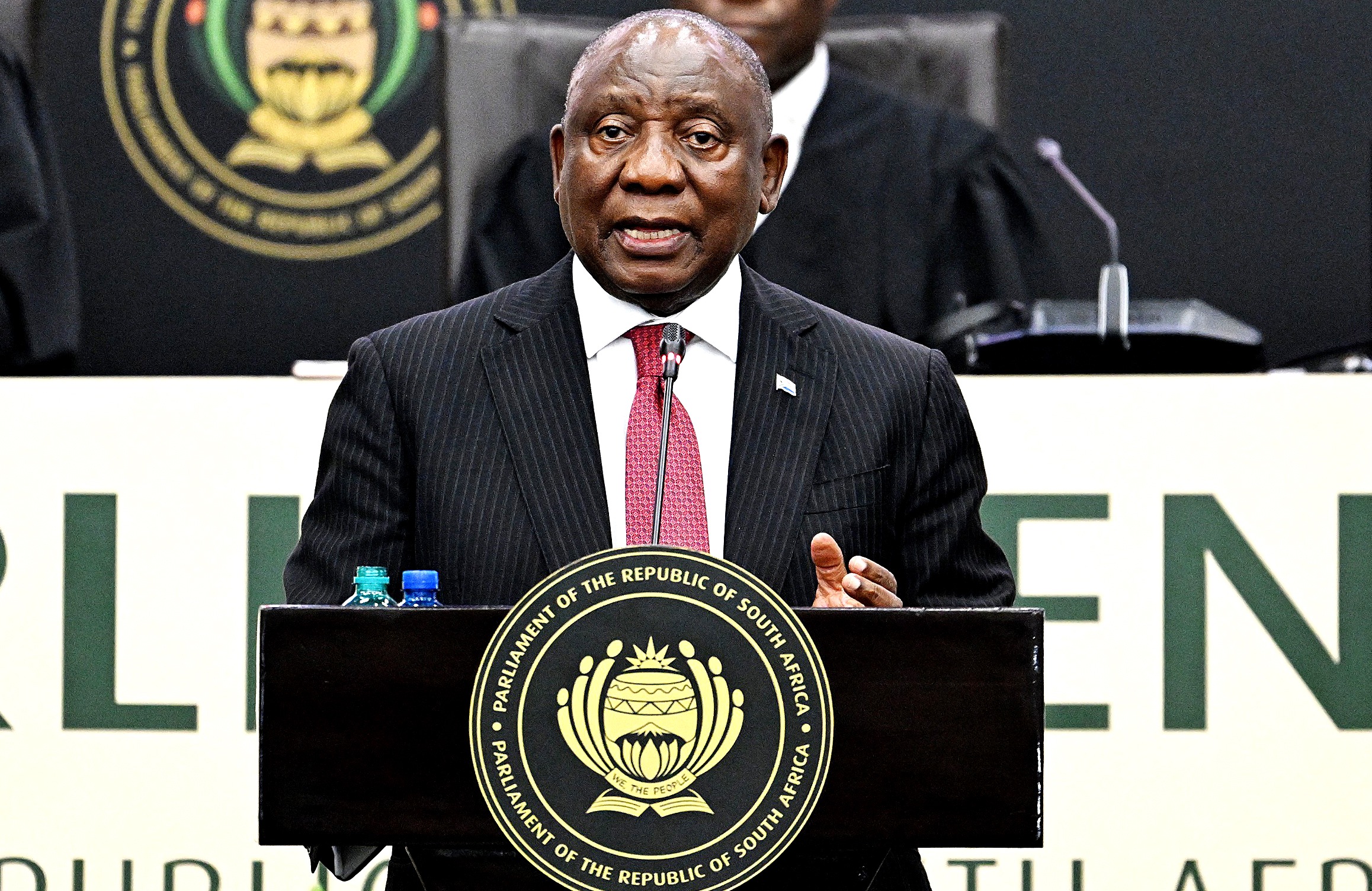
 President Cyril Ramaphosa responds to MPs following a two-day debate on his State of the Nation Address. (Photo: Phando Jikelo / RSA Parliament)
On Thursday, 19 February, President Cyril Ramaphosa said that as elected representatives “we have much to do”, calling for action, greater effort and faster progress — “together in unity”.
He was speaking after two days of debate on his 2026 State of the Nation Address (Sona), touching on beavers (yes, beavers), Black Economic Empowerment (BEE) and, of course, water.
In last week’s Sona, he announced a new water task team and the deployment of the South African National Defence Force (SANDF) to support police in their fight against gangsterism in the Western Cape and illegal mining in Gauteng, which was extended to Eastern Cape on Tuesday.
Here are the key takeaways from Ramaphosa’s reply in Parliament on Thursday.
BEE and the GNU
As Daily Maverick’s Rebecca Davis pointed out, Ramaphosa’s Sona was a masterclass in political crowd-pleasing. He continued this tone on Thursday, when he spoke of the 10-party Government of National Unity (GNU).
“I am grateful to the leaders of the political parties in the Government of National Unity, who meet regularly to discuss matters of national interest. Their contributions have been very useful in managing the challenges our country faces,” he said.
During the debate on Wednesday, however, International Relations and Cooperation Minister Ronald Lamola questioned whether the Democratic Alliance (DA), the second-biggest party in the GNU, was part of the government, because of its often oppositional approach to policy and plans, reported News24.
/file/attachments/2988/ED_587680_307438.jpg "Ronald Lamola took the DA to task over its oppositional stance. (Photo: Deaan Vivier / Gallo Images / Beeld)")
On Thursday, Ramaphosa directly addressed BEE, which the DA opposes. He said the Constitution spoke of redressing the injustices of the past.
“We cannot do that without transforming the various aspects of South African life, but more particularly the economy. It cannot be acceptable to anyone in this House for African people, coloured people and Indian people to be poorer and have fewer opportunities than white people,” he said.
“It cannot be accepted. It cannot be acceptable that anyone in this House would want women to earn less than men and to run fewer businesses than men; it is something that we simply must never accept. And yet there are people in this House … this very House, in the debate who tell us to get rid of the very measures that have been put in place to correct the gross injustice of the past,” he said.
/file/attachments/orphans/WhatsAppImage2026-02-19at173924_656301.jpeg "President Cyril Ramaphosa told MPs that now was not the time to abandon BEE, but rather to strengthen it. (Photo: Phando Jikelo / RSA Parliament)")
While Ramaphosa spoke, some in the DA shook their heads.
“Now you know this issue touches a very raw nerve in me because it is one of the principal issues that we sought to get rid of from this country, the inequality and the exclusion of black people from participating in the economy of the country,” said Ramaphosa.
He spoke about how, during apartheid, he and the now Mineral Resources Minister Gwede Mantashe addressed this issue when they were unionists.
He said the law had divided white workers from black workers who did the same work. White workers would be given blasting certificates, “and black workers were denied a blasting certificate by law. And the white workers get 10 times, if not more, money than black workers, and that was simply, simply the disempowerment of black workers, and it is for this reason that it touches a raw [nerve] with people like me.”
He said that now was not the time to abandon BEE, “Now is the time to make it more effective.”
Later, DA leader John Steenhuisen said in a statement: “We reject the protection of BEE, which has benefited only politically connected elites at the expense of the poor, who remain trapped in poverty, locked out of employment, and with little hope of climbing the opportunity ladder.”
He said the DA would continue to fight for an alternative that created a more inclusive economy for all.
“It is for this reason that the DA has tabled the Economic Inclusion for All Bill. We will relentlessly pursue the replacement of BEE with a policy that truly focuses on addressing poverty.”
/file/attachments/orphans/ED_596792_808676.jpg "Minister of Agriculture John Steenhuisen during the Presidential Response to the Sona debate on 19 February. (Photo: Ziyaad Douglas / Gallo Images)")
Beavers, not weavers
In a departure from his previous comparison of weaverbirds, Ramaphosa called on elected representatives to become like beavers when they build dams — working together in unity.
“Beavers are like a team of engineers. They work together to fell branches, pack mud and raise dams and lodges that create a safe ‘neighbourhood’ of deep water around their home; beavers are a reminder that real building is rarely a solo act,” said the President.
When a river runs too fast, or is too exposed, Ramaphosa said, “One beaver can’t change it, but a community can. They don’t wait for perfect conditions; they start with what’s in reach.”
He continued that one beaver drags a branch while another places it, then others pack mud and strengthen weak points.
“Bit by bit, they raise a dam and shape a lodge — not as a monument, but as a home. And what does that teamwork create? Not just a structure, but a safer environment: calmer water, protection from danger, space for life to grow. Their work turns risk into refuge,” he said.
This didn’t happen through noise or ego, but through coordination, consistency and a shared purpose.
“That’s what working together looks like for us,” said Ramaphosa.
/file/attachments/orphans/WhatsAppImage2026-02-19at142524_339541.jpeg "President Cyril Ramaphosa used the example of beavers working together to stress that unity is strength. (Photo: Phando Jikelo / RSA Parliament)")
“We don’t all have the same role, but every role matters. Some people plan. Some people lift. Some people reinforce. Some people spot the leaks early and fix them before they become disasters.”
Ramaphosa said that with such an approach, “We don’t just complete a project. We create a neighbourhood, a place where others can thrive because we chose to cooperate.”
Water
Ramaphosa also addressed criticism of his new water task team.
He said there had been similar criticism when the task teams for energy and logistics were established — both of which had been successful.
“We will now apply the successful method that we have used in energy and logistics to other urgent challenges that confront our country today,” said Ramaphosa.
“We are already working to establish a National Water Crisis Committee to restore a supply of water to our municipalities that face disruptions right now, but also to ensure water security in the long term,” he said.
Referring to the National Energy Crisis Committee (Necom), he said, “There were groans from some quarters, who said: ‘Yet another committee’.
“Yet, what Necom did was to bring together all the key role-players to focus on the immediate tasks necessary to end load shedding, to restore the integrity of our power system and to lay the basis for stable, sustainable and universal access to electricity into the future.
“It succeeded because it was able to draw on the skills, capabilities, resources and efforts of a broad range of departments and public institutions, as well as the best experts in South Africa and around the world, and to build a platform for collaboration with social partners.
“It was never about meetings and talk shops. It was about taking a hands-on approach to solving the problem, making sure that things actually get done and that they get done quickly.”
He said that, similarly to Necom, “The National Water Crisis Committee is building on work already done by the Water Task Team chaired by the Deputy President, by Operation Vulindlela, by the Department of Water and Sanitation and by the respective municipalities.”
Now, attention shifts to next week’s Budget, where hopefully, it will be plain sailing, unlike 2025’s protracted disputes, largely between the ANC and DA over the proposed VAT hike. DM
Comments
Scroll down to load comments...