



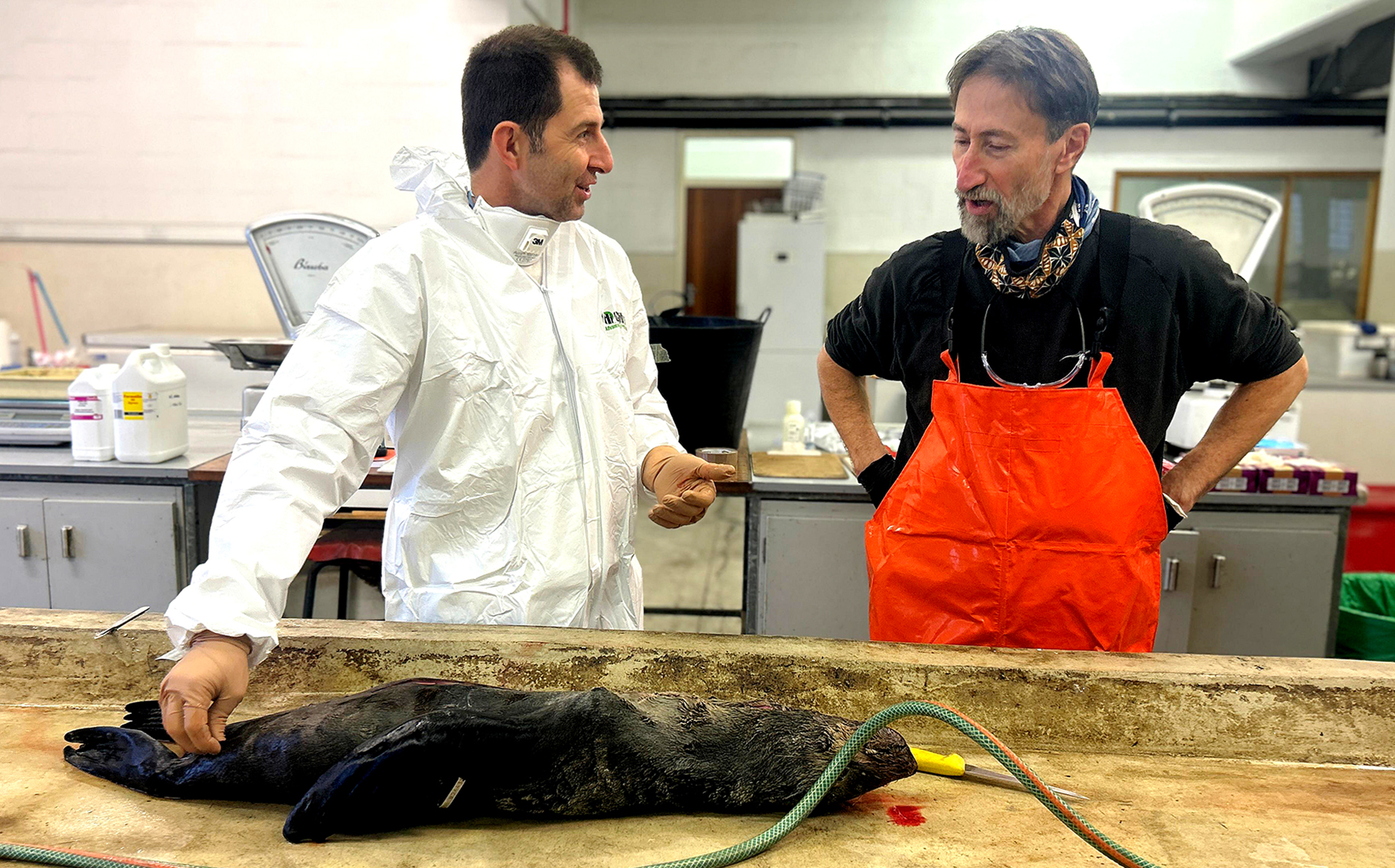
 Dr Brett Gardner and Dr Greg Hofmeyr prepare to begin a necropsy on a Cape fur seal. (Photo: Supplied / Brett Gardner)
Cape fur seals are undeniably adorable – with their playful antics, glistening coats, goofy charm and beachside acrobatics – but experts have issued a stern warning: admire them from a distance.
A confirmed case of rabies in a Cape fur seal at Jeffreys Bay in the Eastern Cape in November has sparked renewed concern among scientists and veterinarians monitoring the long-running outbreak affecting seals along South Africa’s coastline.
Curator of marine mammals at Bayworld in Nelson Mandela Bay, Dr Greg Hofmeyr, says this is the first confirmed case of rabies among seals in the Eastern Cape.
Bayworld said that on the morning of Sunday, 16 November, a small seal approached surfers at Jeffreys Bay, attempting to bite them. The surfers fended off the animal with their boards and exited the water safely. No injuries were reported.
/file/dailymaverick/wp-content/uploads/2025/01/24-02-11_DUIKER_FREEDIVE_SPOT.00_49_52_11.Still003.jpg "A playful Cape fur seal at Duiker Island, captured in the new Out of the Blue documentary. (Photo: Out of the Blue director and cinematographer Floris Tils)")
Hofmeyr says rabies in seals is notoriously difficult to spot.
“You can’t tell if a seal has rabies just by looking at it. Confirmation is only possible after death, when a brain sample is tested in the lab,” he said.
Rabid seals may display aggressive behaviour, including unprovoked attacks and the biting of objects both on land and in water. Others may show unusual movements, such as agitated head shaking.
/file/attachments/orphans/Photo2_650938.jpeg "Dr Greg Hofmeyr , curator of marine mammals at Bayworld in Nelson Mandela Bay. (Photo: Supplied / Javier Lobon-Rovira)")
“They may also show little or no fear of humans or other animals. Once symptoms appear, rabies is always fatal,” Hofmeyr says. “People should also look out for injuries. Rabid seals often have injuries on their head, chest and neck. They may have been bitten by a rabid seal or be injured because they have no respect for their own safety”.
Read more: Seemingly rabid Cape Fur seal carcass sinks in the ocean before being tested for rabies
Many infected seals appear outwardly healthy, plump and in good condition.
Regardless of how rabies manifests, humane death is the only responsible option. “Rabies is 100% fatal. The most responsible course of action for a rabid seal is euthanasia, which prevents the animal’s suffering, limits the spread of the disease and reduces the risk to the public.”
Bayworld obtained permission from the Department of Forestry, Fisheries and the Environment to euthanise the rabid seal involved in the Jeffreys Bay incident.
/file/attachments/orphans/Photo4_728040.jpg "Dr Lesley van Helden, state veterinarian and epidemiologist with the Western Cape Department of Agriculture. (Photo: Supplied / Lesley van Helden)")
A state veterinarian and epidemiologist with the Western Cape Department of Agriculture, Dr Lesley van Helden, says the rabies virus infecting seals at the moment is a canid biotype that originally came from dogs brought to southern Africa around the 1940s.
The canid biotype then established itself in several wildlife species, such as black-backed jackals, presumably when one was bitten by a rabid dog.
“Analysis of the seal viruses has shown their closest relatives to be rabies viruses found in black-backed jackals, indicating that the outbreak probably started by a seal being bitten by a rabid jackal several years ago. From there, the seals have spread rabies from seal to seal, and so have become a new maintenance host of rabies,” Van Helden said.
What to do if exposed
Hofmeyr urged people to exercise caution and act quickly if exposed. While a bite does not automatically transmit rabies, quick action is essential to reduce the risk of infection.
“The first step is to wash the wound thoroughly with soap and running water for 10 to 15 minutes,” Hofmeyr advises. “The virus is wrapped in a fatty envelope that soap breaks down, lowering the viral load.” After cleaning, urgent medical attention is critical to start post-exposure treatment.
Read more: Documentary reveals urgent rabies threat to South Africa’s marine ecosystem
Dr Brett Gardner, a South African-trained specialist marine-mammal veterinarian based in Melbourne, Australia, says the emerging rabies outbreak among Cape fur seals is setting off alarm bells within the scientific community.
“We’re extremely concerned,” Gardner says. “Right now, we simply don’t have enough information.”
He is seeking funding to collect new data between April and July, which he hopes will strengthen an epidemiological model designed to forecast the outbreak’s trajectory.
/file/attachments/orphans/Photo3_497331.jpg "Dr Brett Gardner performs a field anaesthetic on a New Zealand fur seal in the Bass Strait. (Photo: Supplied / Brett Gardner)")
According to Gardner, several scenarios are on the table, of which one is that rabies becomes endemic in Cape fur seals, producing periodic surges of illness that spike, recede, and flare again – much like the natural cycles seen in jackals, kudu and yellow mongooses.
“The other possibility,” he cautions, “is that we’re at the very start of the curve, and this could be the beginning of a catastrophic die-off.”
At present, he says, there is simply not enough data to determine which path the outbreak is taking.
While the health of the Cape fur seal population is a major concern, Gardner points out that the species’ large numbers give it some resilience. Other marine mammals are far more vulnerable.
“If an infected seal were to bite one of the Cape clawless otters in the Western Cape, that could wipe out an entire family group,” he says.
Spillover fears
What really worries him, however, is the prospect of the virus spilling over into Subantarctic or even Antarctic ecosystems. Those regions support dense populations of seals and other marine mammals already under severe pressure – from shrinking ice shelves, rapid climate change, heavy krill harvesting and, most recently, avian influenza.
“But what is really scary is the risk of a spillover event from South Africa or Namibia into the Subantarctic. Then potentially from the Subantarctic into Antarctica. That region, the Subantarctic and Antarctica, has a massive amount of marine mammals, lots of seals that are already facing way more threats than our Cape fur seals. A rabies outbreak would be yet another insult on top of everything they are already facing,” Gardner said.
Bayworld runs a rehabilitation programme for seals. Hofmeyr says all seals brought to the facility – often due to injury – are vaccinated against rabies before being released back into the wild.
Hofmeyr says concerns over rabid seals should not be seen as a reason to avoid the beach altogether. However, he strongly urges the public to keep their distance from seals, whether attempting to touch them or take photographs. Instead, he advises contacting the authorities, who are trained to handle these animals safely.
“Seal behaviour can be unpredictable, and it is often impossible to know whether a seal in the water may pose a risk. Similar to shark safety, lifeguards should remain vigilant and beaches should be closed and cleared if necessary. Swimmers should exercise caution whenever they enter the water. While most seals do not have rabies, it is safer not to take unnecessary risks.”
Hofmeyr urges that, in the Eastern Cape, any sightings of seals ashore, unusual behaviour, or carcasses, should be reported immediately to the Bayworld stranding hotline on 071 724 2122. DM