




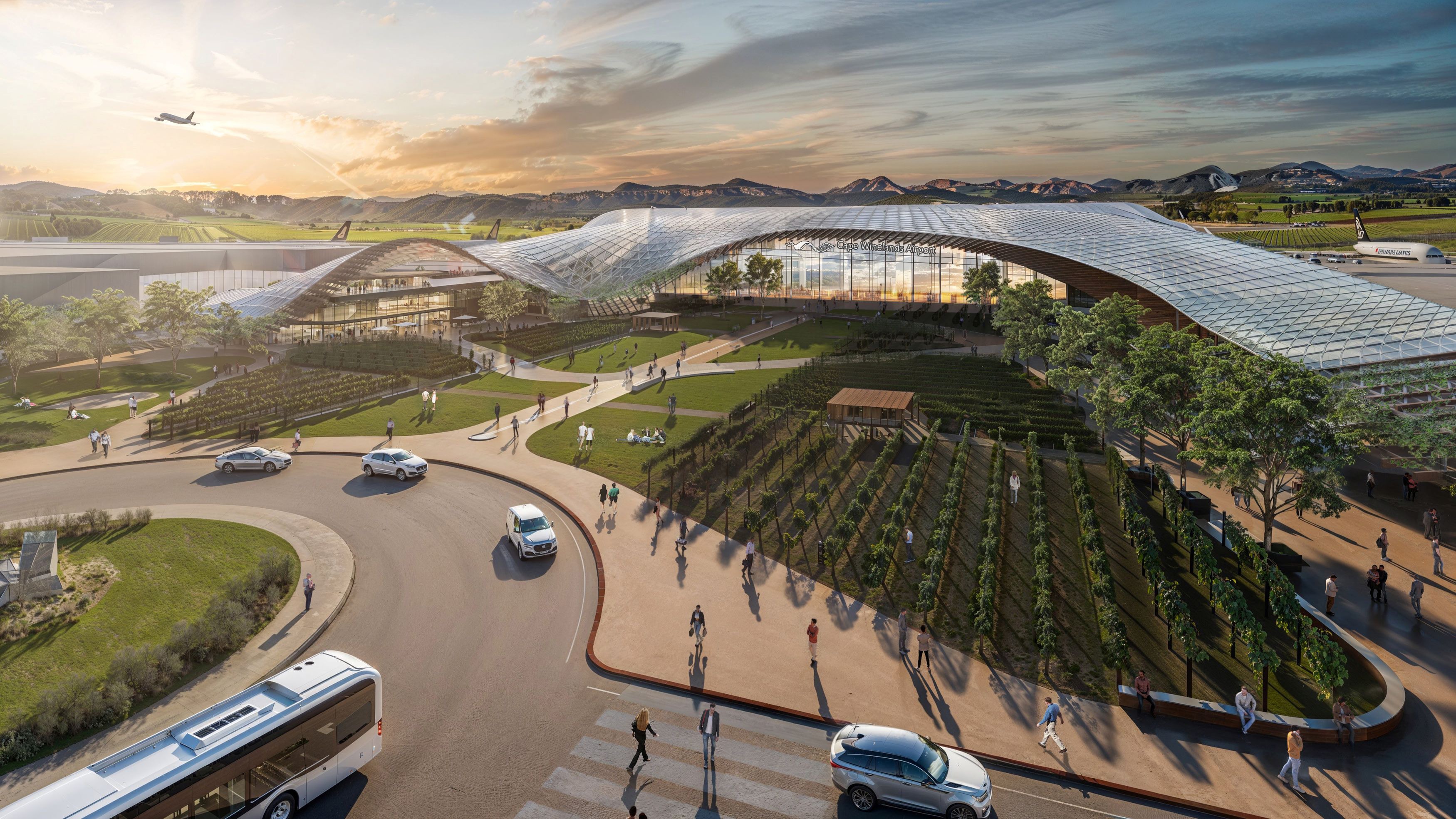
 Artist's impression of the proposed Cape Winelands Airport by Boogertman + Partners. (Photo: Cape Winelands Airport / Supplied)
The Cape Winelands Airport (CWA) is situated just off the R302 and R312 corridors north of Durbanville on the Fisantekraal airfield, a military site built in 1943. Here, a private consortium is developing an airport precinct scheduled to open in 2028, with construction slated to begin in the fourth quarter of 2026.
Nicholas Ferguson, the executive director of RSA Aero, which is the owner, operator and developer of the project, recalled the genesis of what is now an 880-hectare masterplan.
“When I first saw it, I saw value in the runways. I even thought if you take these runways and you rubbalise [reduce them to rubble] them, you could probably pay for the airport,” said Ferguson.
To accommodate a 3,500m runway capable of handling an Airbus A380, the developers had to engage in an aggressive acquisition strategy.
“We had to acquire more land. So, we started off on 150 hectares, we acquired more land, built a quarry, and then bought a farm, and then we bought another farm, and eventually got to the point where we could build a three-and-a-half-kilometre runway,” Ferguson explained.
Headed by managing director Deon Cloete, former general manager of the Cape Town and Durban International airports, the Cape Winelands Airport is a tactical move to drop tourists with cash to burn close to Cape wine estates while offering global carriers a billion-rand incentive in fuel savings.
The airport is expected to sustain approximately 35,000 direct and indirect jobs and could sustain just over 100,000 direct and indirect jobs during its initial 20 years of operation.
Listed property giant, Growthpoint will assume long-term property and asset management responsibilities across the 450-hectare aviation precinct’s logistics, commercial and hospitality components which excludes the terminal buildings, with the right of first refusal to co-invest in future property developments. It will also oversee the development’s main contractor to ensure institutional standards in transparent governance, financial discipline, positive environmental and social impact integration and development delivery.
The diversion model
While passenger comfort is a marketing point, the commercial differentiator of CWA is operational economics. Currently, international flights bound for Cape Town must carry mandatory fuel to reach distant alternates like Johannesburg or Durban in case of emergencies.
Cloete identified this as a massive atmospheric and financial waste. “You can imagine, if you think about a typical day, all aircraft carrying between five and 10 tonnes extra fuel every day for the whole year,” he said.
Offering a Code 4F runway just 25km from Cape Town International, CWA allows airlines to drop that dead weight in favour of revenue-generating cargo.
According to a Pace Aerospace Engineering analysis, this closer alternative could result in carbon emission reductions of up to 60 million kg annually for the industry.
“Generally speaking, any flight from anywhere — whether it’s the US, the Middle East, or the East, UK, Europe — will see a 5% reduction in their operating cost for that particular flight. These are big numbers, in excess of a billion rand per annum,” said Cloete.
The project’s viability is already anchored by signed contracts with local and international carriers. The airport is also pursuing an International Port of Entry licence, a strategic move to break the current monopoly in the Western Cape, which presently only has one such gateway.
Phase | Target Date | Passenger Capacity |
| Phase 1 | 2032 | 1.7 to 2.5 million |
| Phase 2 | 2050 | 5.2 million |
Skin in the game
Wilson Bayly Holmes-Ovcon, better known as WBHO, is both the main contractor of the project and an equity investor.
“They all put skin in the game here so that we can all be accountable and make sure that this is a success story,” said Cloete.
Unlike most South African airports, which rely on the state-owned Air Traffic and Navigation Services (ATNS) for navigation capability, CWA is building its own navigation infrastructure.
And that might not be a bad thing, given the ATNS operational problems over the last year.
Read more: Aviation safety crisis causes chaos at SA regional airports
The strategy, says the project team, mitigates the risk of regulatory bottlenecks and service interruptions that have affected smaller regional airports.
Competition in the skies
The development will give the Airports Company South Africa (Acsa) a run for its money, much along the lines of Lanseria Airport in Johannesburg, which is owned by PIC-linked Harith General Partners. Harith’s landmark R6.5-billion acquisition of the Pan-African Infrastructure Development Fund about a year ago strengthened its position in key infrastructure assets, including Lanseria International Airport and Kelvin Power Station. The fund holds significant stakes in essential infrastructure across Africa, including 37.5% of Lanseria — SA’s only private airport.
/file/dailymaverick/wp-content/uploads/2024/10/Lanseria-HB-01.jpg "Lanseria International Airport. (Photo: Wikipedia)")
Acsa’s CEO, Nompumelelo Mpofu, said the company’s infrastructure investment programme approved by the Economic Regulator stands at R21.7-billion over the next five years, with just over R1.4-billion already spent. “This capital will be deployed across our national network to enhance capacity, elevate passenger experience and unlock new growth corridors in line with South Africa’s developmental agenda,” she said.
Flagship projects include a reconfiguration of the domestic arrivals terminal at Cape Town International Airport, a new bus station and public transport interchange at OR Tambo International and a terminal expansion at George Airport.
/file/attachments/2988/acsaflagshipprojects_824740.jpg "Source: ACSA annual report 2024/2025")
A multimodal logistics engine
But coming back to the Cape Winelands Airport development, while the runway grabs the headlines, the project’s most strategic asset may be the iron tracks running past its perimeter, connecting it to the ports of Cape Town and Saldanha. Cloete envisions a platform where air, road, ocean and rail intersect.
/file/attachments/2988/winelandsairportmap_912861.jpg "Cape Winelands Airport will provide airlines with a much closer planning alternate airport that can be used for diversion fuel planning on flights inbound to Cape Town. Source: Cape Winelands Airport")
This will allow CWA to take fuel trucks off the road — replacing the 50 to 60 daily tankers required by current airports with bulk rail delivery, according to Cloete. For passengers, it offers a future “park and ride” release valve for Cape Town’s congested City Bowl.
Read more: Investment bankers step in to tackle N3 freight congestion
“If you live in Malmesbury, you can actually get off [the train] at the airport, and we will shuttle you in,” said Cloete, noting that high-level talks with Prasa and Transnet were already under way to formalise this integration. CWA’s Land Use Planning Act (Lupa) report notes that while current service is limited, the airport could trigger increased frequency, eventually integrating with the MyCiTi feeder services.
Typically for the Cape Town area, road congestion remains a concern. According to a traffic impact assessment by ITS Consulting, increased volumes will trigger upgrades along Klipheuwel and Lichtenburg roads. Project representatives said engagement with provincial and city authorities was under way to address pressure on the R302 and R312 corridors.
The retail strategy is also being positioned as a differentiator. Ferguson confirmed that Growthpoint Properties was a development partner for the precinct, with more than 1,000 retail inquiries already received.
Read more: V&A Waterfront is not waiting around for global tourists to return
“If I look at the current airports, I don't think that they’ve got the retail mix right. We will be quite aggressive in that regard. We’re going to tap into what Growthpoint has done at the [V&A Waterfront] not only in terms of the mix, but the quality of tenants,” he said.
The precinct will also house a historic aviation museum. “We really like to embrace aviation and what it does in history as much as we are future-oriented,” said Cloete.
How this affects you
✈️ By slashing airline operating costs, the airport creates room for more competitive pricing on international routes.
✈️ A secondary runway in the province means fewer diversions to Johannesburg.
✈️ Residents in nearby areas should prepare for increased noise, while homeowners in the broader Northern Suburbs may see a spike in property demand.
✈️ The eventual rail integration means residents could eventually bypass highway gridlock and use the airport as a transit link.
✈️ Locals using the R302, R312 and R304 can expect increased roadworks to handle the 2.5 million passengers expected by 2032.
✈️ The project aims to sustain over 100,000 jobs, specifically targeting skills development for the Fisantekraal community.
Chickens, noise and roads
Despite securing environmental approval in October 2025, the project faces a final hurdle before its late 2026 construction date. Several appeals from neighbouring landowners challenging the development’s physical footprint are with the provincial minister.
Cloete admitted that the project had to navigate pushback from neighbouring poultry operations during the environmental assessment process. He said that while these objections from chicken farmers had forced the team to refine their designs, the developers remained steadfast in their goal to run the entire airport independently of the national power grid.
Read more: After the Bell: Acsa’s Mpumi Mpofu is making SA’s airports glamorous and profitable again
Furthermore, a noise impact assessment within the Lupa application warns that by the time the airport reaches full capacity, the noise impact zone will overlap with the Greenville Garden City residential development.
“Of the 1,500-odd interested and affected parties, six decided to appeal. It’s currently with the minister to consider those appeals. We expect only by the end of next month to have a final outcome from the minister,” said Cloete, referring to the Western Cape minister of environmental affairs, Anton Bredell.
The appeals primarily come from neighbouring landowners, according to Cloete. “They want the airport, but they don’t want the airport right there,” he said. Stakeholders have called for flight operations to begin during the build, but developers argue that mixing an active airfield with a massive construction site is too dangerous.
Ryan Ravens, the CEO of business leadership organisation Accelerate Cape Town, said it comes down to the “Nimbyisim” Capetonians are known for. “We all want development, we all want more density, but Not In My Backyard, right? It’s common across Cape Town.”
/file/attachments/2988/airportartistdrawings_581940.jpg "An artist drawing of what the CWA will look like when completed. Source: Cape Winelands Airport")
Off-grid ambitions
To mitigate South Africa’s unstable electricity supply, CWA aims for operational autonomy. The plan includes a 20MW solar photovoltaic plant and biodigesters. The design intends for the airport to run primarily on this solar infrastructure, using the Eskom grid only as a backup, if at all.
The biodigesters will process galley waste from international flights and general airport organic waste. This solves two problems: it generates power and handles the strict legal requirement to incinerate or sterilise international catering waste to prevent foreign pathogens from entering the country. The airport has also identified three production boreholes on-site.
“We are firmly committed to [getting] this airport off the grid. Everything that we build, anything that’s on the airport that can be electrical, we obviously will have pretty strong specifications on that,” said Cloete.
If construction proceeds in late 2026, the runway outside Durbanville will begin to give physical shape to a simple proposition: Deliver travellers within minutes of the Winelands, and give airlines a measurable reason to choose the Cape. And, as Ravens noted, “Competition is good … it will certainly force Cape Town International to up their game.” DM
Comments
Scroll down to load comments...