



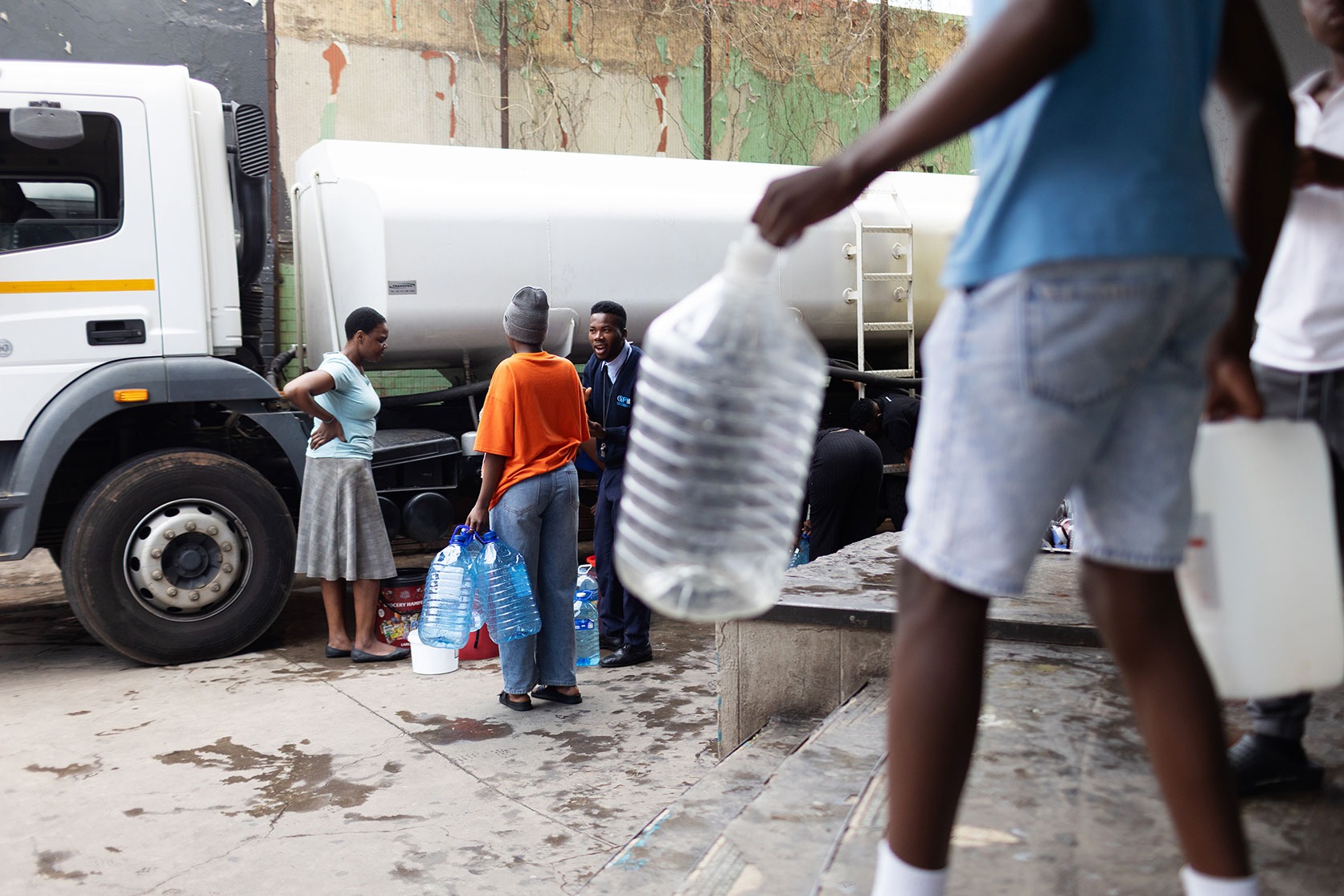
 Residents collect water outside the One Eloff building in Marshalltown, Johannesburg, on 6 October 2025. New water laws will allow the DWS to criminally charge municipalities for non-compliance. (Photo: Alaister Russell / Our City News)
 South Africa would need to shell out R400-billion to address the maintenance backlog of water and sanitation infrastructure in the country’s worst-performing municipalities.
“We’ve estimated that the backlog for water services infrastructure, not only in terms of fixing what’s broken, but also routine or preventative maintenance, is about R400-billion,” Department of Water and Sanitation (DWS) director-general, Dr Sean Phillips, told Daily Maverick in an interview this week.
In response to a question in Parliament in December, Water and Sanitation Minister Pemmy Majodina said this figure related only to the 105 municipalities that scored “critical” or “poor”, on average, in the Blue, Green and No Drop audit reports of municipal drinking water and wastewater systems.
“This includes the investment required to restore assets to acceptable condition, refurbish old infrastructure, reduce water losses, address non-compliance and expand capacity where required… [It] relates only to the 105 municipalities, and does not include the remaining WSAs [water services authorities], including metros or national and regional bulk systems,” she said.
The Drop reports indicated that 67 out of 144 WSAs scored “critical” and a further 38 scored “poor” in the reports, according to Majodina.
“Therefore, a total of 105 (73%) WSAs scored critical or poo, and these have been identified as the worst- performing municipalities in terms of their failure to deliver water services in line with the regulatory standards. The decline in water and sanitation services is mainly attributed to municipalities not prioritising funding for operations and maintenance,” she said.
The Drop reports are regulatory mechanisms the department uses to monitor the quality and service delivery of water and sanitation services by municipalities, alongside water conservation and demand management. The reports, published by the DWS in 2022 and 2023, showed the massive deterioration in municipal water services in South Africa since the audits were previously published in 2012 and 2013.
The Blue Drop report, which assessed the quality of drinking water, found that almost half (46%) of the drinking water in municipal water supply systems does not comply with microbiological standards and is not safe to drink, an increase from 5% in 2014.
The Green Drop report, which looked at the state of wastewater systems, revealed that 39% of municipal wastewater systems are in a critical state of performance and require urgent interventions. Of the 144 WSAs in South Africa, the report found 90 had at least one wastewater system discharging partially treated or untreated sewage into rivers, increasing the risk of life-threatening diseases such as cholera.
The No Drop report, which assessed the distribution of drinking water, found that close to half (47%) of municipal water in the country is lost as so-called “non-revenue water” because of leaking pipes, unreliable or non-existent water meters, illegal connections and poor billing and revenue collection.
Read more: Defaulting municipalities: Treasury crackdown is to avert water sector collapse
According to Phillips, all 105 municipalities agreed at a WSA Summit in January 2024, and again at the National Water and Sanitation Indaba in April 2025 to submit corrective action plans to the department to address their performance.
“By September 2025, despite having all the water services authorities at the Summit and at the Indaba agree that they would all submit corrective action plans – particularly those 105 worst performers – to address their poor performance in the Drop reports, 53 of those had not even submitted corrective action plans to us,” he said.
This week, the DWS confirmed to Daily Maverick that as of 25 January, 42 WSAs had still not submitted their plans to the department.
Collapsing municipal water services
In terms of the Water Services Act 108 of 1997, municipalities, as designated WSAs, are responsible for the supply of water and sanitation services to communities. According to the Act, a WSA may perform the functions of a water service provider (WSP) itself or may contract with an external WSP to provide water services.
The DWS, on the other hand, is responsible for managing South Africa’s water resources and ensuring that municipalities meet their service delivery obligations. Its mandate is defined by Section 27 of the Constitution, the Water Services Act of 1997 and the National Water Act of 1998.
The Drop reports show that most municipalities in SA are failing to meet their basic governance and service delivery responsibilities. According to Phillips, the main causes of the deterioration in municipal water services as shown in the reports is that municipalities are simply not maintaining their infrastructure.
/file/dailymaverick/wp-content/uploads/2023/11/WaterCAN-Joburg-Meeting-5-11_11_2023A.jpg "The director-general of the Department of Water and Sanitation, Dr Sean Phillips, speaks to concerned Johannesburg residents about the water crisis in the City. (Photo: WaterCAN)")
“During last year, we carried out another Blue, Green and No Drop assessment in detail with the municipalities and we’re going to be publishing the results of those this year,” Phillips said.
“The results that we published in 2022 and 2023 showed a significant decline [in municipal water services] from the last time we did them in 2012 and 2013. […] The problem is that there are structural problems in the way in which the water and sanitation function is run at a municipal level. Until those structural problems are addressed, it’s likely that the decline will continue.
“The structural causes of the problem are, firstly, that there’s no ring-fencing of revenue from the sale of water in municipalities, and secondly, that there’s no single-point accounting for the water function,” he said.
Read more: Two reforms that will help address deteriorating municipal water services
Phillips explained that many of these municipalities are trapped in a “vicious downward cycle”, with high levels of non-revenue water leaving their water services operating at a loss, depriving them of funds to perform maintenance, while part of the revenue the council diverts to other purposes.
“Because they don’t do enough maintenance, infrastructure deteriorates further and the non-revenue water increases further,” he said.
In Johannesburg, for example, the amount of non-revenue water that is lost or unaccounted for is 48.4%, and yet, Africa Check has found the city spends less on repairs and maintenance than any other metro in the country. Decades of mismanagement, political blame games and systemic neglect have led residents across Johannesburg to experience prolonged disruptions in water supply. In Drieziek, near Orange Farm, some residents told Daily Maverick’s Naledi Mashishi earlier this month that their taps have been dry since 2016.
Read more: After the Bell: Water, water everywhere, but not a drop for Gauteng
In eThekwini Municipality, non-revenue water has reached an alarming 58%, with planned and unplanned restrictions disrupting the provision of water in areas such as Durban North, Phoenix and Verulam. Of its R70.9-billion budget for 2025/26, the council has set aside R7.3-billion for capital projects, reported Daily Maverick.
In Knysna, the water situation is dire. The town is now estimated to run out of water within 10 days, after years of long-term operational and management failures, which has caused water revenue to be lost to leaks and illegal connections and infrastructure to not be upgraded in decades, Daily Maverick reported. Coupled with this is a regional drought that has caused dams along the Garden Route to drop to lower than normal levels.
“They [Knysna Municipality] also would’ve been in a better position now if they didn’t have so many leaks in their water distribution systems. They’ve got a very high level of leaks – they don’t even know what their percentage of leaks is, because most of the water meters in Knysna are not working, so they can’t measure how much water is being lost,” Phillips told Daily Maverick.
/file/dailymaverick/wp-content/uploads/2025/05/Water-delivery-knysna-1-3.jpeg "The Garden Route District Municipality has sent two water tankers to Knysna following water supply disruptions. (Photo: Garden Route District Municipality)")
According to Phillips, the Water Services Amendment Bill, which is currently before Parliament, aims to ensure that revenue from the sale of water in municipalities is ring-fenced for water services.
He said that the DWS’s amendments to the Water Services Act will also move SA towards ensuring that there is a single-point accountability for all aspects of delivering the water service.
“Internationally, there’s been a movement away from the predominant model in South Africa, where we have municipalities providing the water and sanitation department through a technical water department and the rest of the function distributed around the rest of the municipality. Generally, in the world, the provision of water services have moved away from that and have moved towards a utility model. […] A utility is a professionally run, ring-fenced entity with full control over all the functions, which also does the billing and revenue collection and can be held accountable.
“Our amendments to the Water Services Act will push the country in that direction because it emphasises the need for water services providers to have a licence, and it clarifies that all these functions, including billing and revenue collection, supply chain management, [and] recruitment, are [WSP] functions and must be ring-fenced within the [WSP],” he said.
Municipalities facing criminal charges
Phillips told Daily Maverick that the Water Services Amendment Bill also includes reforms to strengthen the DWS’s regulatory powers so that it can intervene more effectively in municipalities, as well as criminally charge municipalities for non-compliance.
“That’s another amendment we’re making to the Water Services Act. The Water Services Act in its current form doesn’t give us powers to criminally charge municipalities for non-compliance with minimum water standards. The National Water Act is different, [it] has always given us powers to criminally charge anyone who pollutes water resources,” he said.
Read more: Government opens criminal cases against 26 municipalities over sewage pollution crisis
According to the DWS, the department has opened criminal cases against 42 WSAs for contravention of the National Water Act, while a further five cases have been concluded. This is an increase from 36 cases against 26 municipalities for repeated sewage spills or failing to comply with government clean-up directives, Daily Maverick reported in May 2024.
“There are in some instances more than one case against a [WSA]. There [are] currently 46 active criminal investigations under way with another 41 referred to NPA for a decision in terms of prosecution and one where they have decided to prosecute,” the department confirmed to Daily Maverick this week.
Coupled with the criminal cases opened by Department of Forestry, Fisheries and Environment, the DWS said the total number of municipalities facing criminal charges stands at 56.
“[That] means we have criminal charges against more than a third of our [WSAs], and since we’ve started to strengthen our regulation function in the last few years that has accelerated. I envisage that, before long, we’ll have criminal charges against more than half of the [WSAs] for sewage pollution,” said Phillips.
However, he said the fact the DWS has strengthened its regulation and that it has filed criminal charges against 42 municipalities hasn’t resulted in a general improvement in wastewater management by municipalities.
“I suspect that when we release the Green Drop report this year, you’re going to see a further deterioration, on average, in wastewater management. Criminally changing municipalities is not changing their behaviour,” he said. DM