




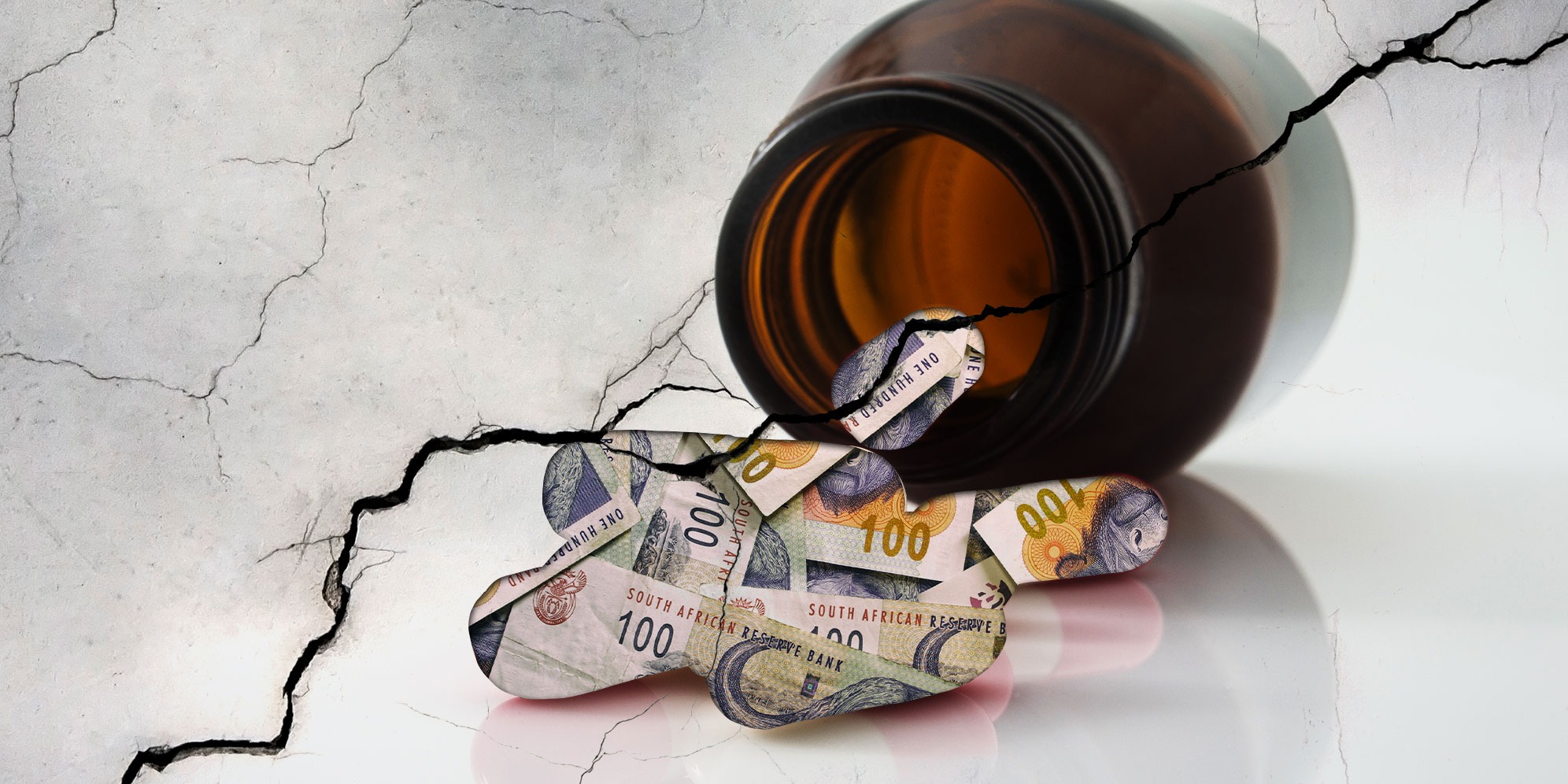
 Illutrative image: Bottle of pills. (Photo: Freepik) | Money. (Photo: iStock) | (By Daniella Lee Ming Yesca)
 The Eastern Cape Department of Health owes pharmaceutical companies R1-billion for medicine and has had 21 of its crucial accounts suspended because of non-payment.
Correspondence seen by Daily Maverick indicates that the department has conceded it will not be able to pay the outstanding amounts anytime soon. It is understood that the department will have only R60-million to R70-million available for payments in March, and perhaps R500-million at the start of the new financial year.
Responding to questions, Eastern Cape Department of Health spokesperson Siyanda Manana said the department is experiencing “financial pressure”, which has “affected the timeous settlement” of some pharmaceutical accounts. He insisted, however, that this does not constitute a “widespread collapse” of the department’s medicine provision.
Manana conceded that “isolated” shortages may occur but said mitigation measures are actively being implemented, including alternative sourcing, redistribution between facilities and the prioritisation of lifesaving medicine.
He said the department is engaging with the national Department of Health to find a solution.
Unpaid bills
Information received by Daily Maverick shows that 21 accounts are affected, some with South Africa’s biggest pharmaceutical companies, including Aspen, AstraZeneca, Adcock Health, Sandoz, and Novartis.
Manana said these accounts are just “temporarily suspended” and added that the department is engaging with suppliers, with some accounts already reactivated.
It is understood that, excluding the 21, nine additional accounts were reactivated after negotiations. Manana said payments for these accounts are being prioritised.
Even cheap drugs out of stock
Even some of the cheapest drugs are currently out of stock, including medicine for scabies and beta blockers used by cardiologists.
Manana said broader fiscal constraints are affecting the health sector and confirmed that the department faces a “significant accrual challenge.” According to the Auditor-General, 69% of the budget is committed to paying off unpaid bills.
Manana added that the situation is being compounded by rising medicine costs, increased patient loads and broader fiscal pressures.
Task team
In April last year, the Eastern Cape MEC for finance, Mlungisi Mvoko, announced that a task team will be appointed with a special focus on the financial instability in the Eastern Cape Department of Health.
“A task team has been deployed in this regard; its role is to monitor expenditure and efficiency. Provincial Treasury will continue to support the Department of Health [...] in streamlining their supply chain management processes to achieve value for money through the implementation of strategic sourcing techniques,” Mvoko said at the time.
Unanimous motion
By January, however, the situation had already become a crisis. The Eastern Cape legislature unanimously passed a motion, brought by the Democratic Alliance’s Jane Cowley, compelling the department and MEC Ntandokazi Capa to address the non-payment of suppliers.
Apart from having run up huge bills with pharmaceutical companies, the department also faces legal action from Afrox, a critical supplier of medical gases to public hospitals.
The national lawsuit seeks to recover R360-million in unpaid invoices, with the Eastern Cape Department of Health the largest provincial debtor, owing approximately R90-million.
/file/dailymaverick/wp-content/uploads/MC-Oxygen-Estelle-2.jpg "Afrox's bulk storage oxygen tank at Gqeberha’s Livingstone Hospital. (Photo: Mike Holmes)")
In her motion, Cowley asked that the provincial legislature note that these accruals “reflect systemic financial stress and directly undermine the department’s ability to comply with statutory payment timeframes, jeopardise service provider retention and expose the province to litigation and possible asset attachment”.
She further requested that the legislature note that the chronic non-payment of critical suppliers carries a material risk to patient wellbeing, as disruption of medical supplies and other essential goods and services could jeopardise hospital operations, emergency care and clinical interventions that rely on continuous supply.
She also questioned why the current administration deliberately excluded the Department of Health from its publicly available “Have I Been Paid?” invoice tracking system, thereby limiting transparency and supplier recourse, and undermining the statutory objective of prompt payment within 30 days.
Among other actions, the motion ordered Capa to urgently convene a multi-disciplinary task team, comprising senior officials from health, treasury, procurement and clinical operations, to secure uninterrupted supplies of medical gases and essential consumables, and to report to the legislature on measures taken to protect patient safety.
The motion further stated that Capa must table a comprehensive, time-bound payment plan for all outstanding and compliant supplier invoices, clearly identifying funding sources, payment milestones and the implications for future procurement and service continuity.
The motion went further to also order Premier Oscar Mabuyane to present a status report to the legislature on the “Have I Been Paid?” system, specifically including concrete steps to incorporate the Department of Health into the platform to restore transparency and accountability in supplier payments.
Auditor-General report
At the start of the current financial year, R514.2-million was set aside specifically to cover unpaid bills. According to the Auditor-General report for the department, tabled in Parliament in November 2025, these unpaid bills have now run up to R7-billion.
/file/attachments/orphans/onlineEChealthdeptrisks_819400.jpg "The Auditor-General highlighted that the Eastern Cape Department of Health’s total liabilities exceeded its assets among other issues. (Graphic: Jocelyn Adamson)")
In this report, the Auditor-General highlighted that the department’s total liabilities exceeded its assets and it also had to commit 69% of its budget for 2025/2026 to cover accruals.
The Auditor-General also issued a dire warning: “Service delivery risk – High deficits and/or cash shortfalls result in delayed payments to suppliers and service providers, leading to disruption in healthcare delivery. Provinces are at risk of procurement delays for medicines, equipment and infrastructure maintenance. A lack of available medical support results in compromised health services, leading to negligence, risking citizens’ wellbeing.”

Repeating crisis
Last year, Eastern Cape hospitals were hard hit by chemotherapy outages, also because of the non-payment of accounts. Some hospitals also struggled with a needle shortage. The year before that, the ambulance services were disconnected because of non-payment to Telkom. Dire cash flow problems also saw the department suspend overtime payments until the new financial year.

In response to the chemotherapy shortages at the time, the department said: “Availability of all categories of essential medicines in all our health facilities is a priority, and every year, the department budgets over R2-billion for this purpose.
“We have strengthened our distribution plan, and our main medicine depots are strategically positioned to supply the entire province. These are the Port Elizabeth medical depot in Gqeberha and the Mthatha medical depot in the OR Tambo district.
“These depots are also assisting health facilities, including clinics. Consistent monitoring of stock levels is undertaken to ensure facilities remain stocked.” DM