
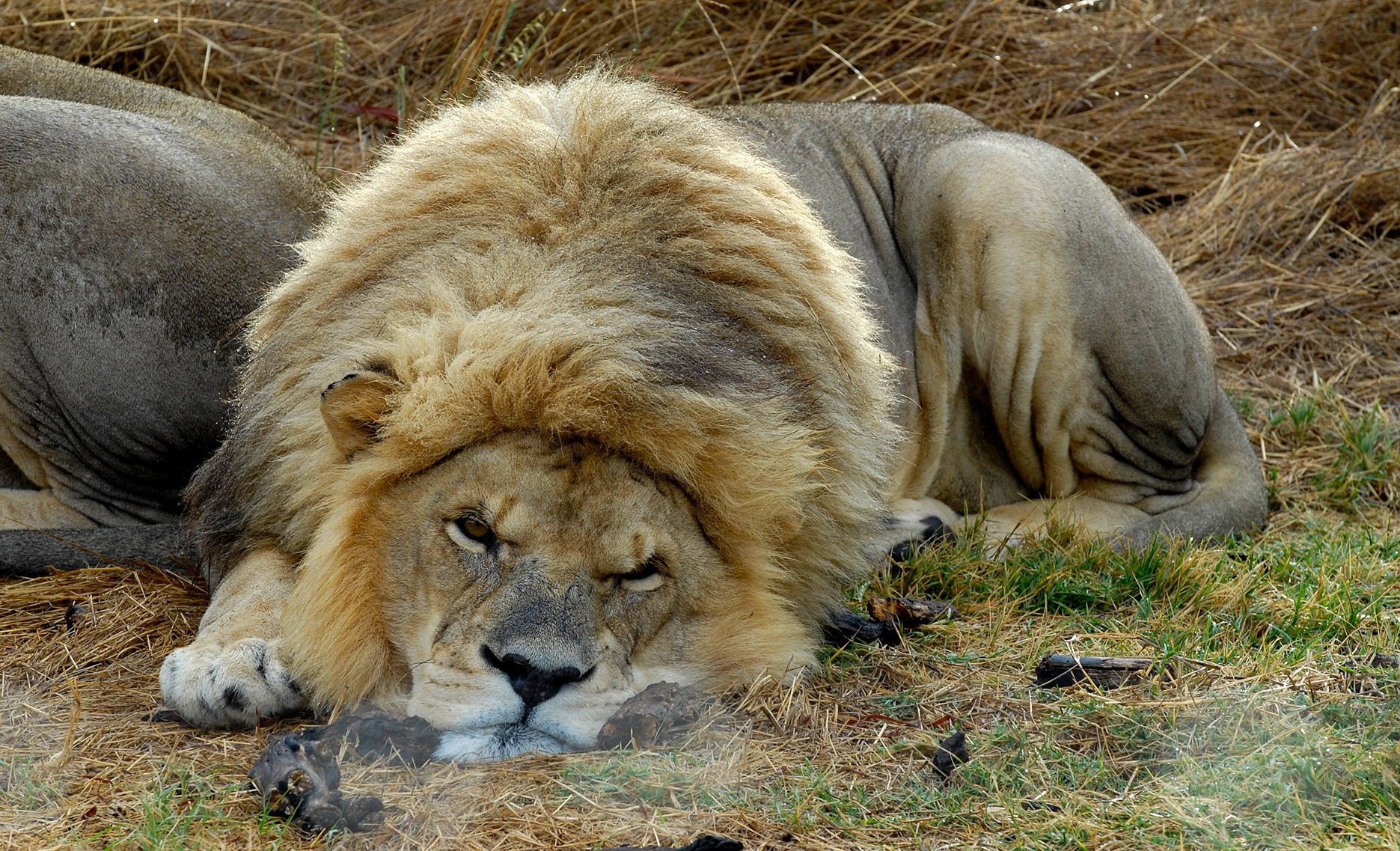
 Moves to phase out South Africa’s captive lion industry have drawn unanimous provincial support. (Photo: Don Pinnock)
 /file/dailymaverick/wp-content/uploads/2025/10/label-analysis-2.jpg)
South Africa’s wildlife politics has entered a new and potentially volatile phase, and a clash seems inevitable.
Just weeks after Dion George was replaced as environment minister by Willie Aucamp, approval of a parliamentary committee report was moving decisively to implement long-planned reforms to phase out the captive lion industry. The timing is striking — and politically loaded.
The report, adopted by a select committee of the National Council of Provinces and just published, approves amendments to the Threatened or Protected Species (Tops) regulations, which require consideration of the wellbeing of listed species in decisions regarding them, and prohibit certain activities involving African lions.
Crucially, all provinces agreed with the tabled report. That unanimity may now complicate any attempt to stall or dilute the reforms at the executive level.
A change at the top
Earlier this year, George — widely regarded as more reform-oriented on wildlife governance — was removed from office in a move that triggered sharp debate within conservation and political circles. It was widely suggested that pressure from wildlife breeders and hunting interests played a role in his departure.
His replacement, Willie Aucamp, has known links to sectors of the wildlife industry. Almost immediately, speculation mounted that the new minister might seek to recalibrate — or roll back — aspects of wildlife reform.
/file/attachments/orphans/Solar2WillieAucampimageSharonSeretlo_205071.jpg "Forestry, Fisheries and Environment Minister Willie Aucamp. (Photo: Gallo Images / Sharon Seretlo)")
An early signal appeared in the reissuing of hunting quotas for elephants, black rhinos and leopards, reopening familiar fault lines over the lack of the required science, governance and ethics of consumptive wildlife use. This suggests an industry-aligned posture; supporters framed it as pragmatic wildlife management grounded in population data. Against that backdrop, the approval of wellbeing requirements and lion regulations lands with particular force.
The wellbeing question
The inclusion of wellbeing considerations now aligns with the National Environmental Management: Biodiversity Act (Nemba), where wellbeing is defined as “the holistic circumstances and conditions of an animal, which are conducive to its physical, physiological and mental health and quality of life, including the ability to cope with its environment”.
This definition is being contested in court by the wildlife breeding industry.
/file/attachments/orphans/Therearebetewwn8000and12000lionsincaptivebreedingsitesinSouthAfricaDonPinnock_795364.jpg "There are betewwn 8,000 and 12,000 lions in captive breeding sites in South Africa. (Photo: Don Pinnock)")
The lion question
At the heart of the report is the Draft Lion Prohibition Notice, which was developed under Nemba.
It focuses on prohibiting certain restricted activities involving African lions, specifically the establishment and registration of new captive breeding facilities, commercial exhibition facilities or rehabilitation facilities, except bona fide sanctuaries.
The committee deliberations make clear that the broader intention is to facilitate the phasing out of the captive lion industry.
For years, South Africa has faced global criticism over captive lion breeding — particularly practices linked to canned hunting, cub petting tourism and the export of lion skeletons. Successive policy processes, including the high-level panel on wildlife, lion breeding, hunting and trade, pointed toward closure or radical restructuring of the sector.
The newly tabled report does not retreat from that trajectory. Instead, it advances it.
/file/dailymaverick/wp-content/uploads/2025/07/FourCorners-133.jpg "South Africa has faced global criticism over the export of lion skeletons. (Photo: Blood Lions)")
A rare alignment
Perhaps the most politically significant detail in the report is that the Free State, Gauteng, KwaZulu-Natal, Limpopo and Mpumalanga all signalled agreement. No province formally rejected the proposals.
In South African environmental politics, such alignment is rare. Wildlife policy often fractures along provincial lines, with economic dependence on hunting and breeding shaping divergent positions.
The fact that provinces agreed gives the reform package institutional weight. It transforms the lion prohibition from a contested executive initiative into a measure carrying provincial endorsement through the parliamentary process.
If Aucamp intends to block or reshape the reforms, he will now be doing so against a formally adopted committee recommendation backed by provinces.
The committee process was aware of the implications of a phase-out. Members pressed the Department of Forestry, Fisheries and the Environment on timelines, economic impacts, job losses and revenue implications. They questioned whether other departments — labour, small business and trade — had been consulted. They asked what contingency plans were in place to prevent illegal activity if facilities closed.
The captive lion sector, however controversial, provides limited but low-quality employment in rural areas — around 2,000 jobs. Its dismantling requires economic transition planning. Without it, reform risks fuelling resentment or driving some actors underground.
Committee members also queried enforcement capacity: how compliance would be monitored in rural and cross-border areas; how ports of entry would be managed; and who would ultimately be responsible for implementation. These questions may shape Aucamp’s response.
The minister’s dilemma
Willie Aucamp now occupies an uncomfortable position. If he supports the reforms, he signals continuity with the policy trajectory established before his appointment, potentially disappointing elements of the wildlife industry that viewed his arrival as a reset.
If he seeks to slow, amend or dilute the captive lion phase-out, he risks appearing to undermine a parliamentary process that has already secured provincial agreement. He would also invite renewed scrutiny from civil society, conservation scientists and international observers.
His early move on hunting quotas suggests a willingness to reassert a more traditional wildlife management frame. But lions are politically different. The captive breeding issue has become a reputational flashpoint for South Africa internationally.
The coming weeks may reveal whether Aucamp opts for procedural delay, technical amendment, or outright endorsement.
At stake is the balance between consumptive use — including trophy hunting and breeding — and non-consumptive, conservation-oriented models rooted in ecosystem integrity and ethical tourism branding.
The reissuing of quotas for elephants, black rhinos and leopards reopened debates about decision-making processes. The lion prohibition now intersects with that same governance terrain. What makes this moment different is the institutional pathway the lion reforms have taken. They have passed through parliamentary scrutiny, public consultation, intergovernmental engagement and provincial consideration. That architecture makes reversal harder — though not impossible.
Now what?
Formally, the committee has recommended approval of the Tops amendments and the Draft Lion Notice. The regulations move forward within the framework of constitutional oversight.
Politically, however, the story is just beginning. Will Aucamp embrace the reforms as part of a coherent wildlife strategy, pairing them with structured transition support for affected communities? Or will he attempt to reinterpret their scope through implementation guidelines, enforcement priorities or subsequent regulatory adjustments?
Observers will be watching not only for formal statements but for signals embedded in timelines, budget allocations and enforcement directives.
South Africa’s wildlife sector is at a crossroads. On the one hand, Parliament has placed a clear marker: the planned phase-out of the captive lion industry remains on track, endorsed by provinces and advanced through committee recommendation. If Aucamp intends to alter that trajectory, on the other hand, he will have to do so in full view of a legislative process that has already spoken. DM