



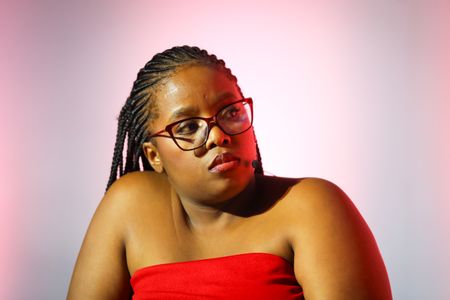
 National Director of Public Prosecutions, Advocate Shamila Batohi, testifies at the Parliamentary Ad Hoc Committee inquiry into alleged corruption and political interference in the criminal justice system at Good Hope Chambers on 11 November 2025 in Cape Town. The inquiry was set up to probe political interference, leadership failures and internal dysfunction in the SAPS. (Photo: Gallo Images / Brenton Geach)
 Prior to stepping down, outgoing National Director of Public Prosecutions (NDPP) Shamila Batohi has apologised for the way she handled herself after walking out of the Nkabinde Inquiry last year.
Her conduct then raised eyebrows, particularly as it was at her insistence that President Cyril Ramaphosa appointed the panel, headed by Judge Bess Nkabinde, to hear evidence into Gauteng NPA head advocate Andrew Chauke’s fitness to hold office.
Read more: President extends Nkabinde Inquiry as former KZN prosecutor opts to testify for Chauke
Chauke is accused of politically interfering in the institution of racketeering charges against the former KwaZulu-Natal head of the Directorate for Priority Crimes Investigation Johan Booysen and the Cato Manor Unit in 2012.
“I could perhaps have dealt with it differently, but I would like the people of this country to understand that we are all human and sometimes you perhaps don’t have the time to reflect through things and to properly decide what’s best. It was something that happened very quickly...”
The decision, which she now concedes was ill-informed, is one she does not regret, Batohi told journalists on Friday, 30 January in Pretoria, during her final media briefing ahead of her retirement.
“I don’t regret the decision. I think it’s going to help move forward, but yes, with hindsight, to the extent that I may need to apologise to the people of this country for having acted in that way. Please forgive me,” Batohi said.
NDPP ‘powerful without power’
Batohi painted a bleak picture of an institution constrained by structural weaknesses, saying the National Prosecuting Authority (NPA) continues to battle entrenched challenges, with a lack of operational and financial independence at the top of the list.
“The NPA is the only entity in the criminal justice family, where the head of the NPA, or the head of the entity, is not the accounting officer of the entity,” said Batohi.
She conceded that the national director’s position is one of a powerful person who is without any power.
According to Batohi, the NDPP cannot determine their own budget, control spending, set salaries, or decide who to hire and fire, which is why the accounting officer question remains critical.
“This has been a battle that’s been fought for the past 20 years,” she said.
The second challenge relates to salary dispensation. Batohi said entities such as the Special Investigative Unit (SIU) can offer higher salaries to attract specialised skills, something the NPA is unable to do.
“In the NPA we are restricted by public service salary rates, and we find that we are becoming a revolving wheel, where we train, we skill, and people then move either to other parts of government, where the salary options are better, or even outside, to the private sector. And so unless you deal with the salary issue, we are constantly going to be training people for elsewhere, and we will not be able to fight this fight against corruption, particularly because it requires very specialised skill,” Batohi said.
The third challenge, she added, has been ensuring that the NPA has the capacity and capabilities to deal with corruption, including having properly trained financial investigators and specialists such as data analysts.
“That it is an institution that has been rebuilt, that it is an institution of integrity, I would say it’s a big success… the NPA of today is not the NPA of seven years ago” — Batohi
The NPA now
When Batohi took office seven years ago, she openly lamented the dire state of the NPA. This was also reflected in the NPA’s 2024 annual report, where she said she had inherited an institution emerging from “a decade of grand corruption perpetrated during the State Capture era” and conceded that she could not have fully anticipated the scale of the challenges ahead.
Asked whether she had been able to turn things around, Batohi said this depended on various factors and on the lens through which one looked at the NPA.
“If that better position is that there haven’t been any State Capture and other high-profile related corruption matters that have gone from enrolment through to finalisation of the trial, then yes, I agree the NPA is not in a better position. And sadly, that is what is driving public sentiment and public assessment of the NPA,” she said.
“But if you ask me whether the NPA is in a better place because it is a stronger institution. That it is an institution that has been rebuilt, that it is an institution of integrity, I would say it’s a big success… the NPA of today is not the NPA of seven years ago,” Batohi said.
Throughout her tenure, Batohi faced criticism for failing to secure prosecutions in major State Capture matters, particularly involving the Gupta brothers, whom South Africa (SA) failed to extradite from the United Arab Emirates after a Dubai court rejected the country’s request on technical grounds, including problems with arrest warrants and jurisdiction, with authorities only learning of the outcome months later – a delay that effectively allowed the brothers to avoid being brought back to face charges.
Batohi said the criticism was justified, and revealed that SA would soon make another application to bring the Gupta brothers back to the country to face the law.
“There will be another extradition application. I was hoping it would happen in my term, but sadly not. Hopefully it will not be too long when that happens with more charges,” she said.
This comes against the backdrop of a Constitutional Court decision on Friday, which dismissed a series of appeals by the Gupta family and Iqbal Sharma against an earlier Supreme Court of Appeal ruling that the controversial Nulane Gupta-linked corruption case be retried.
The case relates to allegations of fraud and money-laundering around a R24.9-million contract awarded to Nulane Investments, a company linked to Sharma and associated with the Gupta network, for a feasibility study in the Free State.
It means the NPA can now re-enrol the case for trial.
High-profile cases
Beyond the Gupta brother’s failed extradition, the NPA has faced a series of failures in prosecuting high-profile State Capture cases.
In June 2025, Batohi faced fresh calls to resign after the NPA was accused of bungling the extradition of Moroadi Cholota, the former personal assistant of corruption-accused former Free State premier Ace Magashule. The Free State Division of the High Court in Bloemfontein ruled that Cholota’s extradition from the US was unlawful and unconstitutional on the grounds that the extradition had been requested by the NPA rather than Justice Minister Mmamoloko Kubayi, Daily Maverick reported.
Other mishaps include its failure to secure a conviction of pastor Timothy Omotoso and the failed extradition of the Gupta brothers in April 2023. (The NPA has since said it will submit another application to have the fugitive brothers extradited to SA).
Ramaphosa has since appointed Advocate Jan Lekgoa “Andy” Mothibi as the new NDPP, with effect from Sunday, 1 February. Mothibi is currently the head of the SIU. DM