



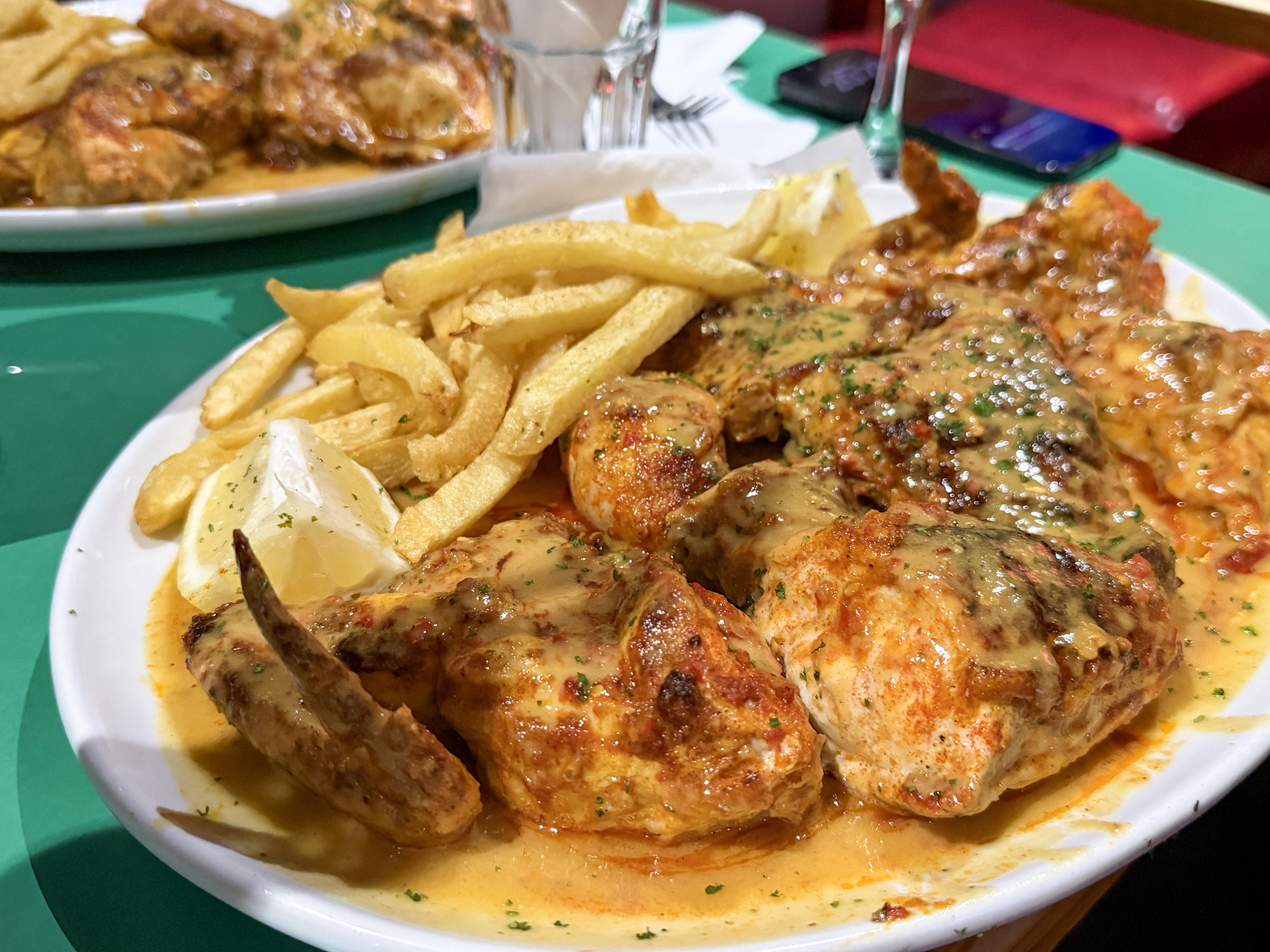
 Peri-Peri chicken at the Tavern of the Seas — a traditional reference to the port of Cape Town. (Photo: Tony Jackman)
Five hundred years – or 501 to be precise – would pass between the moment a descobrimento (discoverer) departed from Lisbon in 1487 and the day in May 1988 that a restaurant named in his honour would open its doors in Cape Town’s Caledon Street.
Bartolomeu Dias and his fellow descobrimentos/discoverers (as the Portuguese term what we call explorers) sailed from the Terreiro do Paço in Lisbon in three tiny caravels in August 1487, charged with finding a sea route to India via the tip of Africa.
/file/dailymaverick/wp-content/uploads/2023/11/paco1.jpg "Terreiro do Paço with its 1775 statue of King Dom José I, who briefed prime minister Marquês de Pombal to rebuild Lisbon after the terrible earthquake of that year. Terreiro do Paço is one of the largest squares in Europe and used to be the site of the palaces of the country’s kings. (Photo: Tony Jackman)")
Dias couldn’t have known that centuries later his name would be beloved of Capetonians. Not for his endeavours on behalf of the “perfect prince”, King João II, but because, since 1988, the name of one of their discoverers has graced a restaurant in central Cape Town that is still thriving 38 years later, in 2026.
Dias Tavern.
Along the way, in the first half of the 19th century, a new sport was invented in the land of other former explorers, in Rugby, England. Rugby, of course. And the Dias Tavern founders were all about rugby, as well as their national cuisine.
So if the place feels a bit like home, and (like me) you’re not Portuguese, that’s because it has a familial feel by dint of how and why it came into existence. Which is why the other thing it feels a bit like is a rugby club.
It’s explained succinctly on the Dias Tavern website:
“When Sam Perreira and partners opened our doors in May 1988, we traded as Bartholomew Dias Tavern. The stakeholders, all children of Portuguese immigrants, grew up in the food trade and wanted to expand their passion for Portuguese cuisine to the community. At the time, they all represented Portugal in the International Football Association, IFA, and the restaurant was built with the support of the players, families and friends.
“Today, you still see the current owners, Dan Faias and Joe Hilario, on site and sense their passion for the business, customers and wholesome food. The menu consists of traditional Portuguese cuisine, as well as local South African flavours with a Portuguese twist. To this day, the grandparents, parents and children of the IFA players frequent our venues for great food and a sense of família and casa.”
And that’s exactly how it felt one evening this week when a friend took us there for dinner. And how it felt twice last winter when I was there for lunch with friends. I’m sure it’s how it always feels there.
And Portuguese – I mean those actually in Portugal – love us, and I can vouch for it. I know this because of rugby.
We were in Cascais, southern Portugal. It was 16 October 2023. And we were in the John Bull pub in Cascais, drinking Portuguese beers and surrounded by locals speaking their own language.
But their own language was peppered with names we recognised. Eben Etzebeth. Faf de Klerk. Kurt-Lee Arendse. Okay, more like Etshbetsh, Fafsh and Arendsh.
When I returned home, I wrote the following:
“We’re back in Cascais. And we need to see the rugby. It’s the night of That Quarterfinal about which our very fine sports writer Craig Ray wrote so wonderfully here. And where else to watch South Africa play France in Portugal than in a British-themed pub called the John Bull in Cascais?
“I’ve never seen more exciting rugby in my life. It was a miracle that no one in the room had a heart attack. The pub was full of locals, and to a man, woman and teenage son they were yelling in support of the Bokke. Leaping up to hug one another when the final minute was up. Somebody even hugged me. It was as if they were their own team. It was beautiful, and I admit to having wept tears wet with pride.”
So I know how the Portuguese feel about rugby.
And food. So, this is the thing: if food is made with the same kind of passion that a rugby match is played, is it not arguably the best kind of food to eat, if like me and those John Bull revellers you are passionate about peri-peri chicken, trinchado and espetada?
/file/dailymaverick/wp-content/uploads/2023/11/johnbull.jpg "The John Bull pub in Cascais, ready for the game. (Photo: Tony Jackman)")
Not that these things are all from Portugal itself. Espetada is from Madeira. Peri-peri is from Mozambique, although it lingered long in South Africa before finding its way to everywhere else that you find the Portuguese in this world.
But if you want perfect peri-peri chicken, the kind of peri-peri chicken that is made with the passion of a rugby-bedonnered chef who loves his family and lives life large, Dias Tavern is where to find it.
I hadn’t been for years when a friend took me there twice last winter, a man who has been going there regularly almost for as long as Dias Tavern has been there. And I had to have the peri-peri chicken, he said with authority and a certain kind of insistence with which one is not likely to disagree, so I did.
And when he invited me again, I didn’t hesitate, and ordered it once more.
This week, I decided I needed to change direction, having had it on both previous visits. So I ordered the “Espetada Grande” (beef) instead. Basically a plate of Eben Etzebeth.
Now, Plate Envy is a thing. Other Person’s Plate Envy. It’s not that the espetada wasn’t tender and delicious. It was. But there was just one little problem with it.
It wasn’t peri-peri chicken.
/file/dailymaverick/wp-content/uploads/louis-espetada-LARGE-best.jpg "Espetada on the coals as prepared by the writer, (Photo: Louis Pieterse)")
And when you’re in the true home of peri-peri chicken (outside of a Mozambican restaurante where it is more likely to be listed as piri-piri on the menu), it’s a pity to order something – anything – else.
Those who insist that good food must be eaten in a fancy-schmancy restaurant that might be eligible for those meaningless restaurant awards that people pay far too much attention to really are missing out.
There are posher prego and peri-peri palaces. But I’m happy with rustic and unpretentious. It would be a travesty if a new generation came along and zhooshed the place up. It happens.
Who cares about simple tables and chairs when you have this view?:
/file/attachments/2987/mountain-new_329126.jpg "Table Mountain is a good reason to choose a seat facing a window when at Dias Tavern. (Photo: Tony Jackman)")
Before the other two people were served their whole peri-peri chickens (I still haven’t got over it), our friend and I both had starter portions of Sardinhas Portuguesa (sardines), which I insisted on pronouncing shardeenyash because I reckoned it sounded more authentic.
So now I have made two notes to myself. The first is:
Whenever you go to Dias Tavern, start with the shardeenyash. There were three and they were just wonderful. Served on a crunchy Portuguese roll, with onions, green peppers and plenty of garlic. Maravilhoso! (I looked it up.)
/file/attachments/2987/sardines_653624.jpg "Sardinhas Portuguesa at Dias Tavern. Maravilhoso! (Photo: Tony Jackman)")
Then two large plates packed edge-to-edge with portions of a whole peri-peri chicken and slathered with peri-peri sauce arrived and were put in front of the wrong people. It was called “baby” in the way that Baby Huey is called baby.
I spent 45 minutes enjoying (yes, I did enjoy it) what I had ordered, but by now my pallour was turning from emerald to sea green, which is why my second note to myself is:
Get a grip, Jackman. You came for the porra de frango (f****n chicken).
I reminisced, over my espetada and my sidelong glances at their chicken, about the Terreiro do Paço in Lisbon, where the city meets the Tejo (Tagus) river, the most exhilarating spot on the planet that I have visited. I wrote about it here. I get chills just remembering the moment.
We also had a discussion about that beautiful, deeply meaningful Portuguese word, saudade. More than a word, even more than a concept or emotion, it holds such deeply melancholic meaning that it deserves to have its own etymological category.
/file/attachments/2987/teju_406853.jpg "Seagulls guard the twin pillars through which ancient discoverers sailed their tiny caravels to discover ‘new’ worlds, at the Terreiro do Paço in Lisbon. (Photo: Tony Jackman)")
It has been called “a feeling of incompleteness”. Far more soul-diminishing than mere homesickness. Afrikaans has two useful alternatives: weemoed, and swaarmoedigheid.
My mate and I tried to come up with the best translations. I ventured: inconsolable. He countered: dronkverdriet! (Loosely: drunk’s remorse.)
We liked both, so there you have it: saudade is now officially translated as “inconsolable dronkverdriet”, the latter being Afrikaans for how you feel after much more wine than we had had.
But saudade: that’s what you start to feel when first you are not served what the other guys at the table are having. Then you go home and have disturbing dreams about it and, when you wake up, there it is.
Saudade. DM
This is the first in a monthly series in which I’ll be revisiting the old Cape restaurants.
The meal and wine were paid for in full by our friend.