




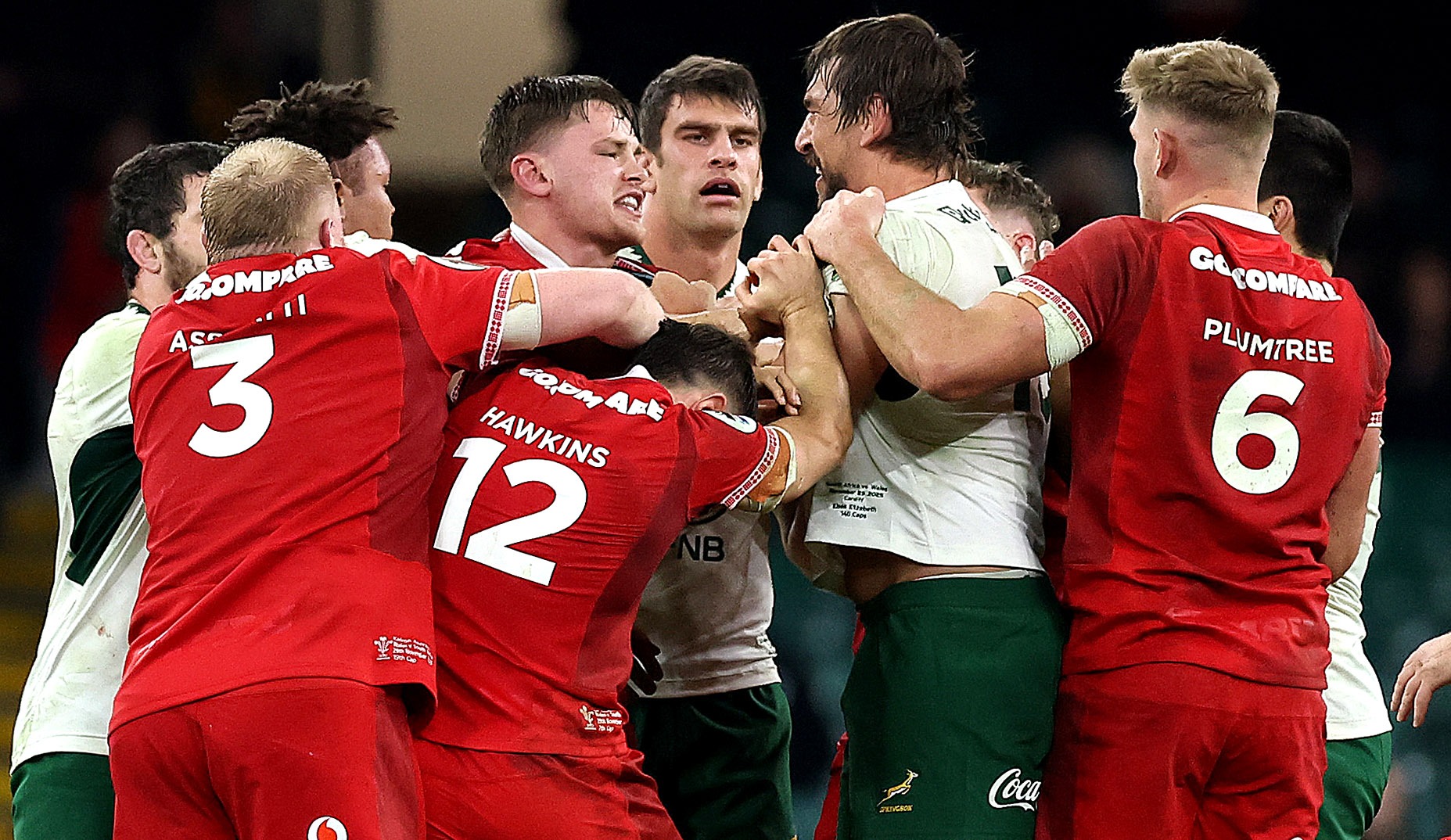
 Springbok lock Eben Etzebeth (centre) has been suspended for 12 matches for eye-gouging Wales' Alex Mann. (Photo: David Rogers / Getty Images)
 Some South Africans think that World Rugby’s judicial processes are biased against Springbok players, yet Eben Etzebeth has escaped with a light 12-match ban for eye-gouging Wales flanker Alex Mann.
/file/attachments/orphans/2249043645_366495.jpg "Referee Luc Ramos talks to Eben Etzebeth after showing him a red card against Wales at Principality Stadium on 29 November in Cardiff, Wales. (Photo: David Rogers / Getty Images)")
The incident took place in the 78th minute of last weekend’s Test in Cardiff, which the Springboks won 73-0, and Etzebeth received an on-field red card.
Eye gouging is one of rugby’s biggest crimes, and there have been several cases where players have received 24-week bans and more.
Etzebeth’s ban runs from 29 November 2025 to 28 March 2026.
More surprisingly, All Black great Ardie Savea provided a character testimonial in support of Etzebeth as part of the submissions to the disciplinary panel. Mann did not take part in person.
The independent disciplinary panel that heard Etzebeth’s case on 2 December decided the offence met the “mid-range” threshold after Etzebeth admitted it was “reckless” but not “intentional”.
“I did not, at any stage, aim for his eyes or intend to make contact with his eye,” Etzebeth said in a statement submitted to the independent disciplinary committee.
The committee disagreed and concluded that Etzebeth’s action was intentional. They found him guilty of a mid-range offence, which usually comes with an 18-week suspension.
The committee, chaired by Christopher Quinlan KC and including former England internationals Leon Lloyd and Becky Essex, reduced the sanction by six weeks due to Etzebeth’s good record and “some mitigating factors”.
/file/attachments/orphans/2249158719_356821.jpg "A view on the stadium big screen showing Eben Etzebeth gouging the eye of Wales flank Alex Mann. (Photo: Dan Mullan / Getty Images)")
Mitigation
Etzebeth’s position was that his act was reckless: he said he aimed for Mann’s shoulder, his hand then moved up in a dynamic situation, and he did not intend to target the eye or even realise he had done so at the time.
Etzebeth admitted it was foul play that merited a red card but stated it was not intentional, saying, “I did not, at any stage, aim for his eyes or intend to make contact with his eye.”
The referee, by contrast, described it as “intentional contact with the eye” in his report. The committee was required to choose a factual basis because different sub‑categories under Law 9.12 (intentional, reckless, eye vs eye area) carry different starting points.
“Law 9.12 may be breached in different ways, providing different entry or starting points depending upon the way in which the law is breached,” the disciplinary committee’s report states.
“For example, contact with the eyes is different (and more serious) than contact with the eye area (though the sanction ranges, to some extent, overlap).
“Intentional contact with the eyes is more serious (in general terms) than reckless contact, though again there is some overlap in the appropriate starting points).
“Therefore, it was important for us to decide the factual basis for the offence. The referee opined it was intentional. The Player said it was reckless.”
/file/attachments/2985/unnamed_444754_242ab7511aef2aac6314dfc838f1d90a.png "Some of rugby’s longest bans for foul play. (Graphic: Craig Ray).")
The panel explained the difference by anchoring their conclusion in the footage rather than in Etzebeth’s or the referee’s labels.
They found Etzebeth was looking directly at Mann’s face, with a clear line of sight, and “cannot have failed to have appreciated” what he was doing when his thumb went into the eye and stayed there for about a second.
They rejected the idea that movement from other players forced Etzebeth’s hand into the eye, saying there was nothing extraneous that caused that movement and that Mann’s own arm did not move his hand onto the face.
They noted that the eye contact was followed by further pushing into Mann’s face, as part of the same, sustained incident.
On that basis, the panel concluded the conduct was an intentional targeting of the face and eye, not merely a reckless risk‑taking action.
But the panel accepted that Etzebeth's overall behaviour was a spontaneous overreaction in a heated moment rather than premeditated.
Read more: Etzebeth’s moment of madness undermines Boks’ record-breaking performance against Wales
Reduction factors
Several factors led to the sanction being reduced from 18 to 12 matches. It could have been reduced by a further three matches, but Etzebeth’s rigid stance that it was reckless rather than intentional, and therefore a partial admission of guilt, meant he was not entitled to the full “discount”.
It was a denial of full culpability and went “to the heart of the foul play”. The panel viewed his approach as contrasted with a player who accepts full factual responsibility, who would be entitled to a greater discount.
They still reduced the sentence based on the following factors:
- Partial acknowledgement of foul play: Etzebeth admitted foul play and that it warranted a red card.
- Disciplinary record: The “unchallenged evidence” was that he has never received a red card.
- Remorse: Etzebeth apologised to Mann after the match.
- Character evidence: A character testimonial from All Blacks flank Ardie Savea was also given appropriate weight.
- Provocation/retaliation: There was a “degree of provocation”, and the panel believed Etzebeth “retaliated to the pulling of his shirt, in the context of what had occurred before”. DM
The 12 games Etzebeth will miss
- 7 Dec 2025, Toulouse vs Sharks Champions Cup;
- 13 Dec 2025, Sharks vs Saracens Champions Cup;
- 20 Dec 2025, Sharks vs Bulls URC;
- 3 Jan 2026, Lions vs Sharks URC;
- 10 Jan 2026, Sale Sharks vs Sharks Champions Cup;
- 17 Jan 2026, Sharks vs Clermont Champions Cup;
- 24 Jan 2026, Stormers vs Sharks URC;
- 31 Jan 2026, Sharks vs Stormers URC;
- 21 Feb 2026, Sharks v Lions URC,
- 28 Feb 2026, Bulls vs Sharks URC;
- 21 March 2026; Sharks vs Munster URC; and
- 27 March 2026, Sharks vs Cardiff URC.