




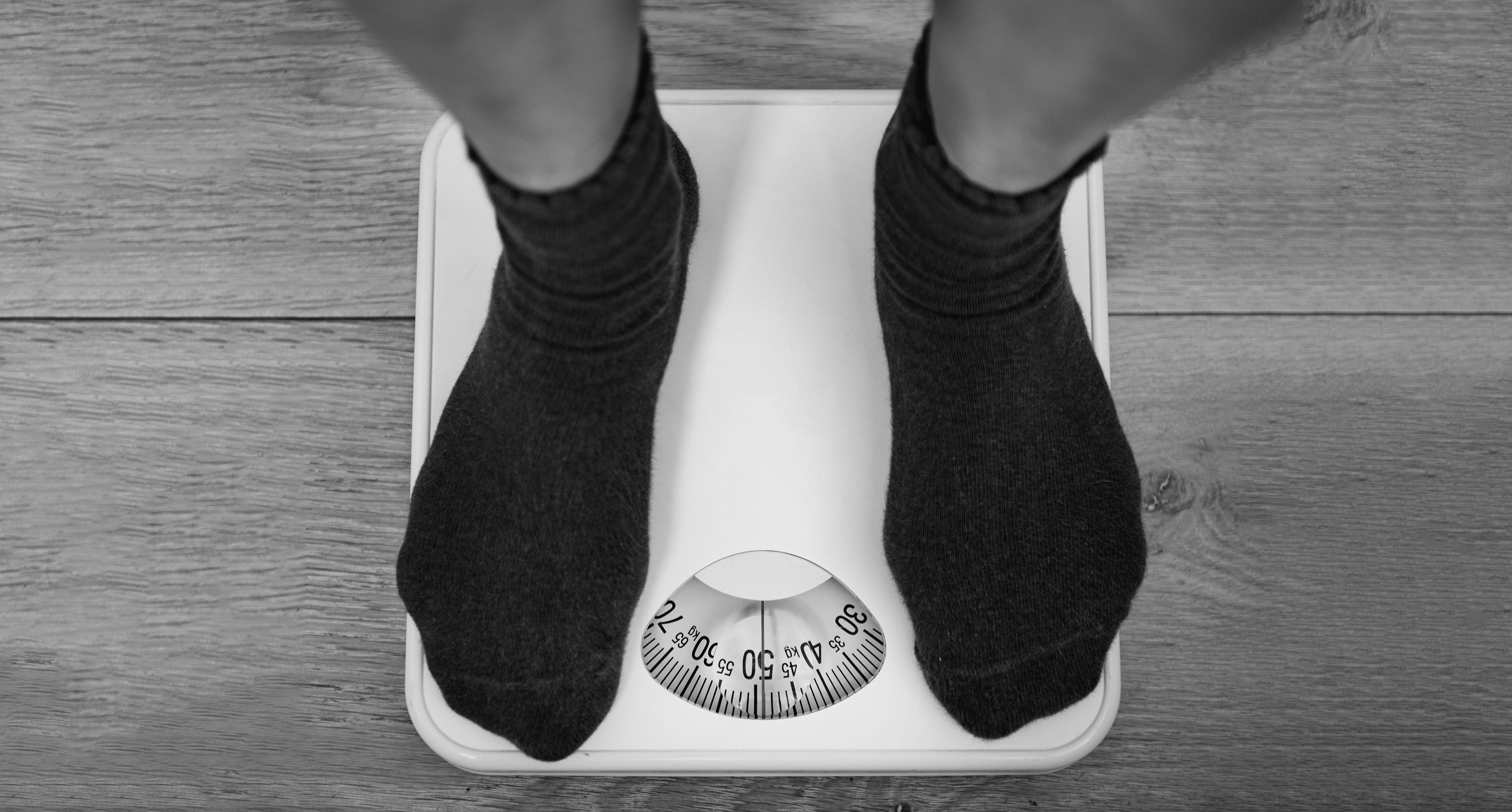
 Person on a weight scale. (Image: Freepik)
 Obesity has become one of South Africa’s most expensive health problems. Between 1998 and 2017, the prevalence of obesity in the country rose by 38%, leaving close to 11 million adults living with the condition, a number that’s still climbing.
The financial impact is massive. In 2020, overweight and obesity cost South Africa an estimated R33-billion, nearly 16% of government health spending, according to the South African Metabolic Medicine and Surgery Society (SAMMSS).
In the private sector, medical schemes bore an additional R21.8-billion cost because of obesity in 2022, according to the Discovery Health Vitality ObeCity Index.
Despite this economic burden, health funders do not consistently treat obesity as a chronic disease.
Medical schemes under pressure
Obesity threatens the funding model of medical schemes, which relies on a balance between healthy and sick members, by pushing more people toward high-cost, long-term chronic conditions.
Bariatric surgeon Dr Thinus Smit warned that within a decade, more than 50% of new fund members could be living with obesity, rendering the subsidy model — where healthy members support the sick — “no longer viable”.
Medical schemes remain cautious, funding downstream complications like diabetes and heart disease, but are generally unwilling to pay for direct obesity treatments.
Read more: The way we understand obesity is changing — What does it mean for SA?
“The single biggest barrier to upscaling the treatment of obesity in South Africa is the fact that funders (both public and private) are slow to understand the evidence-based health economics — the personal benefit to the patient and the financial benefit to the funder when obesity is treated before complications and the multitude of obesity associated comorbidities develop,” said Dr Jeanne Lubbe, head of upper gastrointestinal and metabolic surgery at Tygerberg Hospital.
This reluctance stems partly from outdated views of obesity as a lifestyle choice, not a complex, biologically driven disease. Smit said that schemes are constrained by legacy budgeting, as obesity treatment is relatively “newer” and funds are historically earmarked for established costs like heart disease.
Bariatric surgery and limited cover
Metabolic bariatric surgery, which alters the digestive system to limit food intake and change hunger hormones, is widely recognised as the most effective long-term treatment for obesity, leading to sustained weight loss and improved obesity-related diseases.
Read more: Rates of obesity are soaring worldwide: Have we been misunderstanding the problem?
Even so, access to this surgery remains limited.
Discovery Health Medical Scheme (DHMS), along with a few other funds, including Gems, Polmed, Bankmed, Barloworld, Libcare and Netcare, will consider bariatric surgery claims.
DHMS’s approval is subject to strict clinical criteria and multidisciplinary assessments. Funding is capped at R200,000 a year with c0-payments, leaving many patients to cover a significant balance.
For many, that gap is insurmountable. Smit reported that in his practice, approximately 80% of patients who qualified abandoned the path to surgery because they could not afford the cost. “We have probably treated about 8,000 or 9,000 people in the last 30 years, as far as bariatric surgery is concerned. That’s not even a drop in the bucket,” he said.
DHMS funded 430 bariatric surgeries between January 2024 and October 2025. Dr Noluthando Nematswerani, the chief clinical officer at Discovery Health, noted that while the immediate cost of surgery exceeds short-term savings, the scheme observed a decrease in members claiming medication for hypertension and diabetes two years post-surgery.
/file/dailymaverick/wp-content/uploads/2024/05/Dr-Noluthando-Nematswerani.jpg "Discovery’s chief clinical officer, Dr Noluthando Nematswerani. (Photo: Discovery Health)")
In the public sector, capacity is even scarcer. Only a handful of public hospitals, such as Tygerberg and George Mukhari, offer the surgery.
“At Tygerberg Hospital, we do a high-volume monthly metabolic surgery list, and at SMU [Sefako Makgatho University] a two-weekly high-volume list,” said Lubbe. “This is not nearly enough procedures to service the need in South Africa, where 70% of females and 40% of males are overweight or struggle with obesity.”
New drugs, old funding problems
New anti-obesity medicines, like GLP-1 drugs such as semaglutide (think Ozempic and Wegovy) and tirzepatide (think Mounjaro), offer substantial weight loss without surgery but are expensive and require lifelong use.
“If you are on tirzepatide (such as Mounjaro), you are going to be on it for 12 or 13 months, then you will have spent what you would have spent for one [bariatric] operation, and you are [likely] to stay on that medication for life,” said Smit.
/file/dailymaverick/wp-content/uploads/2024/11/GettyImages-2076693323.jpg "Anti-obesity medicines like Ozempic are expensive and require lifelong use. (Photo: Jose Sarmento Matos / Bloomberg via Getty Images)")
Dr Marli Conradie, head of endocrinology at Stellenbosch University and Tygerberg Academic Hospital, observes the impact of cost in the public sector. “I don’t think I’m seeing the same trend as what happens in private healthcare because people don’t have funds, and people definitely can not afford GLP-1 treatment. I see a trend in patients being more aware and asking questions, but not requesting treatment.”
Medical schemes like Discovery fund these medications from members’ medical savings accounts when prescribed for obesity. That effectively restricts access to those who can afford out-of-pocket payments.
“Significant price reductions will be required for these drugs to be considered for cover,” said Nematswerani, adding that Discovery was actively exploring affordable models and engaging with pharmaceutical companies.
Smit said that the long-term use of anti-obesity drugs was far more expensive than bariatric surgery for gaining a year of healthy life.
/file/attachments/2986/Obesityinfographic_489156_114a3b33053797a272502171efe1fb68.png "This infographic was made using NotebookLM and data and information from the Clinical Practical Guideline for the Management of Obesity in Adults in South Africa and the Department of Health’s Strategy for the Prevention and Management of Obesity in South Africa.")
Stigma inside the system
Funding decisions are also influenced by stigma. Public health strategies that focus on obesity as an issue of unhealthy eating and physical inactivity, ignoring biological and environmental causes, “can contribute to the oversimplification of the disease and to a lack of public understanding of it”, according to clinical practice guidelines from the SAMMSS.
This oversimplification leads to “inaccurate social narratives that obesity is a self-inflicted choice”. Smit recalled how medical schemes have long dismissed obesity as a “lifestyle issue” or a “cosmetic problem,” rejecting requests to pay for surgery.
Read more: How we diagnose and define obesity is set to change – here’s why, and what it means for treatment
South Africa’s first clinical practice guidelines for adult obesity, published by the SAMMSS in November 2025, are a step toward changing that narrative.
“This is the first time we have a formal researched document,” said Smit. “We now have a formal document that we can take to funders, we can take it to the government, we can say: ‘This is the standard of care.’”
Conradie confirmed that the guidelines had been drawn up in conjunction with the government sector. “A lot of education has to be done, and the conversations are only really starting around access to treatment,” she said.
“We can only cross that bridge when we are all talking the same language. One has to first frame it as a chronic disease, and then you can start framing access to treatment.”
These new guidelines, as highlighted by Lubbe, will help combat the stigma that obesity is an individual’s fault by emphasising the crucial role of appetite regulation.
A costly delay
Effective treatment is an investment that prevents the spiral of high-cost chronic complications, reducing long-term healthcare expenditure. Smit said that treatment, particularly surgery, leads to significant health improvements and extends life expectancy by an estimated 12 to 15 years.
Early intervention delays or avoids costly procedures later. Smit used the example: “If a patient has a BMI [Body Mass Index] of 50, he is going to have a hip replacement at 50. If you treat his obesity, he is going to have the hip replacement at 70, and the hip replacement will last.”
Conradie believes that the savings are beginning to materialise for providers. “The orthopaedic surgeon will realise that if he does not address the BMI of 60, then the knee replacements for osteo-arthritis are really futile. And that penny is starting to slowly drop,” she said.
Read more: Dragon slayer — Dr Nomathemba Chandiwana battles obesity, ‘SA’s new HIV epidemic’
The National Department of Health’s Strategy for the Prevention and Management of Obesity, running from 2023 to 2028, focuses largely on prevention and healthier environments. While important, prevention alone will not reduce the existing disease burden weighing on the health system.
“Funders, including government, can have massive financial and other resource gains if obesity is recognised as a disease that we can treat very effectively,” said Lubbe.
“Ignoring this fact now will result in financial and resource losses in the coming years when we are forced to deal with the comorbidities and complications of obesity in our patients.”
Bridging the funding gap
Without broader funding for effective treatments, the gap between need and access will continue to widen.
“You can't look at how much you spent last year on bariatric surgery; you have to look at how much obesity is costing you,” Smit said, referring to medical aid schemes.
To address the funding gap, the Obesity Community Fund was created, leveraging Broad-Based Black Economic Empowerment (BBBEE) contributions from corporations to sponsor surgery.
Read more: Obesity in South Africa — experts explain how inequality is driving the surge
Smit explained that this unique model allows corporate donations to count toward BBBEE compliance, either as socioeconomic development (sponsoring a patient) or skills development (training a surgeon). The fund also encourages a stokvel-like model for patients’ contributions to fund themselves.
“The hope is that, over time, 10,000 people a year can be helped by this fund if there are enough members,” said Smit. “Our goal is to help 10 people in the first year, and we’ve done eight so far.”
South Africa’s obesity epidemic poses a growing financial risk to both public and private healthcare. While medical schemes currently pay for complications, they have yet to fully embrace the cheaper, long-term solution of paying for obesity treatment itself. DM