




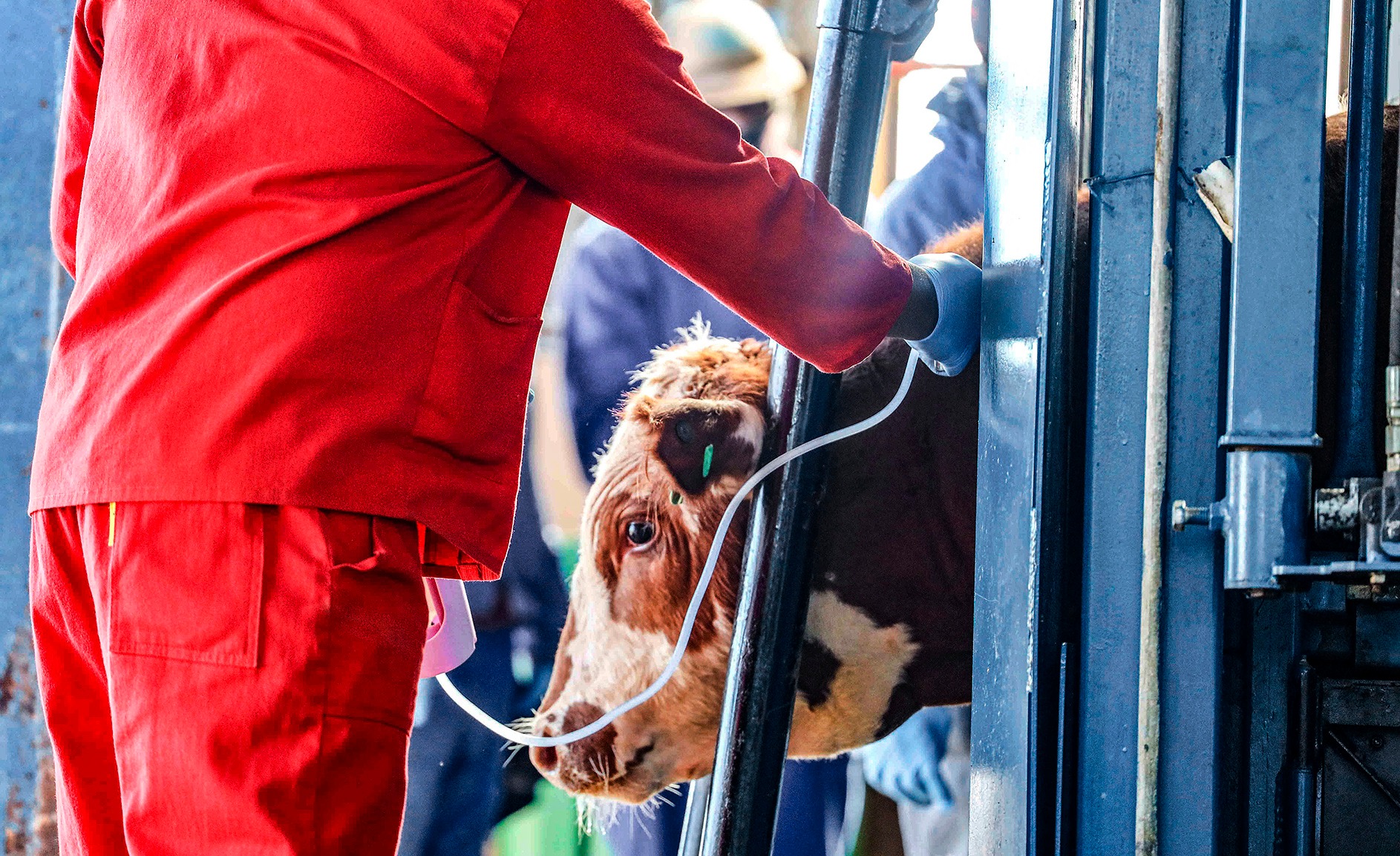
 Cattle are vaccinated at the Karan Beef feedlot in Heidelberg, Gauteng, on 23 June 2025. (Photo: OJ Koloti / Gallo Images)
As South African farmers battle one of the worst foot-and-mouth disease (FMD) outbreaks in years, the financial and emotional strain is deepening across the livestock sector.
“It’s having this huge ripple effect right up and down the value chain,” said Theo Boshoff, the Chief Executive Officer of the Agricultural Business Chamber of SA (Agbiz), describing the widening impact of the outbreak.
Livestock farmers, dairy farmers, small stock farmers (sheep and goats), feedlots, auction houses, abattoirs and agribusiness suppliers are all feeling the strain.
For many farmers, FMD means “your source of income stops very abruptly. You still have expenditure because you still need to feed the animals, but you can’t make any money off of it,” said Boshoff.
On top of that, farmers are having to watch their animals suffer and die.
“You can imagine the huge toll that takes on those who are affected,” said Boshoff, who is a member of the FMD Industry Coordination Council. In its latest update, the council acknowledged that “the situation on the ground continues to escalate”.
/file/attachments/orphans/ED_562021_428425.jpg "Karan beef cattle at the Karan Beef feedlot in Heidelberg, Gauteng, were vaccinated against FMD on 23 June 2025. (Photo: Gallo Images / OJ Koloti)")
The CEO of Red Meat Industry Services, Dewald Olivier, said slaughter numbers dropped by 5% between August and November, while beef exports fell by 26% from June to December. These declines translate into significant losses in foreign income and shrinking market access, with the financial blow felt sharply at farm level and throughout the broader value chain.
Against this backdrop, the government has announced the arrival of urgently needed vaccines aimed at containing the escalating outbreak.
On Tuesday, Agriculture Minister John Steenhuisen announced that the first batch of one million high-potency vaccine doses from Biogénesis Bagó in Argentina was due to arrive in SA this weekend.
This shipment is the first phase of a broader agreement, with a further five million doses set to follow in March.
/file/dailymaverick/wp-content/uploads/2025/07/ED_562029.jpg "Agriculture Minister John Steenhuisen says 14 million cattle will be vaccinated. (Photo: OJ Koloti / Gallo Images)")
“These vaccines are a critical component of the Department of Agriculture’s new strategy against FMD, where the national herd of over 14 million cattle will be proactively vaccinated, to ensure SA transitions to ‘FMD-free status with vaccination’,” said Steenhuisen.
“Our farmers are the providers of our food and the backbone of our economy, bringing essential foreign currency into the country.
“In these tough times, we all need to be working together. Every South African’s support is vital to help our farmers win this war against FMD. By following movement controls and biosecurity protocols, we protect the livelihoods of the entire nation.”
Read more: Farmers take foot-and-mouth disease fight to Steenhuisen as vaccine battle escalates
The CEO of the South African Health Products Regulatory Authority (Sahpra), Dr Boitumelo Semete-Makokotlela, said: “The health of our livestock is critical to SA’s food security, economic stability and the livelihoods of our farmers.”
The escalating outbreak
Before 2019, SA had FMD-free status – the disease was contained within places like the Kruger National Park with wildlife populations, and never reached commercial herds.
That changed in 2019 when SA lost its FMD-free status following an outbreak. The disease was controlled, then broke out again, and was controlled once more.
/file/attachments/orphans/FMD_Corrections_959561.jpg)
“So it kept on growing, but the scale of it kept on building and almost kept on multiplying,” said Boshoff. The Animal Diseases Act had been designed around a “stamp-out methodology” to quarantine infected animals and cull them to prevent the disease from spreading, but this approach proved inadequate as outbreaks multiplied, he said.
By last year, authorities concluded that traditional methods were no longer sufficient.
Western Cape
While frustration has been mounting nationally as the crisis drags on, the Western Cape and other provinces have vaccinated more cattle. On 15 February, Premier Alan Winde oversaw the vaccination of 450 head of cattle in Fisantekraal, Cape Town, as part of what the province described as “a massive drive to vaccinate the entire provincial herd”.
“This vaccination drive is a proactive step to protect cattle in this area,” said Winde. “No cases of FMD have been detected in this Fisantekraal herd. But we are taking every precaution because we want to protect jobs and livelihoods.”
The province expects to receive 200,000 vaccine doses over the coming weeks and plans to vaccinate all high-risk herds, with the Western Cape also requesting permission to procure its own vaccines. Sahpra has also granted Section 21 authorisation for the Dollvet FMD vaccine, meaning that controlled imports of the vaccine, which is not yet registered in SA, will be allowed under strict regulatory oversight.
Semete-Makokotlela said Sahpra would ensure that veterinarians and farmers had “timely access to safe, effective and scientifically approved tools to protect animals against this highly contagious and devastating disease”.
Eastern Cape
The Eastern Cape’s MEC for Rural Development and Agrarian Reform, Nonceba Kontsiwe, said they had received just 2,600 doses of vaccine, while the province had more than three million cattle.
She said more vaccines were expected from Lesotho in March.
“FMD has been declared a [national] disaster because it has caused devastation among farmers, and, as the department, we managed to secure some vaccines, but the quantity is quite small... We are hoping for more in March,” said Kontsiwe.
“We only received 2,600 vaccines, which is a drop in the ocean, but with the controlling measures we have put in place, we hope we will manage the situation even though it’s difficult in the communal lands.”
She said the province required at least 500,000 vaccines.
“We are working to control the movement of animals, as people tend to transport their cattle to different areas, which spreads the disease. This is a worrying situation that needs all of us to work towards a common goal. The Eastern Cape alone has more than three million cattle; if we can get 500,000 vaccines then we can cover most of the affected areas.”
Eastern Cape farmers have raised concerns that the government does not provide food and water for cattle in the requisite 28-day quarantine before they are moved to a different area.
Kontsiwe responded that the government only assists by providing treatment for infected animals.
Boshoff said that beyond vaccine challenges, farmers had to take additional precautionary measures, often at great cost. Many were spending heavily on biosecurity – “things like access control, security, spraying, dipping of your shoes, spraying your car tyres”.
/file/attachments/orphans/FMD21_413864.jpg "A farmer walks through his dairy hub. Between January 2024 and January 2026, more than 90 SA dairy farms reported FMD, with over 210,000 cattle affected. (Photo: Leano Larona)")
Zambia ban
The vaccination drive comes against the backdrop of Zambia’s ban on South African exports, which the government believes will have a limited impact, although there are fears within the farming community that other countries may follow suit.
The Department of Agriculture’s Deputy Director-General, Dipepeneneng Serage, said: “Zambia imports an insignificant volume of agricultural products. Although every agricultural product exported out of SA grows the SA agricultural economy, suspension by Zambia would not really make any significant impact.
“We understood why Zambia arrived at its decision and hope they will review this suspension as soon as we start with the mass vaccination.”
National disaster
Last week, during his State of the Nation Address, President Cyril Ramaphosa declared the FMD outbreak a national disaster.
“While the rest of our agriculture sector is thriving, the cattle industry is today facing one of the worst outbreaks of foot-and-mouth disease our country has ever experienced. This disease is damaging our economy, resulting in export bans, trade restrictions and devastation of herds,” said Ramaphosa.
The FMD Industry Coordination Council clarified that this classification is “not the same as the national state of disaster declared during Covid-19” and does not introduce “wide-ranging regulatory powers through directives”.
Instead, the declaration “enables government to respond with greater speed, coordination and resource alignment” while keeping existing legal frameworks under the Animal Diseases Act in place”. DM
Comments
Scroll down to load comments...