




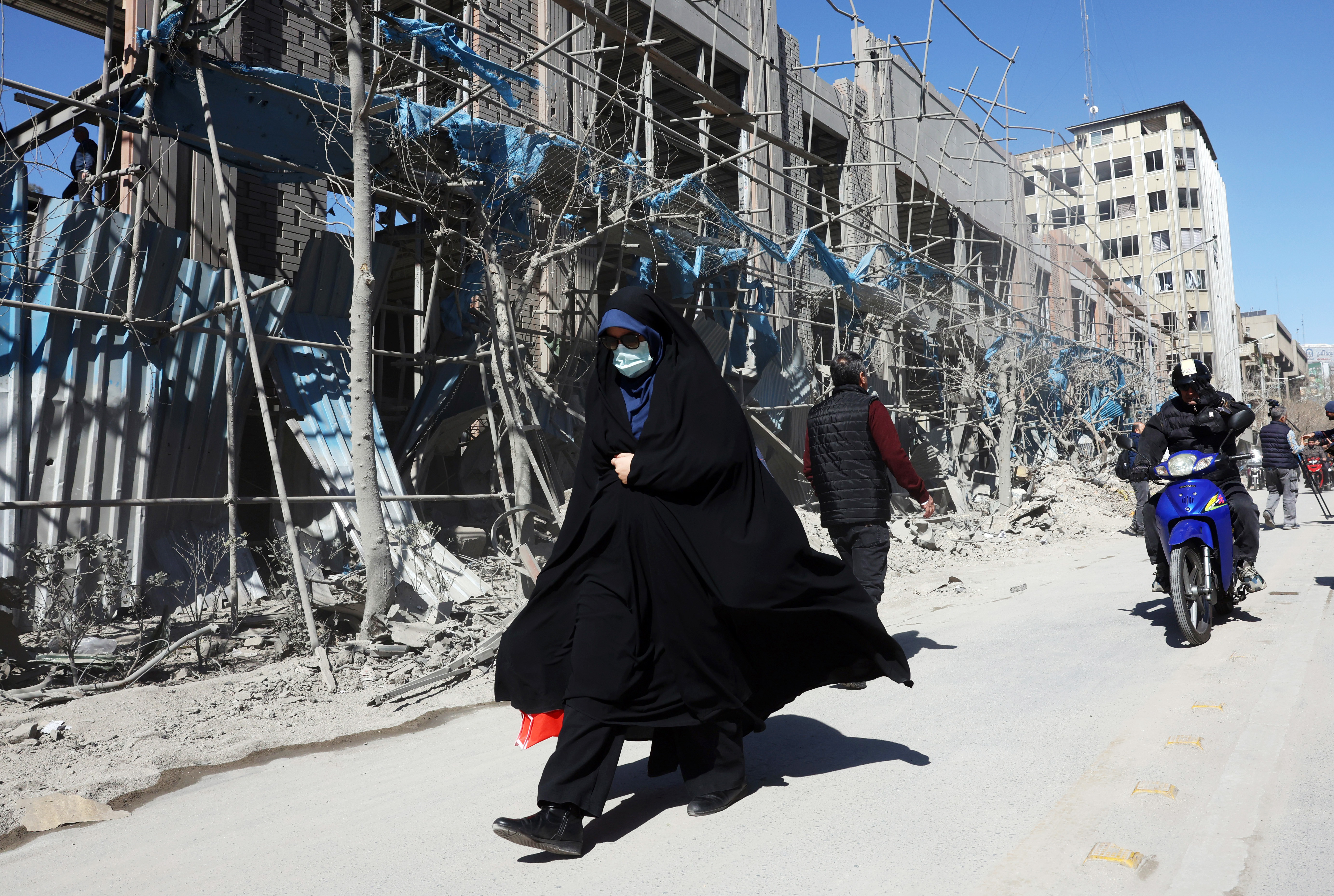
 An Iranian woman passes a damaged building around Ferdowsi Square in central Tehran after an air strike on 3 March 2026. (Photo: EPA / Abedin Taherkenareh)
Israel and the US’ attack on Iran over the weekend has already ignited conflict in the Middle East, with ominous warnings that the conflagration could spread out of control and questions being asked about when it will stop and what the end game is as more regional players are dragged in.
The attacks, dubbed “Operation Epic Fury” by the US and “Operation Lion’s Roar” by Israel, began on Saturday morning, 28 February, targeting senior leadership, including Supreme Leader Ayatollah Ali Khamenei, nuclear facilities and military infrastructure.
However, schools and hospitals have also been hit. At a girl’s school in Minab, southern Iran, more than 180 schoolgirls were killed and more than 100 wounded in an attack the UN education agency Unesco described as a “grave violation of international law”.
Iran’s retaliation, as repeatedly promised, was swift.
Six American soldiers were killed, and more wounded, when Iran targeted neighbouring countries harbouring US military bases, an embassy and other assets – including Jordan, Qatar, Oman, the United Arab Emirates (UAE), Bahrain, Kuwait, Saudi Arabia and Israel – with missiles and drones.
Several missiles also targeted a UK military base in Cyprus and an Australian air base in the UAE.
The Iranian Red Crescent said early on Monday that at least 555 people had been killed in Iran, the Guardian reported.
Nine people were also killed and others wounded near Jerusalem in one of Iran’s retaliatory attacks on Israel, while dozens were killed in Lebanon by Israeli strikes after the Iranian-allied Hezbollah militia fired several missiles at Israel, the BBC reported.
/file/attachments/2989/1213796939_790580.jpg "People walk past the destroyed Gandhi hospital in Tehran on 2 March 2026. The hospital was hit in Israeli air strikes on 1 March. (Photo: EPA / Abedin Taherkenareh)")
At least 22 people were killed in Pakistan after members of the Shia minority, angered by the killing of Khamenei, attacked the US Consulate in Karachi, while dozens more were wounded, some seriously, in Pakistan’s southern Sindh province as unrest spread there, the New York Post reported.

Iran has closed the Strait of Hormuz, blocking the world’s major route for cargo tankers travelling from the Persian Gulf to the open ocean, crippling global oil, fuel and liquefied gas energy supplies.
Several companies have stopped shipments after several tankers were hit near the strait, Reuters reported, resulting in oil and gas prices spiking.
Saudi Arabia’s Ras Tanura oil refinery, which houses one of the Middle East’s largest refineries with a capacity of 550,000 barrels per day, came under attack on Monday.
Meanwhile, the International Atomic Energy Agency (IAEA) said it had no idea whether Iran’s nuclear programme – the justification for the attacks on Iran – had been hit.
“We have no indication that any of the nuclear installation have been damaged or hit,” IAEA chief Rafael Grossi told the agency’s 35-nation board, Al Jazeera reported.
This violence and confusion represented only the first days of the conflict, portending just how badly the situation could further deteriorate.
Already, Iran’s allies and proxies in the region are joining in, exacerbating the divide between the Middle East’s Shia and Sunni Muslims, especially those Shia living under repressive, autocratic Sunni monarchies supported by the West who have repressed their Shia populations with ruthless brutality.
/file/attachments/2989/1213795266_601872.jpg "The Arleigh Burke-class guided-missile destroyer USS Bulkeley (DDG 84) launches a Tomahawk Land Attack Missile during operations in support of Operation Epic Fury from an undisclosed location on 28 February 2026. (Photo: EPA / US Navy)")
Saudi Arabia has a restive Shia minority and Bahrain has a majority Shia population. Israel is bombing Lebanon, although it has continued daily attacks on Lebanon despite last year’s ceasefire.
Iraq, politically fractured since the invasion of the country by the US in 2002 on trumped-up charges of weapons of mass destruction, is majority Shia, while members of Pakistan’s Shia minority have staged violent street protests with deadly consequences. Fragile Syria also has a minority Shia-offshoot Allawite population.
Backlash
There has already been a strong political backlash from both Democrats and some Republicans to US President Donald Trump’s unilateral authorisation of the attacks without the required congressional approval, as well as fears about the war dragging on with no clear endgame and the fear of American casualties.
“Trump’s critics are demanding that the White House provide greater clarity about what comes next. Opponents and analysts say the lack of a clear plan outlined so far has created a danger of the US being sucked into a long-lasting conflict of the sort that Trump repeatedly vowed to avoid,” The Guardian reported.
“If the administration has a game plan, they have yet to reveal it, frankly,” said Alex Vatanka, a senior fellow and Iran specialist at the Middle East Institute in Washington, the Guardian added.
“The decision by the United States and Israel to plunge into a new war with Iran creates a highly dangerous moment with unpredictable consequences,” said the BBC’s seasoned Middle East correspondent, Jeremy Bowen.
“Israel used the word ‘pre-emptive’ to justify its attack – the largest in the Israeli Air Force’s history, according to the Israel Defense Forces. The evidence is that this is not a response to an imminent threat, which the word pre-emption implies. Instead, it is a war of choice,” he added.
While Trump has spoken about the lack of human rights in Iran, Washington has been a big supporter of many dictators in the Middle East and elsewhere.
According to one report, up to 73% of the world’s dictators have received American support.
“We shouldn’t beat around the bush: Donald Trump’s and (Israeli Premier Benjamin Netanyahu’s) military attack on Iran is an illegal act of aggression,” former executive director of Human Rights Watch Kenneth Roth wrote in the Guardian.
“There is no lawful justification for it. It is no different from Russian President Vladimir Putin’s invasion of Ukraine or Rwandan President Paul Kagame’s invasion of the Democratic Republic of Congo,” Roth added.
‘Already planned’
Many have argued that the Iran attacks are about regime change, Reuters reported, specifically at the behest of Netanyahu, the Guardian reported.
In 1996, a policy document, “A Clean Break: A New Strategy for Securing the Realm”, was prepared for Netanyahu by several American neoconservatives.
The document argued that rather than pursuing a “comprehensive peace” with the entire Arab world, Israel should work jointly with Jordan and Turkey to “contain, destabilise and roll back” those entities that are threats to all three.
Some of those neocon authors, many holding high-level positions in the George W Bush administration, were also behind the Project for a New American Century which advocated for the invasion of Iraq years before 9/11.
General Wesley Clerk, former commander of Nato’s forces in Europe, said he met a senior military officer in Washington in November 2001 who told him the Bush administration was planning to attack Iraq first before taking action against Syria, Lebanon, Libya, Iran, Somalia and Sudan.
/file/attachments/2989/1213795113_985477.jpg "Protesters in Istanbul, Turkey, set fire to a banner depicting US President Donald Trump during a demonstration against US-Israeli attacks on Iran on 1 March 2026. (Photo: EPA / Erdem Sahin)")
Moreover, several days ago, talks between the US and Iranian delegations in Geneva had progressed positively, according to mediator, Omani Foreign Minister Badr bin Hamad Al Busaidi, and were due to continue this week in Vienna, Al Jazeera reported.
However, according to The Times of Israel, quoting a report in Axios, this latest attack was already being planned in December last year when Netanyahu met Trump at Mar-a-Lago in Florida.
“Trump said we had to attack Iran because we can’t allow it ‘to have a nuclear weapon’. Really? This is the same president who, in June, said: ‘Iran’s nuclear facilities have been obliterated.’ Vietnam. Iraq. Iran. Another lie. Another war,” said US Senator Bernie Sanders on X.
It’s not only American politicians who are dismayed by developments but also the American population, with only 25% supporting the attacks, according to a poll, ABC Australia reported.
There have also been warnings and fears that the war could go nuclear as the two nuclear powers continue to attack Iran, which has no nuclear weapons as of yet.
Should Iran deplete the limited number of American and Israeli interceptor missiles, thereby enabling serious attacks and damage to an Israeli city, Israel might deploy one of its arsenal of nuclear weapons against Iran, according to Professor Steven Star, a former director of the University of Missouri’s Clinical Laboratory Science Program and a senior scientist at Physicians for Social Responsibility. DM
Comments
Scroll down to load comments...