




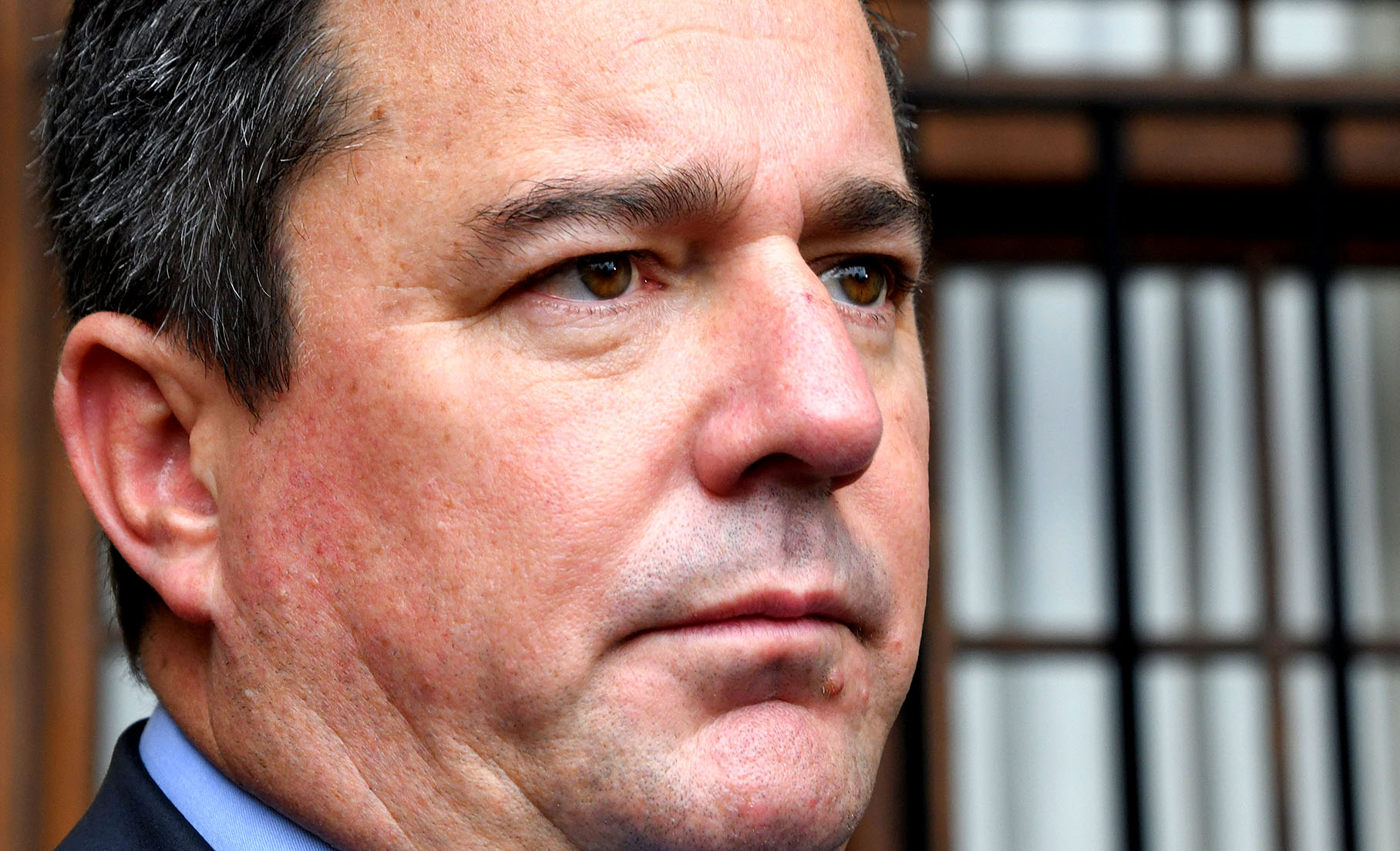
 Agriculture Minister John Steenhuisen says the department is prioritising high-risk farms. (Photo: Gallo Images / Frennie Shivambu)
Minister of Agriculture John Steenhuisen has dismissed claims that there were delays in the arrival of foot-and-mouth (FMD) disease vaccinations, as the disease continues to wreak havoc as it spreads across South Africa.
A presentation by the Agriculture Department on Tuesday showed that it had recorded 1,072 confirmed outbreaks of FMD, with another 714 suspected outbreaks in the country.
“There were no delays in the vaccine arrivals; in fact, the Biogénesis Bagó vaccine came a week ahead of what we had previously announced and the vaccines have arrived on time,” Steenhuisen told Parliament’s portfolio committee on agriculture on Tuesday, 24 February.
“Where we had an issue was with the Botswana Vaccine Institute (BVI), which had a factory closure in December, in order to meet their international laboratory requirements, and that led to a situation where we had to find other places in the world to get vaccines,” he said.
Steenhuisen was responding to a comment from ActionSA MP Athol Trollip, who said there had been “significant delays” in the arrival of imported vaccines. ActionSA, along with other political parties including the EFF and Freedom Front Plus, have previously criticised the government for its delayed response to the FMD crisis and the roll-out of vaccines, according to a News24 report.
‘Reaching our target’
South Africa lost its FMD-free status with the World Organisation for Animal Health in 2019.
The current outbreak, which began in 2021, has spread across all nine provinces, devastating herds, affecting livelihoods and export markets. While FMD is a highly contagious viral disease that affects animals with cloven hooves, the disease poses no danger to humans.
Read more: Amid foot-and-mouth hysteria, experts stress need for state-controlled vaccination
President Cyril Ramaphosa declared foot-and-mouth disease a national disaster during his State of the Nation Address (Sona) earlier this month, to “mobilise all necessary capabilities within the state” to deal with the crisis.
“While the rest of our agriculture sector is thriving, the cattle industry is today facing one of the worst outbreaks of foot-and-mouth disease our country has experienced. This disease is damaging our economy, resulting in export bans, trade restrictions and devastation of herds,” he said.
On Tuesday, Steenhuisen said that he hoped the disaster declaration would result in additional funding from the National Treasury. He said engagements with National Treasury officials were ongoing and the department had already written to the Treasury indicating its vaccine needs and costs.
During his Sona, Ramaphosa also established a task team, comprising farmer organisations and experts, that will work with Steenhuisen and the Department of Agriculture and will report to him every month.
He said South Africa would need 28 million vaccines to treat the national herd of 14 million cattle over the next 12 months.
Presentation to the Portfolio Committee on Agriculture (Update on the Foot and Mouth Disease Situation and ...
On Saturday, 21 February, South Africa received a million FMD vaccine doses from Biogénesis Bagó in Argentina. In a statement, Steenhuisen said the shipment formed part of a “sustained supply pipeline”, with further consignments expected to arrive in the coming weeks, including vaccines sourced from BVI in Botswana and Dollvet in Turkey.
The Agriculture Research Council (ARC) has also committed to producing 20,000 vaccines a week, according to the statement.
Of the one million Biogénesis Bagó vaccines, KwaZulu-Natal and Free State will each receive 200,000 doses; Eastern Cape will receive 150,000 doses; Mpumalanga, North West and Limpopo will each receive 100,000 doses; and Gauteng, Northern Cape and Western Cape will receive 70,000, 50,000 and 30,000 doses respectively.
Read more: One million vaccine doses en route as foot-and-mouth disease fight intensifies
During Tuesday’s parliamentary committee meeting, Department of Agriculture director-general Dr Mooketsa Ramasodi confirmed that another consignment of 1.5 million vaccine doses is expected to arrive this week.
“From March, Biogénesis Bagó can provide five million [doses] per month and Dunevax, the Dollvet vaccine from Turkey, will be able to provide us with six million [doses] per month.
“This will then allow us to reach our target of vaccinating 80% of the national herd by December and to ensure that we’ve reduced the incidence of the disease by 70%,” Steenhuisen told MPs.
As News24 reported, this would require at least 11.2 million cattle to be vaccinated by December, requiring 22.4 million vaccines.
Steenhuisen said that with the arrival of more vaccines, the department could massively ramp up the volume of vaccines allocated to each province.
‘Proactive strategy’
During the meeting, ANC MP Nobuhle Nkabane criticised the department’s handling of the outbreak as being reactive, rather than proactive. Steenhuisen has faced fierce criticism from farmers and political parties, including from members of the DA, for his handling of the crisis.
“If you look at the current approach, we are reacting to what has already happened,” she said.
/file/dailymaverick/wp-content/uploads/2025/07/WhatsApp-Image-2025-07-03-at-14.44.09.jpeg "ANC MP and former Minister of Higher Education and Training, Nobuhle Nkabane. (Photo: Phando Jikelo / RSA Parliament)")
Steenhuisen disagreed, saying a mass vaccination strategy would prevent future outbreaks.
“This is a proactive strategy. It’s reactive in the sense that we have to get on top of the current outbreak, but for the first time now we have a clear strategy to get ahead of foot-and-mouth disease in South Africa by proactively vaccinating the entire national herd.
“What this strategy will do is ensure that we are ahead of foot-and-mouth disease and, if we break the back of the current outbreak and we meet our target of vaccinating 80% of the national herd by December and reducing the outbreaks by 70%, this could potentially be the last major outbreak of foot-and-mouth disease we have,” he said.
Read more: EC farmers fear a second wave of FMD amid struggle to contain rapid spread
Steenhuisen said that previous strategies, such as movement control, had not worked in preventing the spread of the disease.
“Movement control is a huge problem,” he said. “We’ve seen outbreaks now in the Western Cape that can be traced back directly to animals brought in from infected areas in North West.”
He said it would be “foolhardy” to continue relying only on movement control and adherence as a strategy when it was not being observed in practice. DM
Comments
Scroll down to load comments...