




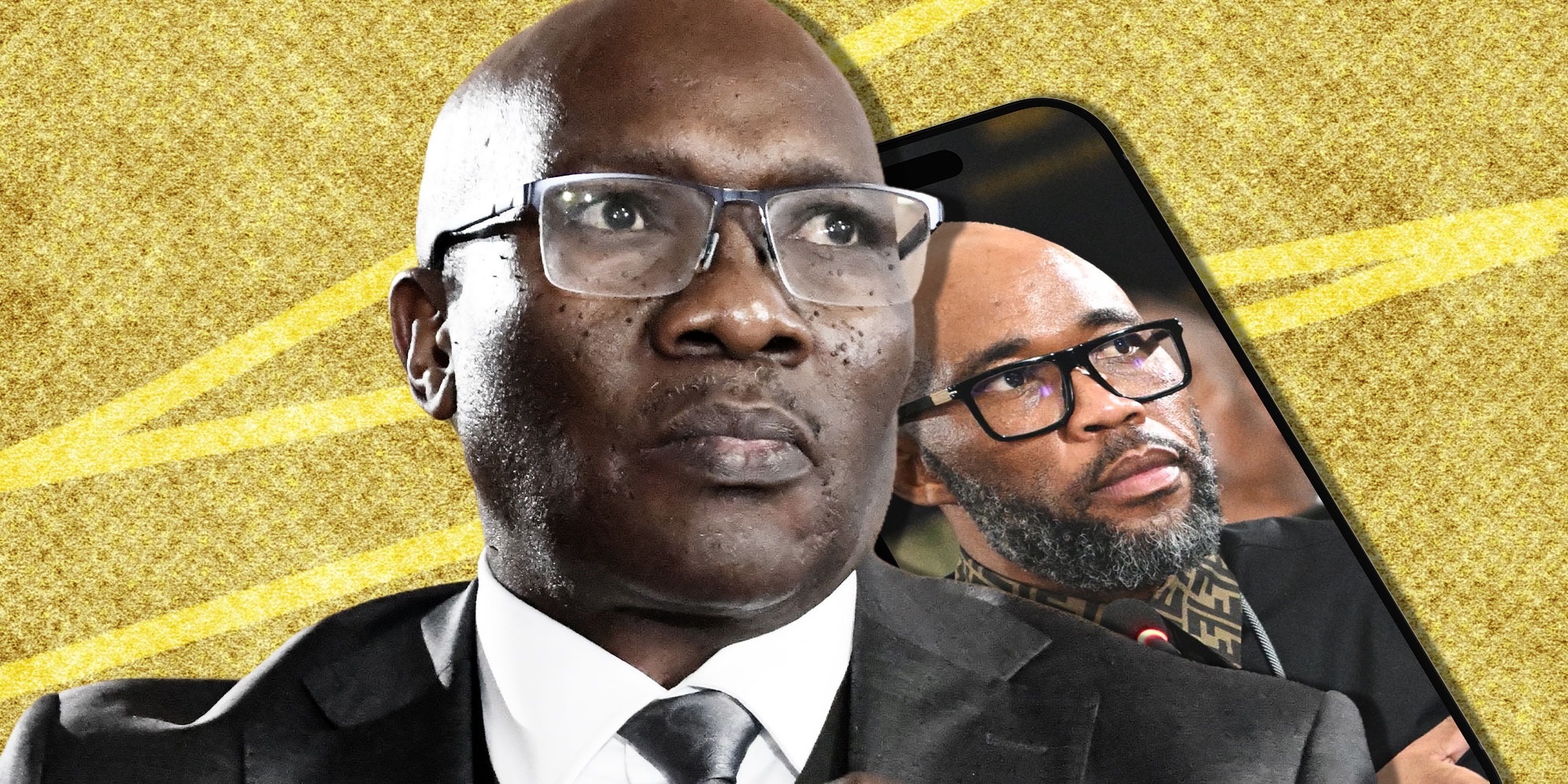
 Illustrative Image: Lieutenant General Dumisani Khumalo. (Photo: Gallo Images / Frennie Shivambu) | Vusimuzi 'Cat' Matlala. (Photo: Lefty Shivambu / Gallo Images) | (By Daniella Lee Ming Yesca)
 The wedge between certain police officers and the Investigating Directorate Against Corruption (Idac) is becoming more obvious, reiterating the deep rifts between some of SA’s law-enforcing state structures.
National Crime Intelligence head Dumisani Khumalo testified at Parliament’s ad hoc committee on Thursday 15 and Friday, 16 January.
The committee is investigating allegations that a cartel, known as the Big Five, has infiltrated SA’s criminal justice system, law enforcement, politics and private security.
On Friday, while answering questions from committee members, Khumalo outlined his stance on comments that Idac head Andrea Johnson previously made while also testifying as a witness.
And this suggested that Khumalo believes that she – or a cyber expert working with or for Idac – has lied.
/file/dailymaverick/wp-content/uploads/2025/11/ED_585364.jpg "Idac head Andrea Johnson testifies at the parliamentary ad hoc committee inquiry into alleged corruption and political interference in the criminal justice system at Good Hope Chambers in Cape Town on 6 November 2025. (Photo: Gallo Images / Brenton Geach)")
Responding to questions, Khumalo also said that while Johnson was not part of the cartel that allegedly infiltrated law enforcement, certain Idac actions appeared to be “sympathetic” to it.
Crime Intelligence versus Idac
Relations between Khumalo and Idac have been tenuous.
In June last year, Idac members arrested him, as well as six of his colleagues, in connection with an allegedly irregular appointment.
They denied the accusations, and in this broader scandal, there have been some assertions that Khumalo’s arrest was part of a plot to protect certain crime suspects.
Khumalo on Friday said that when he was detained, “it did not feel right”.
He described the case he faced as “a pure labour matter” and said the motives behind it appeared to include disrupting reforms he had implemented at Crime Intelligence to clean up the unit.
Khumalo’s specific comments that contradict Johnson revolve around Vusmuzi “Cat” Matlala, an organised crime suspect with ties to various police officers, who was arrested last year on charges including attempted murder.
Matlala has also been accused of being a Big Five cartel member, but has not been formally charged in relation to this.
Aside from the police service, Idac has been involved in investigating issues relating to him.
/file/attachments/orphans/ED_588181_449466.jpg "Vusimuzi “Cat” Matlala testifies at the Parliamentary Ad Hoc Committee inquiry into alleged corruption and political interference in the criminal justice system at Kgosi Mampuru Correctional Facility on 27 November 2025 in Pretoria. The inquiry was set up to probe political interference, leadership failures, and internal dysfunction in the South African Police Service. (Photo: Gallo Images / Frennie Shivambu)")
Johnson testified about this when she appeared before the ad hoc committee in November last year.
At the time, she said that Idac previously wanted to access Matlala’s electronic devices, and after approaching the Hawks, engaged with the national police commissioner, Fannie Masemola, about the matter.
Johnson said Masemola indicated that Matlala’s cellphones had been seized by the Political Killings Task Team (PKTT).
Khumalo, aside from being the Crime Intelligence boss, was the team’s project leader tasked with ensuring the devices were made available to Idac.
‘Data was deleted’
According to Johnson’s previous testimony to the ad hoc committee, a police officer, presumably from the PKTT, had arrived with two cellphones in an evidence bag.
“The cellphones were still on,” Johnson had said, adding that she was not sure why this was the case.
Read more: Kidnapping and ‘body bags threat’ add sinister edge to SA’s clashing State Capture narratives
A cyber expert was on standby to ensure the download of cellphone contents was done properly.
“During the download process… the cyber expert made it clear that there were gaps as it became apparent that data had been deleted,” Johnson had alleged.
She said the cyber expert would include this in a report compiled on the devices.
‘False allegations’
On Friday, while Khumalo was answering questions from ad hoc committee members, he denied that data had been deleted from Matlala’s cellphones.
“It will be defeating our investigation if we delete even a full stop from those gadgets,” he said.
Khumalo’s affidavit to the ad hoc committee also stated: “I wish to place on record that the allegations that data was deleted from the phones of Mr Matlala are false and that there was no tampering with the information on the phones as alleged.”
Read more: Andrea Johnson rejects ‘Witch-Hunt’ claims as policing scandal exposes deep rifts
It said that the cellphones had been switched on when handed over to Idac because a digital forensics investigator was still working on the devices.
Aside from differing views between Khumalo and Johnson, there also appeared to be friction between her and KwaZulu-Natal police commissioner Nhlanhla Mkhwanazi.
‘Malice’ and a rebuttal
He sparked the law enforcement scandal in July last year when he held a press conference during which he made staggering accusations, including that a cartel had infiltrated policing, politics and private security.
It is these accusations that the ad hoc committee, as well as a parallel hearing known as the Madlanga Commission of Inquiry, is investigating.
As part of this scandal, Mkhwanazi previously alleged that some Crime Intelligence officers had been dubiously targeted so that investigations against particular criminals would implode.
Ad Hoc Committee on Lt Gen Mkhwanazi’s Allegations- Adv Glynnis Breytenbach ask Lt Gen Dumisani Khumalo about reforms he made in crime intelligence in @SAPoliceService. #PKTT #adhoccommittee #@ParliamentofRSA @DOJCD_ZA @NPA_Prosecutes @DefenceCluster pic.twitter.com/cfYqVmpDHr
— Justice-and-security-Cluster (@JustSecuCluster) January 16, 2026
According to other allegations he made, sources in Idac told him there was a good structure in the directorate, but also a “structure that is malicious that is used as a weapon to further disrupt the criminal justice operations”.
Johnson previously hit back, saying there was “no truth to the allegation” that Idac was involved in a “witch-hunt” against certain police officers.
She had said: “I do not seek to divide and conquer.”
The ad hoc committee is set to resume on Tuesday when former Independent Police Investigative Directorate head Robert McBride is expected to testify for the first time in the scandal in which his name has been referenced several times. DM