




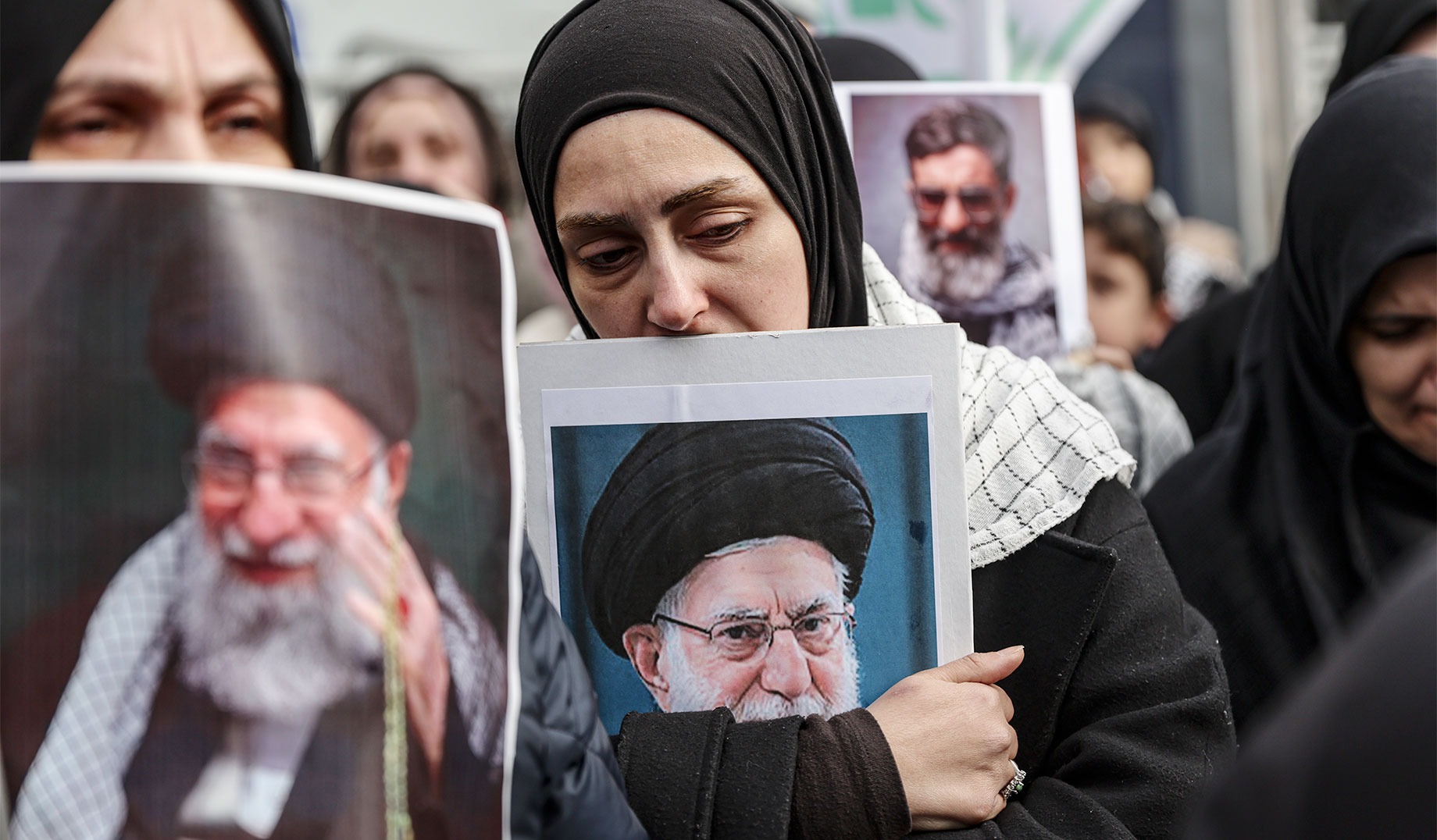
 Protesters in Istanbul, Türkiye, hold portraits of the late Iranian Supreme Leader Ayatollah Ali Khamenei during a rally against US-Israeli attacks on Iran on 1 March 2026. (EPA / Erdem Sahin)
Like so many others, just as I was getting started on my day on Saturday, 28 February, international news coverage and everything else was totally and suddenly monopolised by devastating attacks on Iranian military sites by US and Israeli air and naval forces.
In retaliation, Iran launched missile and drone strikes at Israeli sites, American bases and various civilian sites — including a luxury high-rise hotel and multi-use port facilities — located in Persian Gulf Arab states.
Initial assessments pointed to major damage to Iran’s missile launch facilities and, maybe most importantly, the death of Supreme Leader Ayatollah Ali Khamenei, along with several other senior leaders, when a missile struck his compound in Tehran.
/file/attachments/orphans/13790435_153250.jpg "Smoke rises in central Tehran after an Israeli attack on 28 February 2026, described as a ‘pre-emptive strike’ by Israeli Defence Minister Israel Katz. (Photo: EPA / Abedin Taherkenareh)")
This newest outbreak of aerial destruction is also taking place during the Muslim fasting month of Ramadan, and it came just as the third bilateral US-Iran negotiation in Geneva, mediated by Oman, had wrapped up.
There had been some modest claims of progress in the meetings, and no indications of any breakdown in the talks. While the two sides were in the same negotiation, they seem to have had significantly different objectives.
As for the Iranians, their government, weakened and its legitimacy compromised by recent protests, as many thousands had been killed by security forces, was increasingly desperate for any relaxation of US-imposed economic and financial sanctions.
That would have made it possible to provide at least some benefits to a hard-pressed populace — beyond an unrelenting authoritarian government, slogans and a serious financial drain on Iran by its long-time support of Syria and those non-state actors such as Hezbollah, Hamas and the Houthis.
Evolving US agenda
Meanwhile, over the past months, the Americans have made a smorgasbord out of their agenda. Some of this may be from policy confusion in Washington, or perhaps it has just been an evolving rationale for an intended military action.
Initially, it seemed the position was that the Iranians must pledge to end efforts towards concentrating radioactive uranium up to weapons-grade levels. On the face of this, that seems to have contradicted President Trump’s ebullient statements about the obliteration of Iranian nuclear facilities after last year’s attacks.
(The Iranians remain adamant they are not intending to concentrate U235 beyond levels needed for energy production, which requires a much lower level, even though they had already exceeded that level of concentration previously.)
Nuclear development had actually gained progress once the first Trump administration abrogated its role in the multipower agreement on Iranian nuclear developments that had been negotiated by the Obama administration in 2015.
/file/attachments/orphans/GettyImages-2262693144_937270.jpg "US President Donald Trump. (Photo: Kevin Dietsch / Getty Images)")
The US government seems to have shifted or expanded its initial key demands to include eliminating the development of Iranian ballistic missiles that presumably could reach the US.
Then, most significantly, and most recently, it has encouraged regime change and for the Iranian population to seize control of the nation and replace the theocracy that now rules it. The killing of the supreme leader is presumably going to aid that.
In truth, the Iranian population has significantly lost faith in its government, especially after the thousands of victims of the most recent protests. But such feelings may not translate seamlessly into a vast civic rising. Earlier massive national protests have not led to an end to the theocracy. So far at least, there are no indications of defections by the army, the police, or Revolutionary Guards from their support of the government.
/file/attachments/orphans/13795105_138582.jpg "Protesters clash with security forces near the US Consulate in Karachi, Pakistan, on 1 March 2026, after Iranian Supreme Leader Ayatollah Ali Khamenei was killed in an Israeli airstrike in Iran. (Photo: EPA / Rehan Khan)")
As the New York Times’ David Sanger described this US policy evolution: “With his broad attack on Iran early Saturday morning and his call to the Iranian people to overthrow their government, President Trump has embarked on the ultimate war of choice.
“He was not driven by an immediate threat. There was no race for a bomb. Iran is further from the capability to build a nuclear weapon today than it has been in several years, thanks largely to the success of the president’s previous strike on Iranian nuclear enrichment sites, in June.
“While Mr. Trump claimed Tehran was ultimately aiming to reach to the United States with its array of missiles, even his own Defense Intelligence Agency concluded last year that it would be a decade before Iran could get past the technological and production hurdles to produce a significant arsenal.
“And there were no indications of a coming Iranian attack on the United States, its allies or its bases in the region. Instead, Mr. Trump struck the Islamic Republic largely because he apparently sensed a remarkable moment of weakness for the government — and an opportunity for the United States to topple Ayatollah Ali Khamenei and the Islamic Revolutionary Guards Corps after 47 years of episodic confrontations…”
Threats of harsh retaliation
Meanwhile, Trump has threatened increasingly harsh retaliation if Iran’s missile attacks in the Middle East continued. One very recent social media post from the president, issued to encourage defections, said:
“That process should soon be starting in that, not only the death of Khamenei but the Country has been, in only one day, very much destroyed and, even, obliterated. The heavy and pinpoint bombing, however, will continue, uninterrupted throughout the week or, as long as necessary to achieve our objective of PEACE THROUGHOUT THE MIDDLE EAST AND, INDEED, THE WORLD!” [All caps in the original]
As far as Israel — the co-attacker with the US on Iran — is concerned, its key issues were, first and foremost, to eliminate the possibilities that Iran could launch missiles and rockets at its not-so-distant territory. Second, it is to put an end to any efforts to resurrect Iranian support for its erstwhile proxies — Hamas, Hezbollah and the Houthis — that can still threaten Israel.
Once the attacks by the US and Israel began, they targeted military facilities and key government offices. But most significantly, perhaps, the attacks also hit the compound where the Ayatollah Ali Khamenei and other senior leaders had gathered and where they were killed. That has put Iran’s leadership into a period of real uncertainty in the middle of an ongoing conflict.
In retaliation for the US/Israeli attacks, Iran has launched missiles at cities in the Persian Gulf states, including Dubai, Bahrain, Doha, Kuwait and Riyadh, in addition to some aimed at Israel. There are also reports of an attack on a commercial oil tanker in the Strait of Hormuz — a major chokepoint to the world’s oil supply.
/file/attachments/orphans/13794004_254171.jpg "People take shelter in an underground parking lot in Tel Aviv, Israel, on 1 March 2026. (Photo: EPA / Abir Sultan)")
Presumably, the attacks on the Gulf States were meant for American bases, but a number of the missiles have hit civilian targets unconnected to any US military presence. That has infuriated those nations against their neighbouring belligerent, Iran. Most recently, it appears that Saudi Arabia has moved towards allowing the Americans to use some of its facilities for their efforts against Iran.
As far as domestic consequences in the US go, perhaps inevitably, the president made little effort to build national support for his key demands with any public, thoughtful, deep analysis and evidence, beyond his rhetorical bluster. Similarly, the president has made little effort to bring Congress into his confidence over his plans or to offer evidence for his assertions, thus giving impetus to an increasingly acrimonious standoff with many Democrats who are making angry noises about forcing floor votes on the current military actions.
Unpredictable consequences
But it may even alienate some die-hard Republican Maga supporters who had embraced Trump’s pledge to end wars rather than start them, and to stand back from those troublesome foreign entanglements. If this conflict — or its consequences — drags on into the spring and summer — let alone into the autumn — it could significantly and negatively affect Republican chances in the November mid-term elections. Politics is never all that far away.
And so, where might this most recent military action lead to? Much, of course, depends on what kind of leadership evolves from the negotiations over its leadership succession. Iran might settle on a new leader who will even more fiercely confront the US, Israel, and the Gulf states — and encourage attacks against American diplomatic and business presences beyond the region, regardless of the consequences. One such attack, against the US Consulate in Karachi, Pakistan, has already happened.
Or the new leadership might decide to lower the temperature and begin downplaying its conflict with the US (and others) and seeking sufficient accommodation to gain reductions on sanctions, giving the Americans a face-saving moment to end their attacks.
/file/attachments/orphans/13794013_793893.jpg "Emergency services personnel inspect the damage to a building struck by an Iranian missile in Tel Aviv, Israel, on 1 March 2026. (Photo: EPA / Abir Sultan)")
Alternatively, though, it might also be that the Iranian political system splinters into multiple factions and competing leaders, as well as giving opportunities to regional ethnic minorities to make their respective moves, groups such as the Baluchis, Kurds and Azeris. That might well make the situation more unstable.
Further, if this conflict continues for a significant period, there is always the possibility that the fighting will roil the global oil and natural gas markets, closing the transit through the Strait of Hormuz yet again, which will increase prices dramatically. That could well benefit non-Persian Gulf producers such as Angola, Nigeria, some Latin American nations and oil shale and fracking producers in North America (and maybe Russia), but it would not make consumers happy.
While Iran has cultivated close ties with both China and Russia, neither nation seems likely to offer much more than verbal support. That is especially true for Russia, which is otherwise engaged in its less-than-successful invasion of Ukraine and its dreadful cost in treasure and manpower in that war.
China, of course, will be primarily interested in tying up oil supplies, rather than encouraging yet more conflict. As far as South Africa is concerned, even as it condemns the fighting, now may well be the time for it to begin a recalculation and recalibration of just how much its close alignment with Iran has cost it internationally, and thus how it might begin to move beyond that association. DM
Comments
Scroll down to load comments...