
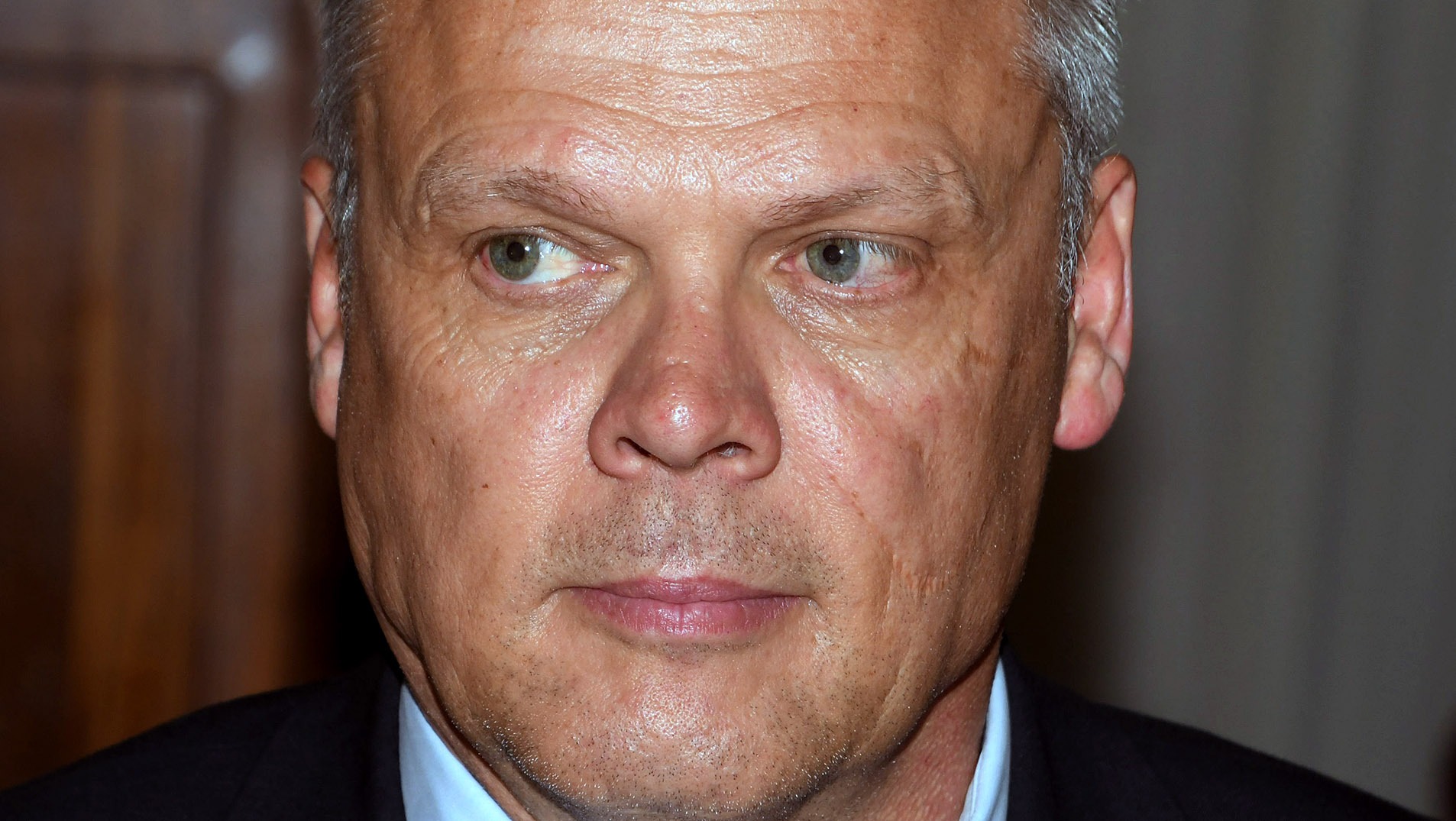
 Environment Minister Willie Aucamp in Pretoria on 5 December 2025. (Photo: Gallo Images / Frennie Shivambu)
When South Africa’s new environment minister gazetted fresh wildlife hunting quotas last week, the move did more than restart an administrative process. It reopened a long-simmering debate over how wildlife policy is made, who influences it – and where the country’s most prized animals are likely to come from.
Last week, Minister of Forestry, Fisheries and the Environment Willie Aucamp announced his intention to allocate export quotas for elephant, black rhinoceros and leopard hunting trophies for 2026 and 2027. The notice marks a clear policy shift from the position taken under his predecessor, Dion George, who left the portfolio late last year without issuing new quotas.
The quotas are now open for public consultation. But the numbers themselves – and the circumstances under which they were introduced – have already drawn scrutiny from scientists and conservation organisations, and prompted sharp criticism from George, who argues that the decision raises unresolved legal, ecological and governance questions.
What the environment department is proposing
According to the government notice, the proposed annual export quotas for both 2026 and 2027 are:
- Elephant: 300 tusks, derived from no more than 150 individual elephants;
- Black rhino: (critically endangered): 12 hunting trophies; and
- Leopard: 11 hunting trophies, limited to 11 designated hunting zones across KwaZulu-Natal, Limpopo, Mpumalanga and North West.
The Department of Forestry, Fisheries and the Environment (DFFE) justifies the elephant quota by citing national population estimates of about 43,680 elephants, with an annual growth rate of about 5.5%. The notice states that off-takes between 0.35% and 0.7% of the national population are considered sustainable (apparently “to ensure large trophies”).
/file/dailymaverick/wp-content/uploads/2025/11/Don-UKbanIvory2.jpg "Last week, Minister of Forestry, Fisheries and the Environment Willie Aucamp announced his intention to allocate export quotas for elephant, black rhinoceros and leopard hunting trophies for 2026 and 2027. (Photo: Conservation Action Trust)")
This calculation can be misleading since only mature bulls on private land are hunted. The proposal makes no attempt to quantify the numbers of the actual population to be hunted nor the effect on this population.
For black rhino, the quota aligns with CITES Resolution Conf. 13.5, which limits trophy exports to a small percentage of adult males to avoid impacting population growth. Leopard quotas are described as precautionary, with hunting restricted to males aged seven years or older, and only in areas assessed as having stable or increasing populations.
The notice does not specify the exact properties from which animals would be sourced, nor how off-takes would be distributed between state and private land.
Response to the quotas
Asked about the new quotas, George frames his objections primarily around process and timing, rather than outright opposition to all hunting.
/file/dailymaverick/wp-content/uploads/2025/07/Screenshot-2025-07-18-at-14.36.49.png "Leopard in Mopani veld. (Photo: Liza-Marie Lombard, a Daily Maverick reader)")
He said that while he was minister, quotas were not issued while court cases and regulatory processes were still under way, particularly in relation to animal welfare and biodiversity governance. He said his decision to delay was based on legal advice and a desire to avoid undermining the department’s position in ongoing litigation.
In George’s account, the key issue is that the scientific and legal context has not materially changed since his departure.
“The environment didn’t change. The data didn’t change. The court processes didn’t change,” he said. “The only thing that changed was the minister.”
The department says, correctly, that the quota-setting exercise is consistent with CITES rulings and claims it is in line with national biodiversity legislation.
Sourcing the hunts
The elephant quota raises a practical question not addressed directly in the notice: where, geographically, will trophy elephants be sourced?
While South Africa’s elephant population is large, most elephants occur within national parks, where hunting is prohibited. This includes Kruger National Park, which holds the country’s largest elephant population and is widely recognised for protecting some of Africa’s few remaining great tuskers.
/file/dailymaverick/wp-content/uploads/2025/06/black_rhino1.jpg "Black rhino. (Photo: Supplied)")
Because hunting cannot take place inside Kruger or other state-protected areas, attention turns to private reserves – particularly those adjoining the park. Primarily to the Associated Private Nature Reserves (APNR), which share unfenced boundaries with Kruger and form part of a single ecological system.
Elephants move freely across these boundaries. As a result, elephants hunted in the APNR may spend significant portions of their lives inside Kruger, even if they are legally shot on private land.
Views from the ground
The founder of Baby Rhino Rescue, Helena Kriel, said was shocked that black rhinos could be included in a hunting quota.
“In my work with key rhino sanctuaries across South Africa and in Kenya, one thing is very clear: every rhino life is precious,” she said. “For us saving a black rhino is paramount. There are just 2,000 left in South Africa.
“That they are included in a hunting quota, regardless of what this could possibly bring in terms of conservation funds, is just an outrage. South Africa has 30% of all black rhinos remaining on Earth. That South Africa would not consider it important to protect each one is a stain on the country.”
For leopards, a Non-Detrimental Finding is required to support export quotas, but none has been prepared since 2015. We simply don’t know how many leopards there are, so the legality of this quota is questionable.
On elephant hunting, long-term research by the conservation NGO Elephants Alive analysed proposed elephant off-takes in the APNR bordering Kruger. Their work focused particularly on bull elephants, the animals targeted for trophy hunting.
Their findings include:
- Prime breeding bulls (generally over 35 years old) make up the smallest proportion of the male population;
- These older bulls play a critical role in maintaining social stability, mentoring younger males and passing on genes associated with large tusks;
- Visual ageing of elephants is imprecise, especially when narrow age categories are used, increasing the risk that older or genetically valuable bulls are removed unintentionally; and
- Selective removal of large-tusked bulls – whether legal or illegal – has been associated elsewhere with declining average tusk size over time.
The NGO previously recommended that off-takes be set conservatively, particularly in open systems like the Greater Kruger landscape, where hunting, natural mortality and illegal killing affect the same population.
These recommendations are based on peer-reviewed literature and long-term field data, rather than advocacy positions. They have generally been ignored and higher off-takes of about 50 elephants are traditionally supported by SANParks.
In previous submissions, Elephants Alive has argued that hunting quotas should take into account natural mortality, illegal killings, Damage-Causing Animal removals and movements between protected and privately managed areas.*
Both the NSPCA and the NGO Humane Society for Animals said they were still considering the quotas and could not comment at present.
A policy divide
In an interview on the issue, George situated the quota decision within a broader policy disagreement over what constitutes conservation.
He said he didn’t accept the argument that hunting automatically equates to conservation benefit and argued that blurring the distinction between fair-chase hunting and more industrialised forms of wildlife exploitation undermined governance.
“I don’t see wildlife simply as a financial asset,” he said. “Once that becomes the dominant logic, the regulatory system starts bending to fit it.”
Supporters of the quota system argue, by contrast, that regulated hunting generates revenue, incentivises private landowners to conserve habitat and fits within international conservation frameworks.
Consultation
Public submissions on the proposed quotas close 30 days after publication. The consultation process is likely to draw responses from scientists, conservation organisations, hunting bodies and the public.
Based on the documents currently available, several questions remain open:
- How will elephant off-takes be managed in ecologically open systems like Greater Kruger and Mapungubwe?;
- What safeguards will ensure that prime or future large-tusked bulls are not disproportionately removed?;
- How are cumulative pressures – hunting, illegal killing, damage-causing elephant euthanasia and natural mortality – factored into quota decisions?; and
- How robust is conservation policy when a change of minister produces such a rapid shift in direction?
For now, the gazetted quotas represent the clearest signal yet of Aucamp’s consumptive approach to wildlife management. Whether they withstand scientific, legal and public scrutiny will become clearer once the consultation process closes – and once the practical realities of implementation come into view.
Wildlife Expert
A wildlife specialist who asked to remain anonymous because of the volatility of the issue made the following comment:
"The core problem with Aucamp’s newly gazetted wildlife quotas is not ideology but process. On the face of the government’s own documents, the minister appears not to have applied his mind to how quotas should be set in practice.
"Rather than starting with where hunting is legally possible, which animals are actually available and what the ecological consequences would be in open systems like Greater Kruger, the quotas are derived mechanically from national population totals and maximum CITES percentages.
"This approach ignores the fact that most elephants and black rhinos occur in protected areas where hunting is prohibited and that trophy hunting targets a very small, highly specific subset of animals – primarily mature males on private land and not all private land either.
"In effect, the quotas reflect what is theoretically allowable, not what is ecologically defensible. By failing to ground the numbers in site-level realities, the policy risks concentrating pressure on a handful of vulnerable populations – particularly large-tusked elephants moving between Kruger and adjacent private reserves.
"This is not evidence-based wildlife governance. It’s a political signal to a hunting constituency, dressed in the language of sustainability, without the analytical work required to support it. This is what George was pointing out."
*Note: This information was obtained from off-take proposals made by the APNR to SANParks.