



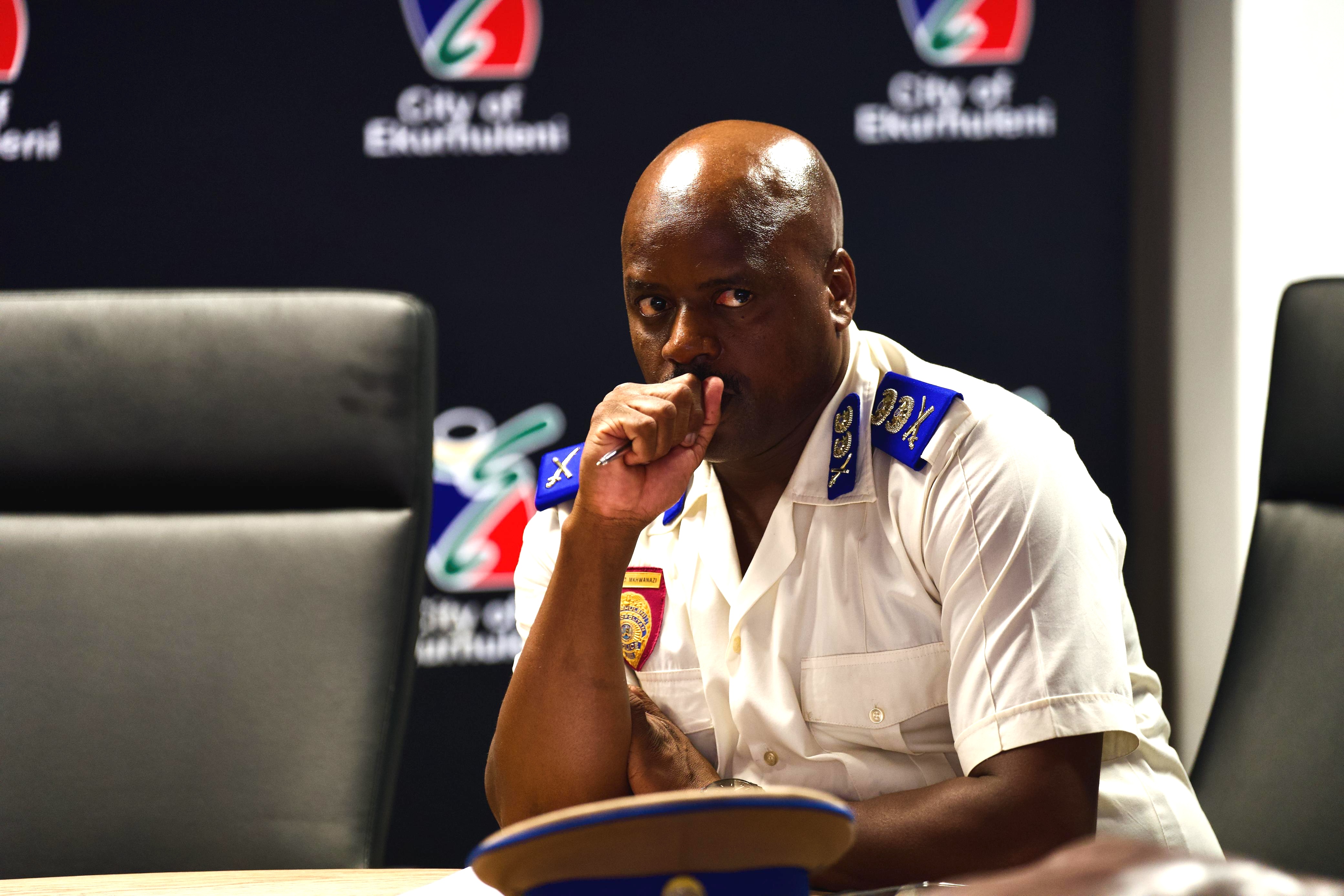
 Ekurhuleni EMPD Chief Julius Mkhwanazi. (Photo: @City_Ekurhuleni)
 /file/dailymaverick/wp-content/uploads/2025/10/label-Op-Ed.jpg)
Under direction from President Cyril Ramaphosa, the South African Police Service (SAPS) has set up a task team to investigate alleged crimes identified by the Madlanga Commission. A 29 January 2026 statement from the Presidency named 14 individuals against whom “there is prima facie evidence of wrongdoing” and who are to be investigated by the task team.
The Madlanga Commission was established in August 2025 to examine allegations of corrupt relationships between crime bosses and senior politicians and the police in SA. Five of the individuals named by the Presidency are SAPS and Directorate for Priority Crime Investigation (Hawks) personnel with alleged links to organised crime figures or other allegedly corrupt senior SAPS members.
The other nine are allegedly part of a local corruption network in the Ekurhuleni metropolitan area, east of Johannesburg. They include current or former members of the Ekurhuleni Metropolitan Police Department (EMPD), senior Ekurhuleni Metropolitan Municipality personnel, and the head of an Ekurhuleni-based private security company.
Among those named is Julius Mkhwanazi, acting head of the EMPD until he was suspended in November 2025. (Julius Mkhwanazi should not be confused with Lieutenant-General Nhlanhla Mkhwanazi, whose allegations gave rise to the establishment of the Madlanga Commission and a separate parliamentary inquiry.)
Some of the most disturbing testimony provided to the Madlanga Commission has highlighted the alleged activities of a corrupt group of police, incorporating EMPD and SAPS personnel, as well as private security, in Ekurhuleni. Members of the group, some of whom are named in the Presidency statement, allegedly regarded Julius Mkhwanazi as a senior authority figure.
Evidence regarding the group, which probably has features in common with local police corruption networks elsewhere in SA, emphasises the need for more concerted efforts to tackle endemic police corruption.
Gunned down
One of those who gave testimony about the group before the Madlanga Commission was Marius van der Merwe, a private security officer. He was gunned down outside his home on 5 December 2025, three weeks after his anonymous testimony.
Using police resources, information and powers, the group allegedly engaged in diverse criminal activities in and around Ekurhuleni, aimed at their personal enrichment. In addition to Van der Merwe’s killing, members of the group may be responsible for at least two other murders.
Van der Merwe’s murder appears to have been an act of retribution, intended to silence him after he testified about the night of 15 April 2022 when the group allegedly tortured and killed Emmanuel Mbense, a warehouse robbery suspect.
The alleged purpose of the torture was to obtain stolen goods and money that Mbense had mentioned, for their personal use. The group may also be implicated in the March 2023 murder of police informer Jaco Hanekom.
A civilian member of the gang, who was allegedly directly involved in Mbense’s killing, apparently stated that “if anyone talks” he would be willing to “go to prison for killing them”. The man, described by the SAPS as a “person of interest” in the murder of Van der Merwe, committed suicide on 7 February 2026.
Although the Ekurhuleni police group’s alleged activities are of an exceptionally serious nature, they are not a central focus of the Madlanga Commission. Rather, it is because of Julius Mkhwanazi’s alleged links to tenderpreneur VusiMuzi “Cat” Matlala, believed to be an influential underworld figure with many SAPS connections, that the commission has received testimony about the group’s activities.
Alleged attempts to shield Mkhwanazi from accountability
The commission also examined the alleged efforts by senior Ekurhuleni Metropolitan Municipality personnel to shield Mkhwanazi from accountability.
The Independent Police Investigative Directorate (Ipid) has known about the group’s activities for several years. But little was done about it until 4 February, when Ipid announced it had submitted the results of its investigation into Mbense’s April 2022 murder to the National Prosecuting Authority.
At a 7 February media briefing, SAPS National Commissioner General Fannie Masemola said a task team had already been established to investigate alleged crime highlighted in testimony to the Madlanga Commission. He said the team comprised, among others, “experienced, skilled and specialised detectives, forensic experts, crime intelligence analysts and operatives”.
New National Director of Public Prosecutions, Advocate Andy Mothibi, indicated that the task team would include senior prosecutors to “facilitate prosecutor-guided investigations”. The Asset Forfeiture Unit will also be part of the team.
Strengthening the investigation and prosecution of police and political figures with alleged links to organised crime is a critical step. A well-managed and coordinated investigation will be required as criminal police officers are frequently able to stymie investigations – partly by ensuring that no one is willing to testify against them.
Insulated from undue interference
The task team must also be insulated from undue interference by politicians or others connected to corrupt and criminal networks. It is vital that the task team’s work is seen as credible, effective and impartial.
However, the existence of the corrupt Ekurhuleni police group shows that police corruption has multiple permutations in SA. Establishing a task team to investigate cases emerging from the Madlanga Commission is just a small part of what needs to be done to tackle police corruption in the country.
A recent Institute for Security Studies report highlights that the current fragmented system for overseeing and investigating police corruption is neither structured nor resourced effectively relative to the scale and complexity of the problem.
Corruption will continue to be embedded in the SAPS and South African policing system until the minister of police and police leadership prioritise tackling the problem in a much more purposeful and sustained way. The president should also indicate this as a priority in his State of the Nation Address. DM
For more, read the full ISS report ‘Tackling police corruption in South Africa’ here.
David Bruce is an Independent Researcher and Institute for Security Studies (ISS) Consultant.
First published by ISS Today.