




 MC-Chuttered-Clinic
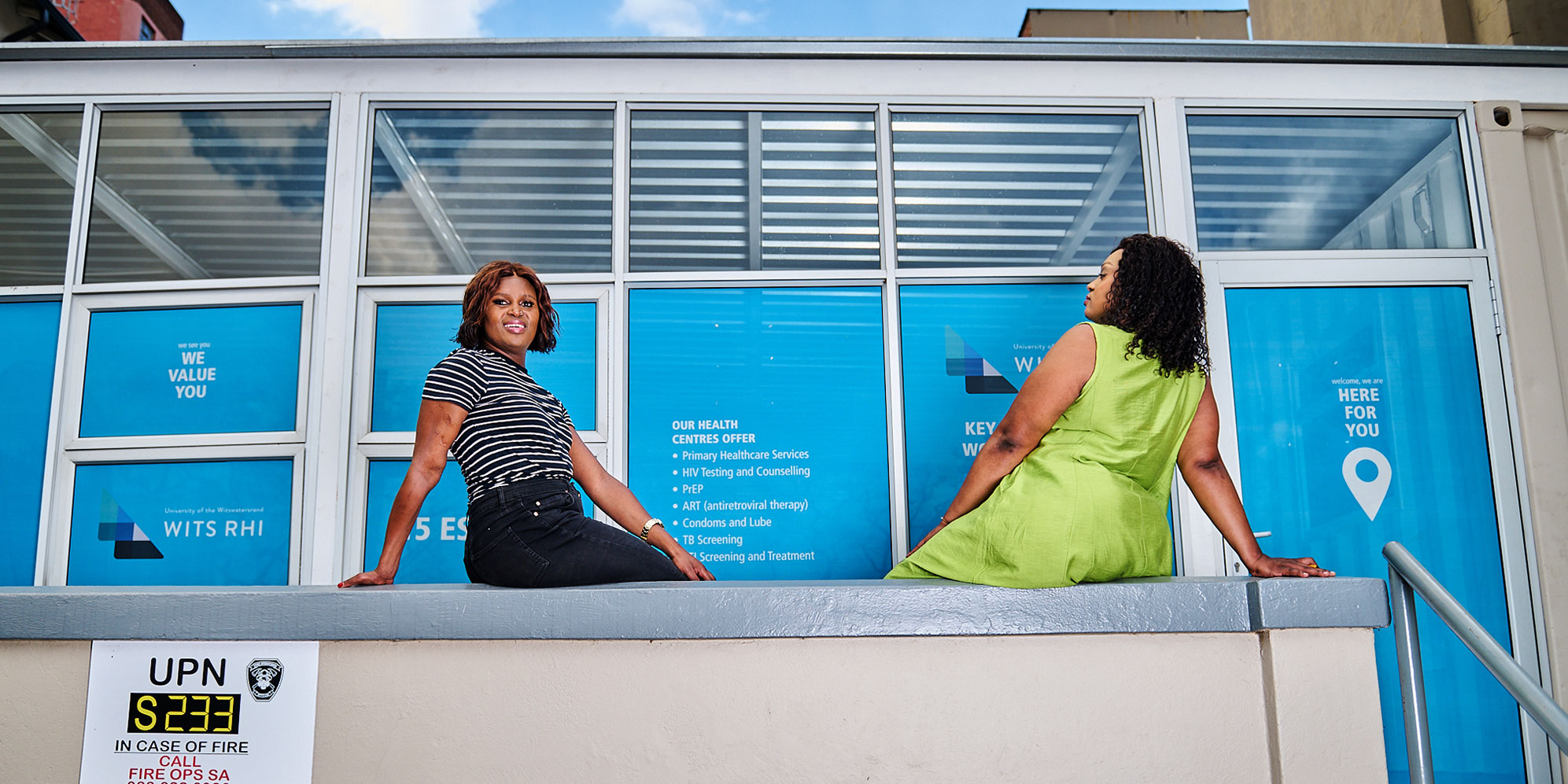
 Tuesdays on Esselen Street, Hillbrow used to be favourite days for *Kat. The Wits Reproductive Health Clinic (RHI) is based here and it’s where Kat works. The strip was abuzz on this day of the week when transgender people were among the clients arriving for services.
“It was more than a clinic, it was a safe space,” says Kat. It’s late October as she climbs the stairs leading to what used to be the waiting area. On the steps are painted messages of encouragement and motivation like, “Your health is your happiness. You deserve it”.
There is a bright display at the foyer entrance as a welcome and the blue and pink signs throughout the building resemble location markers from a mobile phone app – they’re guides for trans clients, also a literal signpost that a journey of a thousand steps begins here.
/file/attachments/orphans/2-Kat-Didi-Wits-RHI-Hillbrow_655403.jpg "Kat and Didi sitting on the steps to the Wits RHI building in Hillbrow where they used to work. (Photo: Thom Pierce / Spotlight)")
Kat is walking with her colleague *Didi. Both are linkage officers, connecting and navigating patients through care. They were also clients receiving their hormone therapy through Wits RHI. They call each other sisters because their kinship is bound by the intimacies of joys and struggles, victories and losses.
The massive loss that struck this year began with an executive order issued by US President Donald Trump in January. As the administration pulled the plug on programmes funded by the President’s Emergency Plan for Aids Relief (Pepfar), it halted projects including the transgender clinic and other services for sex workers in Johannesburg’s Hillbrow area. The original Wits RHI clinic first opened its doors in the early 2000s to sex workers and was one of the first clinics to dispense HIV medicines in South Africa.
Not the end or the beginning
Kat and Didi pick up the conversation in the patient waiting room where the lights are turned out and the chairs have not been sat in for months. But they’re sharing a story that the Trump disruption is not where the story ends. It’s also not the beginning.
Didi rewinds to the beginning of her own journey. She tells how she grew up knowing the body she was born in was somehow just not right. She says: “I have not been a boy a single day of my life. Throughout my young teenage years, I was told I was gay. But deep down I knew I didn’t belong in that group.”
“When I was 14, my mother bought me a phone and I could finally Google things. I came across all these derogatory terms like ‘she-male’. Then I found terms like transvestite and transexual and then transgender. Then it finally hit me that I am a transgender woman,” says Didi.
At 16, she says she started looking into therapy, but all outside sound medical convention. “It was doing all the wrong things (like tripling a dose of oral contraceptives. Birth control pills contain oestrogen, one of the hormones critical in the feminising process but are not medically recommended for transitioning.) but you’re desperate. All my friends had boobs, meanwhile my voice was getting deeper, and I was like ‘where my boobies at?’,” Didi says. She can laugh about it now, but she’s deeply serious about the toll it takes on people’s mental health and their bodies when they have nowhere to turn.
In her early twenties, Didi connected with Wits RHI, arriving for workshops and community outreach programmes that Kat was running at the time. Soon, they were talking about the need for a dedicated transgender clinic. With community input and wide consultation, they helped plant the seeds for what would become the Wits RHI transgender clinic that launched in 2019. There would be three more transgender clinic sites across the country, including in Cape Town, Nelson Mandela Bay and East London.
The Wits RHI protocol required clients to be at least 18 and to undergo consultations with a medical doctor and psychologist before consideration for accessing hormone therapy and hormone blockers. Trans women receive oestrogen tablets and anti-androgen drugs to stop testosterone production. Trans men would receive testosterone, typically as injections.
These drugs are provided by the Department of Health. Since 2019, hormone therapy drugs have been part of the health department’s National Essential Medicines List, which contains medications recognised for their efficacy, safety, and affordability to meet the most important needs in a health system.
Facilitation of the transitioning journey however, were undertaken by Wits RHI. This included the management of patients, which plays a critical role for monitoring overall health while on treatment and for giving psycho-social support.
As several sources tell Spotlight, the biggest problem for the transgender community is not that hormone therapies are not available at state facilities – though that is sometimes a problem, but that people are often bullied and stigmatised for trying to access hormone therapy at these places. Client stories and evidence collected by organisations like Ritshidze (also affected by the US aid cuts) bear this out. Trans people outline various challenges at public sector clinics, including when asking for hormone therapy. It’s the likes of clinic security guards “looking at you funny” at the security gate; a data capturer insisting that your ID says “you’re a boy even though you tell them you’re not”. Then being in a consulting room and “the nurse calls over her colleagues to laugh at you – the whole experience is a mockery”.
It’s what made the Wits RHI services a beacon for many. Those who arrived here, Didi points out, were welcomed on their individual journeys. “There are pre-op trans people, pre-medication trans people, those who are transitioning socially only, those who are transitioning socially and medically, those who are transitioning socially, medically, legally and through surgery. So transgender people are transgender diverse people.”
270 retrenched due to funding cuts
But then came the devastating blow of the abrupt and severe cuts in funding from the United States.
Naomi Hill, head of the key populations programme at Wits RHI, says: “By the end of March 2025, our entire team of 270 people across our nine sites (sex worker and transgender clinics) in the country was retrenched.”
The Hillbrow clinic also shut its doors and the street grew quiet. Hill was retained to liaise with the health department, to close out with the donor, and to start grant writing with the hope of partially reinstating services.
“We felt it was critical that all of the lessons that have been learned over these past two decades … did not get lost,” she says.
Bringing patients back into care
Over the autumn months of this year, she started speaking to colleagues and ex-colleagues about what they could do. They set up a WhatsApp group, leveraging their collective desire to ensure patients could be brought back to care.
Wits RHI drew on reserve funds to re-employ three peer educators, including Didi and Kat, to contact and link clients back into care. The idea was to support clients to be re-engaged into a state facility. Hill says the aim still is to offer integrated services that are trans friendly.
“We provided hormones as part of an integrated HIV package of care, because internationally, the research demonstrates that when transgender people receive hormone therapy concurrently with HIV services, their uptake and retention in HIV services is higher,” says Hill. She adds that Wits RHI is working with Duke University in North Carolina to research, evaluate and build evidence for this model of service delivery.
Hill’s idea found fertile ground
Charlotte Maxeke Johannesburg Academic Hospitals’ HIV clinic in Parktown said yes to absorbing the Wits RHI transgender clients and Helen Joseph Hospital in Auckland Park agreed to release some of their drug stocks for clients now at Charlotte Maxeke.
As of August, many former Wits RHI clients have been pressing the lift button to the fifth floor of the state hospital on Parktown Ridge to restart their therapy. Here, they find Dr Sarah Stacey, the Clinical Head of the Unit of Division of Infectious Diseases at the Department of Internal Medicine, and her team.
On a rainy afternoon, Stacey greets us with a smile and wide sweep of arms across the modest space of curtained-off cubicles. “This is the HIV clinic, the TB clinic and now also the transgender clinic,” she says.
Stacey says their initial intention was to absorb patients who are men who have sex with men from another NGO, Anova, that had also lost its US funding.
“We initially didn’t think about absorbing the transgender community, thinking hormone therapy is kind of outside our purview.
“We were a little nervous … because we didn’t have experience managing transgender clients. But things have worked, very smoothly actually - it proves that where there’s a will, there is a way,” she says.
Stacey says there have been many lessons to learn. Among these are that the goal to get people living with HIV onto treatment must first address the broader needs people have. For the transgender community, this means securing their access to hormones.
At the clinic at Charlotte Maxeke, staff had to make some adaptations to accommodate the transgender community sensitively. This included bypassing the need to use a client’s ID number - that has a gender marker – for data capturing, opting for a birth date only.
“Having the transgender clinic here has broadened my horizons,” says Stacey. She admits sometimes she’s an outsider to conversations that come up at the clinic, but it’s made her lean in more.
“I say to my team, don’t be shy to talk about things that might be at first surprising or shocking to you. Now you have different information about lives that may be different to yours, but it’s what you can try to incorporate into your consultations,” Stacey says.
For Kat, who has now guided many of the first 90 former Wits RHI clients to receive therapy at Charlotte Maxeke hospital, it’s a detour but also a happy resumption of a journey.
The aim will be to make sure the programme is sustainable, replicable and that all 400-odd people who were on a Wits RHI waiting list prior to the funding shutdown can also be started on hormones soon.
Stacey’s department will need more staff, ongoing sensitivity training for rotating registrars and better access to psychosocial support for its clients.
“Charlotte Maxeke is our first partner in this. We have found many good people in the state [public sector] and we have found a partner who understands the language we are speaking. It’s a relationship of trust, so it’s definitely a good new beginning,” Kat says. DM
*Full identities withheld.
This article was first published by Spotlight – health journalism in the public interest. Sign up to the Spotlight newsletter.
/file/dailymaverick/wp-content/uploads/2024/07/Spotlight-logo-new.png)