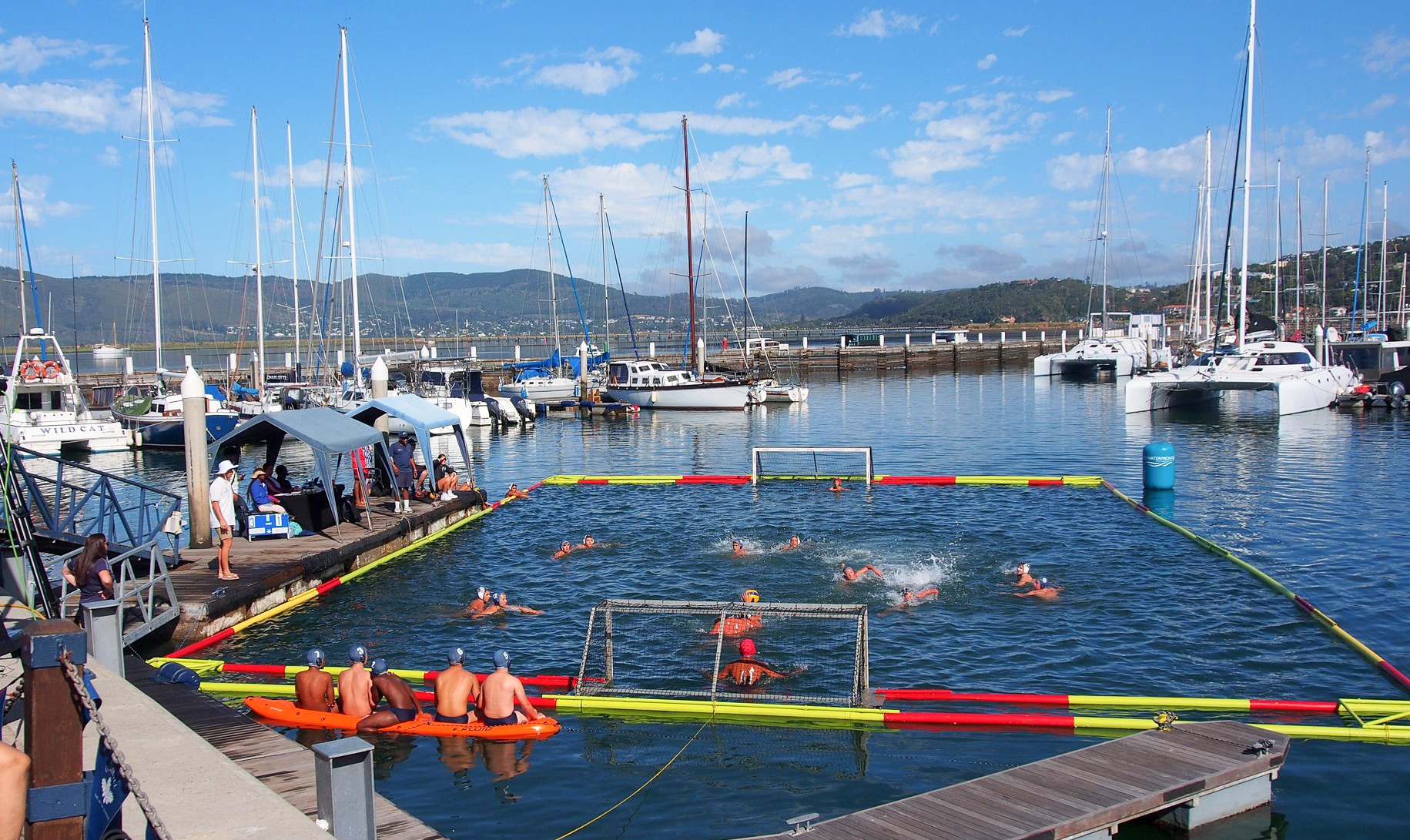
 Players from school's across South Africa usually descend on Knysna for water polo tournaments at the Oakhill Waterfront Chukka Festival — an event cancelled in 2026 due to unsafe estuary water. (Photo: Oakhill School)
 Thousands of South African school water polo players, coaches and families were left disappointed after the Oakhill Waterfront Chukka Festival – a flagship national event held in Knysna since 2011 – was cancelled due to unacceptable levels of E. coli in the water.
Independent testing revealed unsafe water conditions in the Knysna estuary, where the tournament takes place, and organisers were unable to secure an alternative venue that met safety standards.
The month-long festival, which typically attracts about 1,600 players from 70 schools and thousands of visitors, provides a major boost to the town’s tourism and local economy.
Impact on players
For the past three years, Sandra Pakulski had been attending the Oakhill Waterfront Chukka Festivals to support her son.
/file/attachments/orphans/U19OakhillWaterfrontChukkaFestival2025_671205.jpg "Players in action at a previous Oakhill Waterfront Chukka Festival. (Photo: Oakhill School)")
Now in matric, this was her son’s last chance to participate, and since his return to school he had been training every day in preparation for the event.
“It was really disappointing when they sort of called it all off,” said Pakulski. “My parents were going to go with this year. My brother-in-law was going to fly in from George because he had a business meeting and he said he was coming and he wanted to offer his support.”
A festival that makes waves
For more than a decade, Oakhill School has been hosting the Chukka Festivals. It is a flagship, open-water water polo sporting event that takes place across the month of February with separate weekends for U13, U15 and U19 water polo players.
“The cancellation removes a major sporting and community event from the school calendar and impacts longstanding relationships with visiting schools, while also reducing economic activity associated with the festival to the town as well as the school,” said James Cross, the Oakhill Head of School, in email correspondence with Daily Maverick.
According to a statement sent out on 29 January, Oakhill explored several alternative locations across the lagoon where the water quality met public use standards, but was unable to secure a venue that met “the logistical and safety requirements for an event of this magnitude”.
Water scarcity and drought also a factor
The decision to cancel the festival was based on a combination of water quality results as well as the broader water scarcity and drought affecting the Knysna region, said Cross via email.
Knysna has been experiencing a severe, ongoing water crisis that reached a critical point in January. By mid-January, the main water source, the Akkerkloof Dam, dropped to roughly 15% capacity, leaving the town with only about 10-15 days of water, as previously reported by Daily Maverick.
/file/attachments/orphans/Mark_Taylor_CharlesfordWeir_20260113_DSC_4012_349502.jpg "Water is pumped from the Knysna river at Charlesford, but the pumps need to be replaced in order to function optimally. The possibility of building a dam at Charlesford is being investigated. (Photo: Mark Taylor)")
Accommodation establishments left in the lurch
As a result of Oakhill’s decision, there have been thousands of cancellations leaving accommodation establishments high and dry, and unlikely to get more bookings so late in the day.
The spokesperson for the Greater Knysna Business Chamber Tourism Forum, Elmay Bouwer, told Daily Maverick the cancellation of the polo fest had clobbered accommodation establishments. She said that while the tourism forum “fully supports the decision taken by Oakhill School”, local tourism businesses are experiencing “significant and tangible financial losses as a result of this cancellation… and ongoing water issues”.
She adde: “This event hosts 70 schools and approximately 1,600 players, translating into an estimated 4,800 bed nights (based on three nights per player), excluding family members and supporters who travel with them, so these extra people would have visited and taken up thousands of rooms.”
A quick one-day survey was conducted by the tourism forum to assess the loss of income to accommodation establishments, predominantly small to medium size, activity operators and restaurants. Out of 155 members, 21 businesses responded. These alone showed 2,620 room nights lost, which equates to a direct financial loss of more than R2.3-million, not including the ripple effect of visitors spending money on meals, retail purchases and leisure activities.
SANParks ‘not responsible’
SANParks was asked to comment and promptly responded saying that although it was the management authority for the estuary, sewage issues lay with the Knysna Municipality. Phokela Lebea, SANParks’ regional communications manager, said: “With regard to the reported sewage spills and water quality concerns in the Knysna Estuary, it is important to clarify roles and responsibilities. Matters relating to municipal sewerage infrastructure, spills and compliance fall under the mandate of the Knysna Municipality. SANParks, as the management authority for the protected area, does not conduct routine municipal compliance monitoring of sewerage systems.”
DA Chief whip blames Knysna governance
“Knysna governance crisis claims a major tourism event,” is how Sharon Sabbagh, DA chief whip and DA Knysna spokesperson for Local Economic Development and Tourism, described it.
“The DA Knysna notes with regret the announcement by Oakhill School regarding the cancellation of the 2026 Oakhill Waterfront Chukka Festival. This decision is a significant disappointment for learners, families, local businesses and the broader Knysna community. We commend Oakhill School for acting responsibly, cautiously and in what it believes to be the best interests of public health and safety,” said Sabbagh.
She said that “the ongoing water, sewage and waste management crises in Knysna have created a climate of risk and uncertainty”.
Responsibility for monitoring water
The Director of Infrastructure Services at the Knysna Municipality, Regenald Wesso, pointed out that the Knysna Municipality did not conduct recreational water quality sampling as this testing was undertaken by the Garden Route District Municipality, which was responsible for environmental health services including monthly water quality monitoring at multiple estuarine and coastal locations in the greater Knysna area.
He said the municipality had “noted reference to independent water quality testing conducted by Oakhill. As the municipality did not commission this testing, we are unable to verify the sampling methodology, locations, timing or analytical processes used. The municipality cannot confirm concurrence between the independent results and those reflected in the Garden Route District Municipality report.”
Oakhill did not divulge the details of its water testing.
Wesso said the results for 2026 indicated “several sites were compliant with applicable recreational water quality guidelines. However, non-compliant results were recorded at selected points.”
According to SA’s recreational water quality guidelines issued by the Department of Water and Sanitation, acceptable Escherichia coli (E. coli) levels in marine recreational water are measured per 100 millilitres, with counts between 0 and 130 regarded as low risk and suitable for swimming, and levels up to 240 per 100ml generally considered acceptable for recreational use.
Concentrations above 240 per 100ml indicate an increased health risk, while levels exceeding 500 per 100ml are considered high risk and may warrant public health advisories or temporary beach closures. E. coli is used as an indicator organism, meaning elevated counts suggest possible sewage contamination and the potential presence of other harmful pathogens.
Questioned about regular sewage spills at the Knysna Waterfront and Knysna Yacht Club, Wesso said: “Based on historical trends, non-compliant E. coli results are most often associated with sewer pump station spillages occurring at, or around, the time of sampling. At this stage, a causal direct link between the reported results and specific sewage spillages has not yet been confirmed.”
Recreational water quality testing within the estuary was conducted monthly by the Garden Route District Municipality at multiple locations, said Wesso. On the Knysna Municipality “Lagoon update” page of the official website, the results can be found. This page lists monthly and historical water quality reports in PDF form that include E. coli counts and other analyses.
Most recently water samples were taken from within the Knysna estuary and various Knysna culverts on 8 January 2026, and these samples were analysed by an independent laboratory to determine E. coli levels in the water.
Sites that fell within the accepted safe levels were Belvidere, Bollard Bay, Crabs Creek, Green Hole, Lake Brenton and The Heads. Areas where high levels of E. coli were found were at Costa Sarda, where there was 2,500/100ml, and Salt River, which had 15,000/100ml.
There is no testing in place specifically at the Knysna Waterfront.
“Improving water quality in the estuary, including the Waterfront and known pressure points such as Ashmead, requires a multi-faceted and coordinated approach,” said Wesso.
“This includes ongoing monitoring and maintenance of sewer pump stations and reticulation infrastructure; prompt response to, containment of, and clean-up following sewage spillages; preventive maintenance and operational interventions to reduce system failures; intergovernmental coordination between the Knysna Municipality and Garden Route District Municipality and continued monitoring to track trends and assess the effectiveness of corrective actions.”
Why is a honey-sucker seen at the Waterfront so often?
Asked why a honey-sucker vehicle (built for handling liquid waste) was deployed to the Waterfront several times a day, Wesso said it did not indicate a complete failure of the sewer system as these vehicles were deployed as a preventive and temporary mitigation measure to remove sewage and reduce pressure on the sewer network, particularly during periods of high usage.
Knysna Estuary ‘of national value’
On the Knysna Municipality’s website it states: “One of the most prominent landscape features in the Greater Knysna area is the Knysna Estuary, or lagoon as it is commonly referred to. Other than being a major tourist attraction for leisure activities, it also boasts considerable conservation importance with it ranking 3rd of South Africa’s estuaries in terms of botanical importance, 8th in terms of importance for conserving fish, 19th in terms of water and bird conservation, and first in terms of overall conservation importance, which includes criteria such as size, diversity of habitat, zonal rarity and biodiversity.”
/file/dailymaverick/wp-content/uploads/2023/11/ED_352972.jpg "The Knysna Estuary is a critical ecological system. (Photo: Gallo Images / ER Lombard)")
Jessica Seath, a marine scientist and programme manager at the Knysna Estuary Research Foundation, says the Knysna Estuary is not just scenic; it’s a vital living system whose future depends on informed science, community involvement and careful protection.
“The Knysna Estuary is an ecologically critical system. It functions as an important nursery and breeding ground for many fish species, including species of conservation and fisheries importance. Healthy water quality underpins all of these ecological processes. Healthy water quality is essential for the Knysna Estuary’s role as a breeding and nursery ground for fish, and although bacteria such as E. coli don’t directly harm marine life, their presence can indicate sewage inputs that undermine long-term ecosystem health,” said Seath. DM