




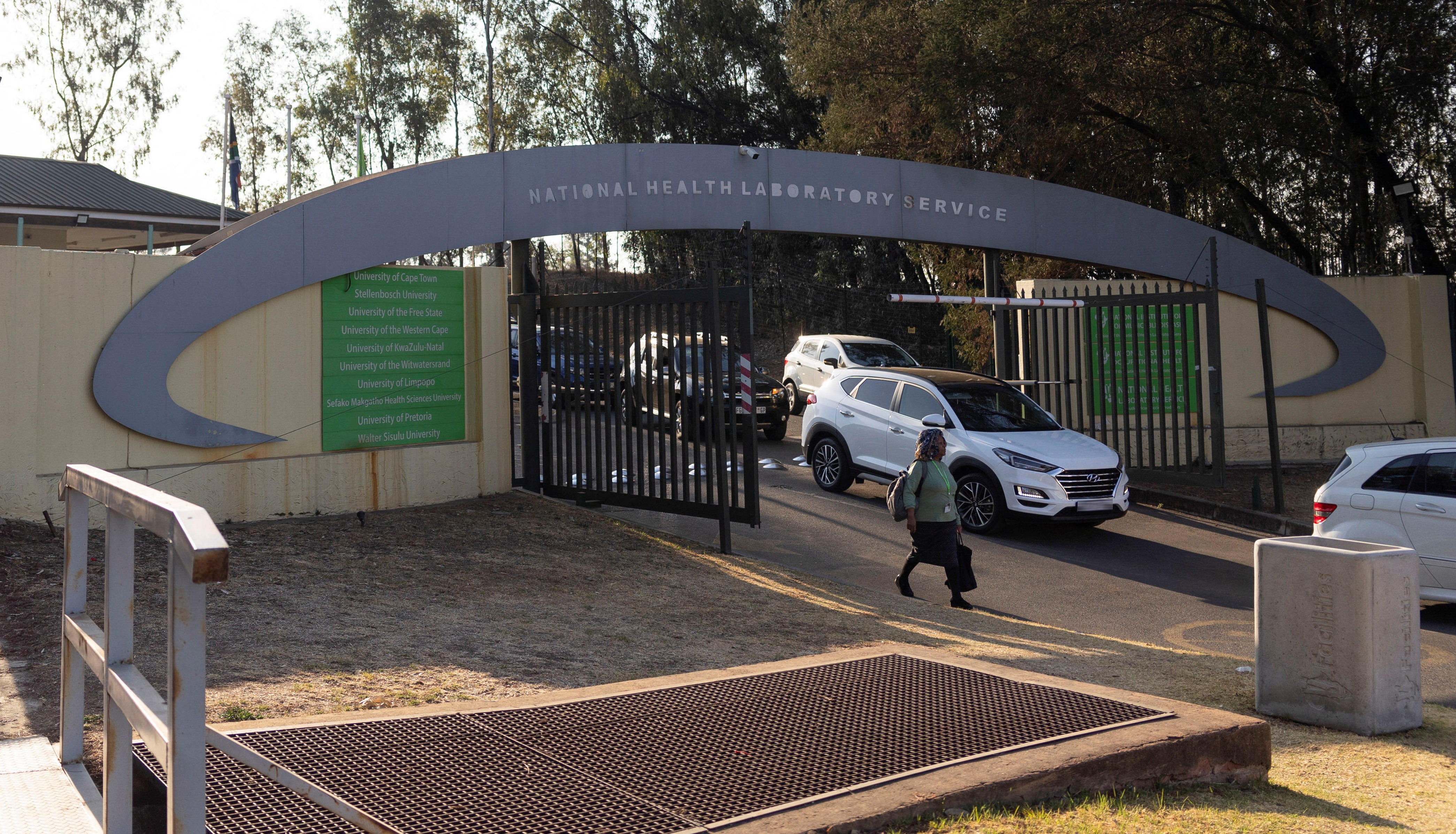
 The National Health Laboratory Service office in Johannesburg. (Photo: Alet Pretorius / Reuters)
 On Tuesday, 17 March, the National Health Laboratory Service (NHLS), which provides laboratory services to all public sector health providers in South Africa, reported an ongoing disruption to its information system, TrakCare, which began at around 9pm on Monday.
The NHLS is the sole provider of diagnostic pathology services to more than 80% of South Africa’s population, with over 300 laboratories across the country. When its system goes down, it has a profound impact on the ability of healthcare providers in the public sector to administer patient care.
Ntobeko Ntusi, the president and CEO of the South African Medical Research Council, told Daily Maverick that the interruption in the NHLS services was linked to a power outage affecting the organisation’s head office in Johannesburg, where the servers and computers holding patient results were housed.
“The NHLS doesn’t seem to have a UPS [uninterruptible power supply] or some other backup system, so that if there’s issues with energy, the whole system goes down, and everybody in the country in the public system cannot access results, which is just, frankly, unacceptable,” said Ntusi.
/file/dailymaverick/wp-content/uploads/2024/05/Professor-Ntobeko-Ntusi.jpg "Professor Ntobeko Ntusi inside his office at Groote Schuur Hospital. (Photo: Biénne Huisman / Spotlight)")
NHLS working to restore system
On Tuesday, the NHLS confirmed that its TrakCare system was unavailable, and that technical teams were “working urgently to restore full functionality”.
“The disruption is attributed to erratic power supply challenges in and around Sandringham, where the NHLS head office is located. This is an infrastructure-related issue and not a cybersecurity incident. The integrity of NHLS information systems remains intact, with no compromise to data security, and all other systems continue to operate optimally,” said the NHLS.
It’s not the first time the NHLS systems have gone offline. In June 2024, a devastating cyberattack on the laboratory service, caused by ransomware that targeted selected parts of its IT systems, disrupted patient care and medical decision-making. The organisation’s systems were rendered inaccessible, resulting in a monthslong restoration effort.
“[These outages have] been happening from time to time. You remember there was that big outage [in 2024] where clinicians couldn’t receive results for a number of days, and you effectively cannot manage patients if you don’t have insights into their physiology, and quite a lot of patients died,” said Ntusi.
The latest outage affected health facilities countrywide. None of the health professionals who use the NHLS system could access patient results — a situation that Ntusi described as “utterly ludicrous”.
“The NHLS is the arm of our South African government, nested within the National Department of Health, that provides all the laboratory investigations in health, and so every patient that is seen in a primary healthcare clinic or in a secondary hospital, or in a tertiary or quaternary facility, that has any kind of laboratory investigation in the public sector, almost all of those are performed by the National Health Laboratory Service,” he said.
/file/dailymaverick/wp-content/uploads/MC-VaccineTrail-Spotlight_2.jpg "The NHLS is the arm of the government, nested within the National Department of Health, that provides all the laboratory investigations in health. (Photo: Rungroj Yongrit / EPA-EFE)")
“When their systems are down, it means that new investigations have to be deferred, but importantly, it means, for those that have already been done, the doctors are not able to access those results, and so cannot use laboratory investigation as a standard of care to guide management. It obviously impacts profoundly on care, on patient outcomes, as well as survival.”
The NHLS noted that TrakCare underpinned the laboratory service’s operations nationally, meaning its unavailability had a widespread impact across the country, affecting health facilities in varying degrees, “depending on local contingency measures”.
“The primary impact has been on specimen registration processes, which is likely to result in delays in testing workflows and turnaround times for results. This may, in turn, affect clinical decision-making timelines at the facility level,” said the NHLS.
“The NHLS is implementing interim contingency processes across its laboratories to maintain continuity of critical services and to minimise disruption to healthcare facilities. At the same time, technical teams are working around the clock to stabilise the environment and expedite the restoration of the system.”
The NHLS stated that it remained committed to ensuring continuity of services and limiting the impact on patients and healthcare providers, and would continue to provide updates as progress was made towards full restoration.
Communication breakdowns
A doctor at a hospital in Cape Town, who chose to remain anonymous out of concern for professional backlash, told Daily Maverick on Tuesday that while the NHLS system had been down since Monday evening, staff had yet to receive any formal communication from the laboratory service about the problem.
“We have had no IT laboratory system for almost 24 hours in the entire country. Crazy,” he said.
The doctor noted that the impact of the outage on hospital functions was “massive”.
“The hardest hit are emergency services, because blood results are usually required soonest to make management decisions. So, we start relying on proxies. Within the wards, you cannot access results on the system. You have to try and go down to the laboratory and get printouts,” he said.
“The problem is [these outages] happen periodically, but usually on a regional basis. This is the laboratory service that would underpin the [National Health Insurance], heaven forbid. The problem isn’t within the labs themselves — we have fantastic staff who are held to ransom by the complete ineptitude of management in Johannesburg.” DM
Update: The NHLS TrakCare system was up and running again in the early hours of Wednesday morning, according to the laboratory service.
Comments
Scroll down to load comments...