




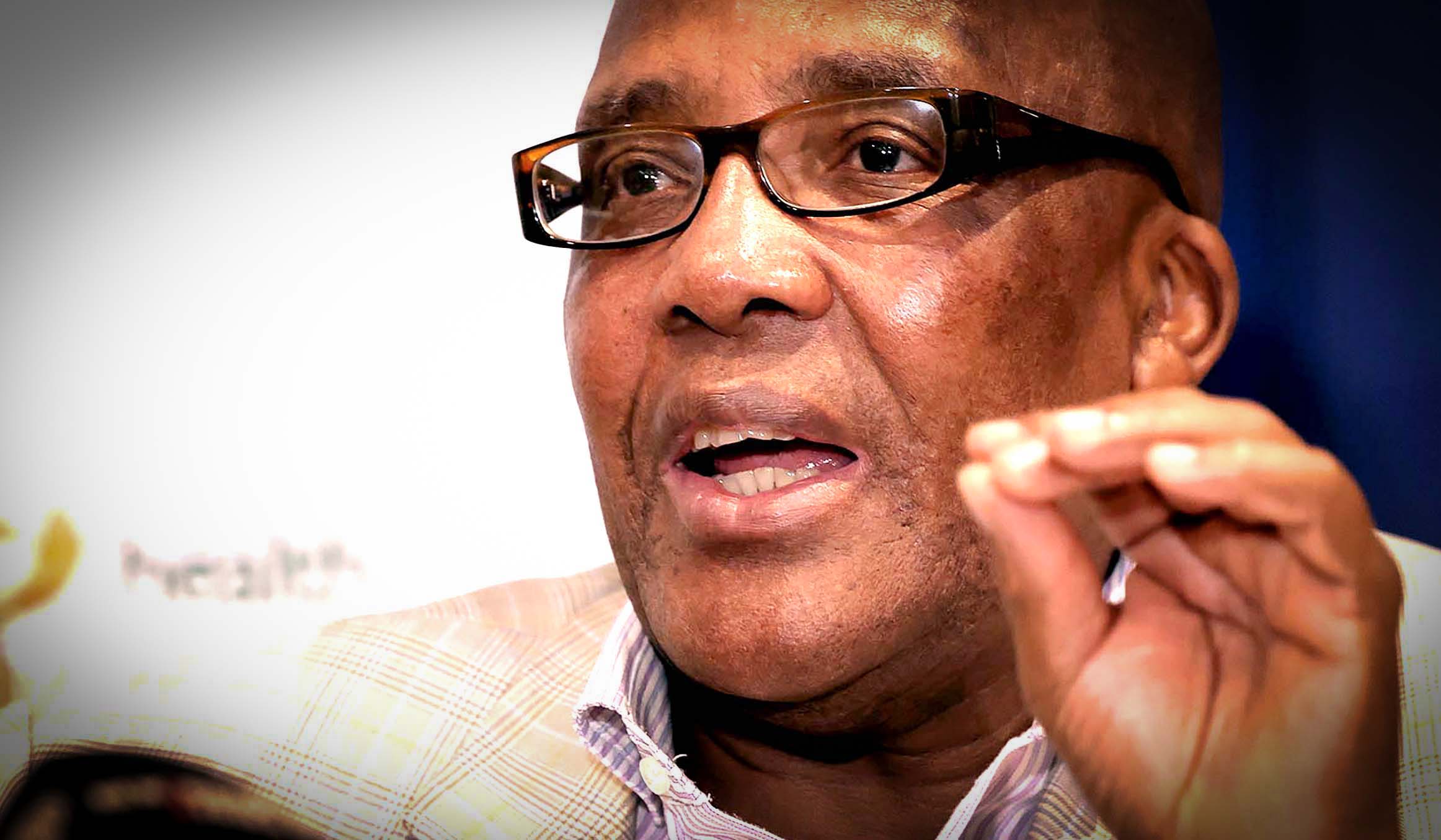
 Health Minister Aaron Motsoaledi. (Photo: Jairus Mmutle / GCIS)
 Health Minister Aaron Motsoaledi has poured cold water on suggestions that the National Health Insurance (NHI) scheme will be vulnerable to State Capture, insisting that structural changes to funding and procurement will safeguard the system.
His comments come two months after the Special Investigating Unit (SIU) exposed widespread corruption, maladministration and procurement fraud at Tembisa Hospital. The SIU revealed that three major syndicates were involved in the looting of more than R2-billion in public funds, intensifying fears that the NHI could face similar risks.
“Nobody accepts what happened in Tembisa Hospital. We are actually very angry. That is why between me and [the] SIU we have agreed that we must at least regain at least 90% of the money that was lost as a minimum,” he said in an interview with Daily Maverick this week.
Motsoaledi acknowledged the failures exposed at Tembisa but argued that the current healthcare system enables abuse because provinces act as both funders and providers.
“At present, why the system is not working is because, as a province, I am a funder and a provider at the same time. It means I fund what I provide. Whether what I provide is nonsense or not, I still fund it,” Motsoaledi said.
He said the NHI would fundamentally change this arrangement by introducing a funder-provider split.
“The provinces are going to be providers, the NHI will be funders,” he said.
Despite concerns about corruption and capture, Motsoaledi said this should not delay the full implementation of the NHI, arguing that governance failures should not deny South Africans access to universal healthcare.
“You can’t deprive people of NHI or universal health coverage on the basis that we’ve got scoundrels who steal money or corrupt people.
“It can’t be fair because you are punishing even innocent people through the actions of others,” he said.
/file/dailymaverick/wp-content/uploads/2025/02/NHI-article-copy.jpg "National Health Insurance aims to address healthcare inequity in South Africa, says Minister Aaron Motsoaledi. (Photo: Rosetta Msimango / Spotlight)")
In the latest Institute for Justice and Reconciliation Annual Barometer, published last week, 61% of South Africans either strongly approve of or approve of the NHI.
Motsoaledi also pointed to weaknesses in procurement processes at provincial level, saying decisions are often taken far from the hospitals where services are delivered.
In the case of many hospitals, “the people who issued the tender are in the provincial government, away from the hospital, etc”.
In some cases, he said, supply chain officials ordered equipment without consulting medical professionals who would actually use it.
Motsoaledi explained that in some instances tenders are issued in the supply chain department, where equipment is ordered, without the involvement of people such as health professors or doctors who work in hospitals who can say whether or not the equipment is needed.
“That’s why they ordered jeans and all that,” he said in reference to a News24 investigation which showed about R500,000 was spent on the procurement of skinny jeans.
Under the NHI, Motsoaledi said, procurement committees would be restructured to ensure that healthcare professionals are directly involved in purchasing decisions.
“Under [the] NHI, we are going to make sure that in the procurement committees, nobody proceeds without the people who are going to use the equipment, who are not necessarily part of the administration but part of the people who are using the [equipment].
The minister insisted on the need for the committees because they can easily push back when incorrect or unnecessary equipment is ordered.
Motsoaledi is a senior member of the ANC, which held its National General Council (NGC) last week.
Addressing the NGC, President Cyril Ramaphosa said there needs to be a concerted and coordinated effort to mobilise all the resources the country needs to improve the quality of care that people receive.
Among other things, this requires that the government address the conflictual nature of engagement over the NHI Act. Ramaphosa said he was proud of the progress made and said some of the country’s facilities were, in fact, NHI-ready.
“South Africa continues to make significant progress in the fight against HIV, Aids and tuberculosis. By the time we commemorated World Aids Day last week, 96% of people with HIV knew their status, 80% of those people were on treatment and 97% of those on treatment had undetectable viral loads,” he said.
Motsoaledi pointed to the country’s academic hospitals, including Baragwanath and Steve Biko, as some of the facilities ready for the NHI. He also singled out St John’s Eye Clinic, where he had surgery in October, praising its world-class standards.
NHI legal challenges
The implementation and roll-out of the NHI have been the focus of criticism and legal fights.
Since its signing into law in May 2024, just before the general elections, there have been several court challenges against the NHI.
/file/dailymaverick/wp-content/uploads/2024/09/ED_503767.jpg "President Cyril Ramaphosa and delegates at the public signing into law of the National Health Insurance Bill at the Union Buildings in Pretoria on 15 May 2024. (Photo: Gallo Images / Frennie Shivambu).")
Read more: EXPLAINER: On what grounds are the legal challenges against the contentious NHI Act being fought?
As Daily Maverick explained, some of these applications test the constitutionality of the law itself.
About this, Motsoaledi said: “We are in court already – I’ve got no option. It’s not about whether I’m prepared [to defend NHI] or not. So we are defending ourselves, but we are also prepared to talk to people and explain to them.”
In some cases, according to Motsoaledi, there’s a lack of understanding around the NHI and its implementation.
“For instance, I addressed doctors just last month in Cape Town... all doctors who are in private practice, and one of them said no, we understand under NHI we are no longer allowed to employ ourselves, we’re all going to be employed by the state,” he said.
Motsoaledi said he asked the doctors: “Where do you get that from?”
The response was that it came from “somewhere in the media”, although no clarification was given.
Motsoaledi told the doctors: “Some of you believe we are going to abolish private hospitals. It’s not true – all we are saying is that we must put up a healthcare financing system that allows me and you and any other person who is not of my status to get healthcare when they need it, whether they get it in public or private, but in a reasonable way, that’s basically what we’re saying.” DM