




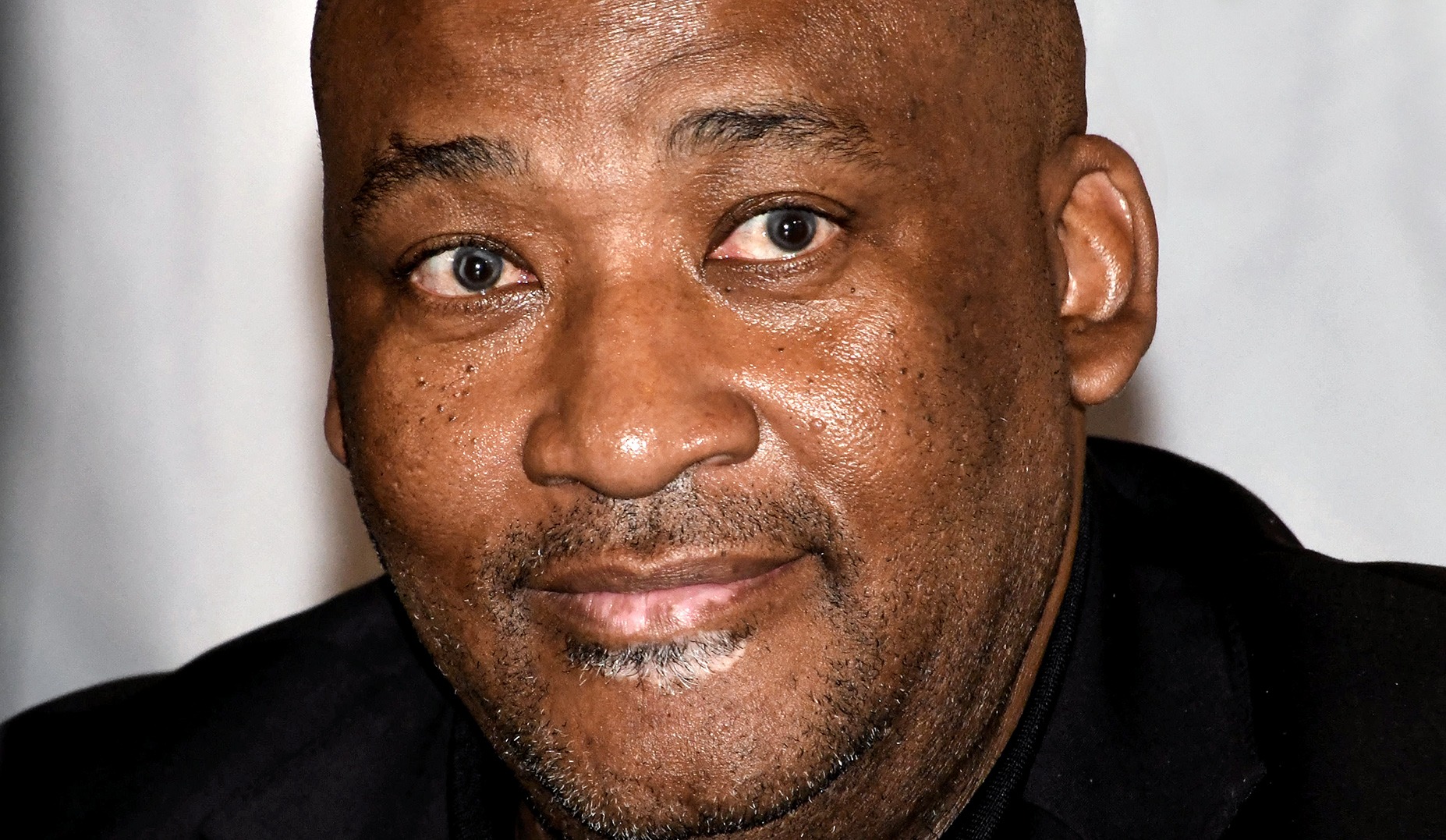
 Minister Gayton McKenzie claimed that his cancellation of artist Gabrielle Goliath’s work selected for the 2026 Venice Biennale was a ‘patriotic’ act. (Photo: Frennie Shivambu / Gallo Images)
 Arts and Culture Minister Gayton McKenzie’s claim that his cancellation of artist Gabrielle Goliath’s work selected for the 2026 Venice Biennale was a “patriotic” act intended to protect the South African Pavilion from being hijacked by a “foreign power” pushing its own “geopolitical message about the actions of Israel in Gaza” appears to be a red herring.
Daily Maverick has evidence that the “foreign power” McKenzie refers to — which is actually Qatar Museums, a cultural institution — had lost interest in purchasing a video recording of Elegy, Goliath’s work that was to be performed in Venice, well before the minister sought to interfere in its content on 22 December.
According to a chronology of events that Daily Maverick has pieced together through several WhatsApp exchanges between key players and interviews, a representative of Qatar Museums had conversations with the organising team for the South African Pavilion in early December about purchasing the artwork, or works, selected by South Africa. This conversation was initiated — almost in passing, according to insiders — in November 2025 during the G20 Summit in Johannesburg, when no artist had yet been selected.
Following the selection committee’s internal confirmation on 6 December of Goliath as South Africa’s sole representative, the conversation between the organising team and the Qatar Museums representative resumed on 8 December. This was one of multiple conversations being held simultaneously with several potential funders at the time. Daily Maverick has confirmed the identity of the Qatar Museums representative, who agreed to share the information on the condition of anonymity.
/file/attachments/orphans/GettyImages-1449374558_366739.jpg "Qatar Museums’ Museum of Islamic Art on The Corniche in Doha, Qatar. (Photo: Alex Pantling / Getty Images)")
On 9 December, Art Periodic (AP), the non-profit enlisted by the arts ministry to organise South Africa’s participation at the Venice Biennale, informed Goliath and her team, which consists of curator Ingrid Masondo and studio manager James Macdonald, about the expression of interest from the Qatari museum cluster — in both funding the pavilion and possibly acquiring the artwork. These kinds of acquisitions are common practice in the art world.
The discussions revolved around which funders the artistic and curatorial team would be comfortable with.
According to Goliath, the artistic and curatorial team’s position was that it was “not suitably positioned or equipped to vet potential funders we had no personal experience with or meaningful insight into. We subsequently suggested they liaise with the selection committee and aim at setting up an advisory board or suitable accountability framework for funding partners. AP agreed that this was a good idea and one they would consider and explore.”
Daily Maverick understands that AP was in the process of setting up this accountability structure when McKenzie canned the Biennale project.
She added it was “significant” that this “expression of interest came without prior knowledge of the selected artist-curator team or the content of the selected exhibition — so a ‘foreign nation’ could not have brought a political agenda and exhibition to the South African Pavilion”.
Further countering McKenzie’s allegations of “foreign capture”, Goliath pointed out that she has been “independently developing and conceptualising this work, Elegy, for years”.
Elegy is a three-suite piece engaging with femicide and LGBTQI+ killings in South Africa, women killed by German colonial forces in Namibia during the Ovaherero and Nama genocide in the early 1900s, and the killing of tens of thousands of women and children in Gaza by the Israel Defense Forces since October 2023. Goliath has consistently described the Elegy project, which has evolved over a decade, as “a work of mourning and repair” rather than being about violence.
/file/attachments/orphans/GabrielleGoliath_Elegy-JoanThabeng_2018_DoDisturbFestival_PalaisdeTokyo_photobyAykaLux_2_973971.jpg "Gabrielle Goliath’s work ‘Elegy - Joan Thabeng’, 2018, Do Disturb festival, Palais de Tokyo. (Photo: Ayka Lux)")
Goliath’s proposal was then shared with Qatar Museums on 11 December on condition of confidentiality, and on that day there were follow-up inquiries about the technical aspects of the work, the number of editions being planned and the price range of the work. Both Goliath’s galleries at the time, Galleria Raffaella Cortese in Italy and Goodman Gallery in South Africa — which has since dropped her — provided this information to the organising team over the next few days, and it was relayed on 15 December to Qatar Museums.
Read more: Goodman Gallery drops artist Gabrielle Goliath after her Venice Biennale selection
But, already as early as 11 December, the Qatar Museums representative expressed reservations about funding a solo work at the Venice Biennale, adding they would be “happy to share it with our Art Mill curator for their interest”. Art Mill is a museum of international modern and contemporary art being built in Doha, which is scheduled to be completed in 2030.
After the specs and prices were shared with Qatar Museums, there was no further movement on that conversation until the organisers informed the Qatar Museums representative on 4 January that Goliath’s work had been cancelled by McKenzie. Their response: “It sounds sadly political.”
One industry insider pointed out that Qatar Museums may have cooled on Goliath’s work because it deals with LGBTQI+ issues.
/file/attachments/orphans/GabrielleGoliath_photobyAntheaPokroy_2_468327.jpg "Gabrielle Goliath. (Photo: Anthea Pokroy)")
Common practice
Last week, upon reading the selection committee’s statement of solidarity with Goliath, the Qatar Museums representative wrote back to the organisers saying: “Sad. But given that climate in SA, it is good that we did not get involved.”
Goliath noted, “It is common practice for pavilions to be funded by a range of parties, from tech sponsors, collectors, museums, galleries, etc… The minister’s narrative betrays his lack of understanding of the arts economy and the workings of Biennale pavilions.”
Indeed, as the Qatar Museums representative noted when expressing their lack of interest in sponsoring the South African Pavilion because of its single-artist nature, Qatar Museums had provided primary funding for the Nigeria Pavilion at the 2024 Venice Biennale, which had been a multi-artist exhibition.
That year, the Nigeria Pavilion was also funded by auction house Christie’s, Art X Lagos and private individuals such as Nigerian lawyer Gbenga Oyebode and financial executive Tope Lawani. These types of sponsorships of national pavilions at the Venice Biennale have become increasingly commonplace because of governments cutting funding for the arts from their budgets.
South Africa’s own Venice Biennale private-public partnership between the Department of Arts and Culture and the non-profit Art Periodic was a result of McKenzie’s “discontinuation of the Venice Biennale project”, according to the department’s 2023-24 annual report. With the South African government locked into a 20-year lease of an exhibition space in the Sale D’Armi buildings in the Arsenale complex in Venice, taxpayers were still shelling out for the exhibition space, regardless of whether it would be used.
This led Art Periodic to make an unsolicited approach to the department on 20 October last year, offering to organise and raise money for the entire Venice Biennale process: from call-outs to artists, to the selection process, to the transport, installation and deinstallation of artworks in Italy.
The relationship was enthusiastically announced by the department on 5 November. In none of the documents relating to AP’s appointment or outlining the department’s expectations is there a requirement that funds only be raised locally, as McKenzie states in his 10 January press statement.
McKenzie’s silence
McKenzie first floated the artistic and political “capture” narrative last week when responding to Daily Maverick’s questions on the eve of our publishing an exposé on his interference with, and eventual cancellation of, Elegy. Daily Maverick had, on deadline, sought to confirm the name of the country in question with the arts ministry before publishing what appeared, at first glance, to be a vague conspiracy theory. Until now, no response has been forthcoming.
Qatar Museums had not responded to enquiries from Daily Maverick at the time of publishing. While the minister has made himself available for comment to publications such as the South African Jewish Report, he did not respond to questions from Daily Maverick this week. His team said he was “travelling”.
Instead, the minister repeated the claim in a press statement released on 10 January that was riddled with misdirection and inaccuracies — raising questions as to whether he had lied to the South African public.
Media outlets in Israel this week picked up on the story, with “diplomatic sources” naming Qatar as the “foreign power” McKenzie had alluded to. Many of these reports echoed claims of Goliath’s work being part of cultural “influence operations” against Israel.
Asked to comment on McKenzie’s allegations that Qatar had sought to push its geo-political agenda through the SA Pavilion at Venice, political commentator Steven Friedman pointed out the irony of South Africa being “far more active” than Qatar regarding Gaza and Palestine. He also noted that Goliath’s work was, in fact, “closer to the country’s foreign policy position on Gaza” than McKenzie, who Friedman described as a “right-wing Zionist”.
/file/attachments/orphans/Steven-Friedman-600-pix_646026.jpg "Steven Friedman (Photo: Supplied)")
Friedman also questioned why President Cyril Ramaphosa had yet to censure McKenzie for his censorship and interference, or remove him from his Cabinet. “Ramaphosa doesn’t need him to keep the Government of National Unity together,” said Friedman.
Qatar has been known for its soft power approach to diplomacy and reputation-washing in both the sports and arts and culture spheres. It owns the Paris Saint-Germain Football Club in France and is a major funder and collector of art from around the world, including South Africa.
The Museum of Islamic Art in Doha bought Irma Stern’s work Arab Priest in 2011 and loaned it back to South Africa’s Iziko National Museum in 2019.
The National Museum of Qatar owns an edition of William Kentridge’s The World on its Hind Legs sculpture, while Sheikha Al Mayassa bint Hamad bin Khalifa Al Thani, the sister of the current emir, has visited the Goodman Gallery in Johannesburg. The gallery refused to comment on whether it had sold any works to the Qatari Royal family, saying it “respects customer confidentiality”. DM