




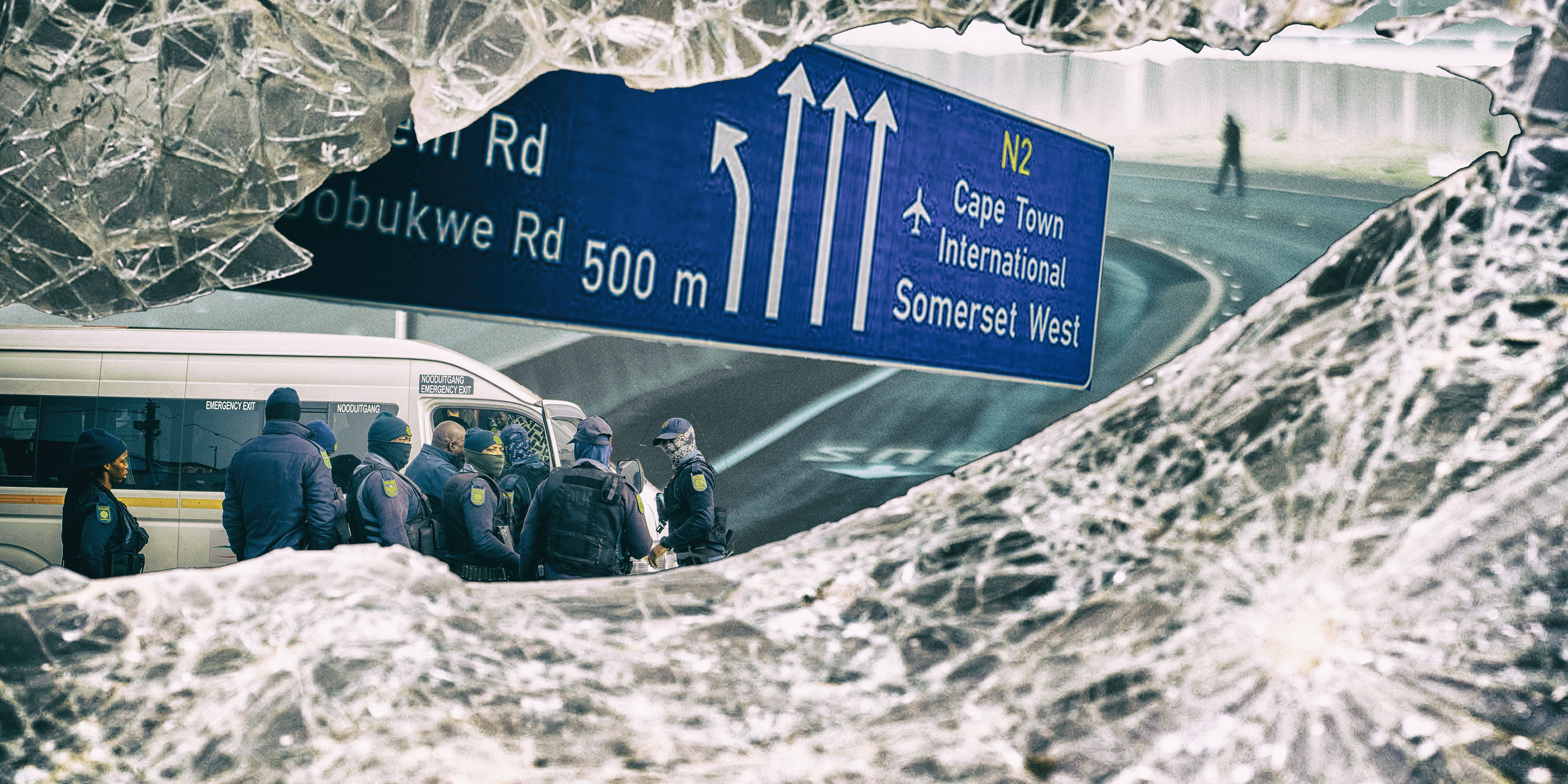
 Illustrated image: Smashed window of a car. (Photo: EPA / Valdrin Xhemaj) | Law enforcement in Nyanga. (Photo: Gallo Images / Die Burger / Jaco Marais) | N2 signage (Photo: Supplied) | The N2 inbound to Cape Town near the Borcherds Quarry exit to Nyanga (Photo: Gallo Images / Die Burger / Jaco Marais)
 Cape Town Mayor Geordin Hill-Lewis has repeatedly said that building a wall on the N2 will help keep residents safe, but Acting Police Minister Firoz Cachalia says a wall can’t replace police on the beat and will do little to address the city’s underlying crime issues.
In a recent parliamentary reply on the issue, Cachalia said the wall would not, in itself, “directly address organised criminal activity operating beyond the immediate roadside environment, firearm-related offences, gang-related violence or broader public order challenges affecting surrounding communities”.
He was replying to a question from Build One South Africa MP Mmusi Maimane on whether the N2 wall was an effective safety measure and more suitable for addressing the safety concerns of nearby residents and road users than visible policing.
/file/attachments/orphans/ED_572639_915067.jpg "Acting Minister of Police Firoz Cachalia. (Photo: Gallo Images / Brenton Geach)")
“The South African Police Service (SAPS) has not determined that the N2 safety project proposed by the City of Cape Town constitutes a substitute for sustained visible policing or enhanced investigative capacity,” said Cachalia.
“While the construction of a highway wall/barrier along the N2 may contribute to situational crime prevention by restricting pedestrian access to the roadway and potentially reducing certain opportunistic crimes directed at motorists, infrastructure interventions cannot replace core policing functions.”
The wall was proposed as a safety measure on a section of the N2 known as the “Hell Run”, where motorists have often been attacked.
The City’s December 2025 announcement faced an immediate backlash for bypassing community consultation and attempting to “sanitise” the tourist experience by shielding visitors from nearby poverty. Critics argued that the budget would be better spent addressing the root socioeconomic hardships of the communities lining the N2 corridor.
In January, the City tabled an adjustment budget, which featured the plan for the wall, with R115-million allocated over two years for its development and construction. This is in addition to the deployment of city police to patrol the highway.
Hill-Lewis has suggested that critics of the wall are delaying action on the city’s safety concerns while his administration is taking action. “While others suggest holding hands and healing, we will do whatever it takes to protect all of Cape Town's residents,” he posted on Facebook in February.
/file/dailymaverick/wp-content/uploads/2025/11/P12-Impact-Tracker6.jpg "Cape Town mayor Geordin Hill-Lewis at the launch of the N2 and Airport precinct safety deployment at Setters Way on 2 October 2025. (Photo: Gallo Images / Brenton Geach)")
‘Endless politicking’
On Monday, Cape Town’s MMC for Safety and Security, JP Smith, told Daily Maverick: “The endless politicking around the N2 wall by opposition parties shows that they are committed to putting politics before people.
“While they continue to distort the narrative around this issue, people are still falling victim to crime incidents on the N2. The City remains committed to safeguarding our residents and will not be swayed by the opinions of opposition politicians or an acting minister who continues to fail communities across the metro.
“The City wholeheartedly agrees that security infrastructure is just one part of the safety picture, and must be complemented by effective policing and prosecutions. This is why the City has been calling for the urgent proper resourcing of SAPS, as well as the devolution of crime investigation powers to City officers, who are ready to help build prosecution-ready case dockets in support of the SAPS and [National Prosecuting Authority].”
‘All spin but no plans’
Questions have also been raised over how the City of Cape Town actually plans to build the wall. The Western Cape government and Sanral, which have jurisdiction over parts of the areas where the wall will be built, have yet to be consulted.
In response to a question from Western Cape member of the provincial legislature Brett Herron, MEC for infrastructure Tertuis Simmers, said: “The department has not been formally engaged regarding the proposed N2 wall and, at this stage, has no involvement in its planning. Should a wall be proposed on any section(s) of the N2 where the department is the road authority, any such structure would require formal approval by the department in terms of the Roads Ordinance 19 of 1976”.
Herron told Daily Maverick that Hill-Lewis had made many commitments about the wall, “despite the obvious fact that many of the incidents they have cited as contributing to their decision to build a wall did not take place where the wall would have made a difference, since these incidents of violence were not on the N2.”
/file/attachments/orphans/ED_158234_687408.jpg "The aftermath of violent service delivery protests that led to the closure of the N2 highway near Somerset West on 11 April 2019. Shops and liquor stores were looted and structures were set ablaze. Police retaliated with rubber bullets and stun grenades, but sporadic protesters proved hard to disperse. (Photo: Gallo Images Netwerk24 / Jaco Marais)")
The section of the wall which Hill-Lewis referred to (from the Baden Powell Road intersection at Khayelitsha to Bhunga Avenue in Langa), claimed Herron, “is almost, if not entirely, owned and under the authority of the Western Cape provincial government”.
“The [MEC’s] replies indicate that the City has not had any formal engagement with the owner of that stretch of the N2 and its road reserve, where the wall is proposed to be built. The MEC also indicates that the province will have to approve the construction in terms of the road ordinance. The mayor’s fuss about the wall is all spin and no actual planning.”
Roads agency Sanral has told Daily Maverick that it too has not been consulted about the wall.
Sanral questioned the jurisdiction of the proposed wall, as the N2 from Cape Town International Airport to the Raapenberg Interchange (N2/M5) falls under the Western Cape Department of Infrastructure, while the section from the Raapenberg Interchange to the city centre is under the City of Cape Town’s jurisdiction.
Sanral’s jurisdiction begins at the N2/R300 interchange and extends eastwards, out of the city.
MMC for urban mobility Roberto Quintas said: “The process and engagements to determine the full scope of the project are under way. More information will be available once these processes have been concluded.” DM
Comments
Scroll down to load comments...