




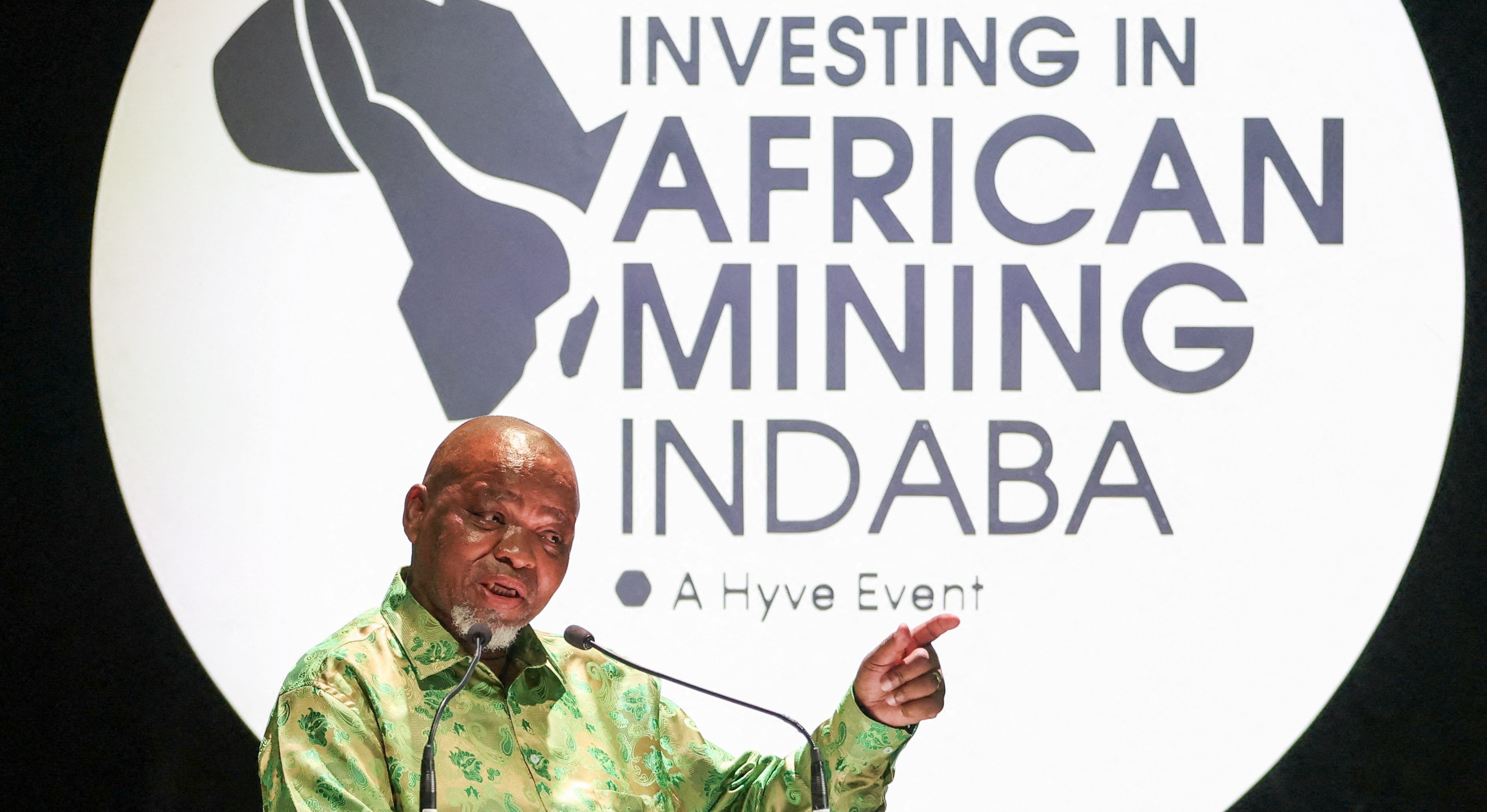
 Minister of Mineral and Petroleum Resources Gwede Mantashe speaks at the indaba in Cape Town on 9 February 2026. (Photo: Reuters / Esa Alexander)
 Minister of Mineral and Petroleum Resources Gwede Mantashe clashed with his Congolese counterpart at the African Mining Indaba over the critical minerals deal that the Democratic Republic of Congo (DRC) signed with the US last year.
At a closed ministerial meeting at the indaba in Cape Town on Sunday Mantashe had accused the DRC of “selling out, or words to that effect,” to the US, according to two African analysts who witnessed the exchange.
DRC mining minister Louis Watum Kabamba seemed offended but held his ground and retorted that the deal was mutually beneficial.
At a later open panel discussion which included the two ministers, Kabamba again defended the deal, saying it was not one-way and the DRC had not sold its minerals for nothing. He said the DRC was looking after its own national interest by diversifying its partners, noting that China had been dominating the purchase of African copper production, for instance.
The US-DRC deal gives the US access to DRC critical minerals in implicit exchange for a peace deal which Donald Trump brokered between the DRC and its Rwandan enemy. But the peace deal is not holding as the Rwanda-backed M23 rebels continue fighting government troops and terrorising civilians in the east of the country. And critics say the critical minerals deal does not help the DRC build processing capacity and requires it to freeze its tax and regulatory regimes for a decade.
Kabamba noted at the Mining Indaba that he had just returned from Washington where US Secretary of State Marco Rubio had convened a meeting of 54 countries to discuss how to cooperate in developing critical minerals.
/file/attachments/orphans/RC2EIJANCSDZ_315288.jpg "The DRC’s mines minister, Louis Watum Kabamba, he speaks during the African Mining Indaba in Cape Town on 9 February 2026. (Photo: Reuters / Esa Alexander)")
Mantashe retorted that “it’s not about the DRC national interest. It’s about the continental interest.” Mantashe suggested that the DRC had been excluded from the Trump administration’s high import tariffs because of the critical minerals deal and that this was abetting a US “divide and conquer” strategy in Africa. Last year, the US imposed a baseline 10% import tariff on the DRC, far less than the punitive 30% it imposed on South Africa.
Daily Maverick asked Mantashe later to comment on what the analysts had described as a spat and on their reports that he had accused the DRC of selling out. He denied both charges.
He said he had not called the DRC a sellout. “It’s you who called them that. We didn’t call them that. We said they must look into the interest of the continent, not self-interest of the DRC. That is not a spat.”
Asked how Kabamba had responded to his criticism in the closed ministerial meeting, Mantashe said South Africa would continue to talk to the DRC because there should be a continental approach to critical minerals.
One of the analysts, who did not want to be named, said the spat had clearly occurred in the context of South Africa’s own fraught relations with the US and added that it was inevitable that African countries would pursue their own national interests.
Mantashe’s exchange with his DRC counterpart reflected the remarks in his welcoming address to the Mining Indaba where he called for continental unity amid rising global resource competition and tensions.
He said African nations had to act collectively in defending their mineral sovereignty, warning that intensifying geopolitical competition over natural resources posed a growing threat to resource-rich developing economies.
So the 2026 indaba theme, “Stronger Together: Progress Through Partnerships”, was more than symbolic, it was a strategic necessity for Africa, he said.
He added that heightened global demand for critical minerals was driving renewed competition among developed economies seeking control over supply chains. Without continental coordination, African countries risked being forced into a “race to the bottom” in negotiations with global investors. DM