



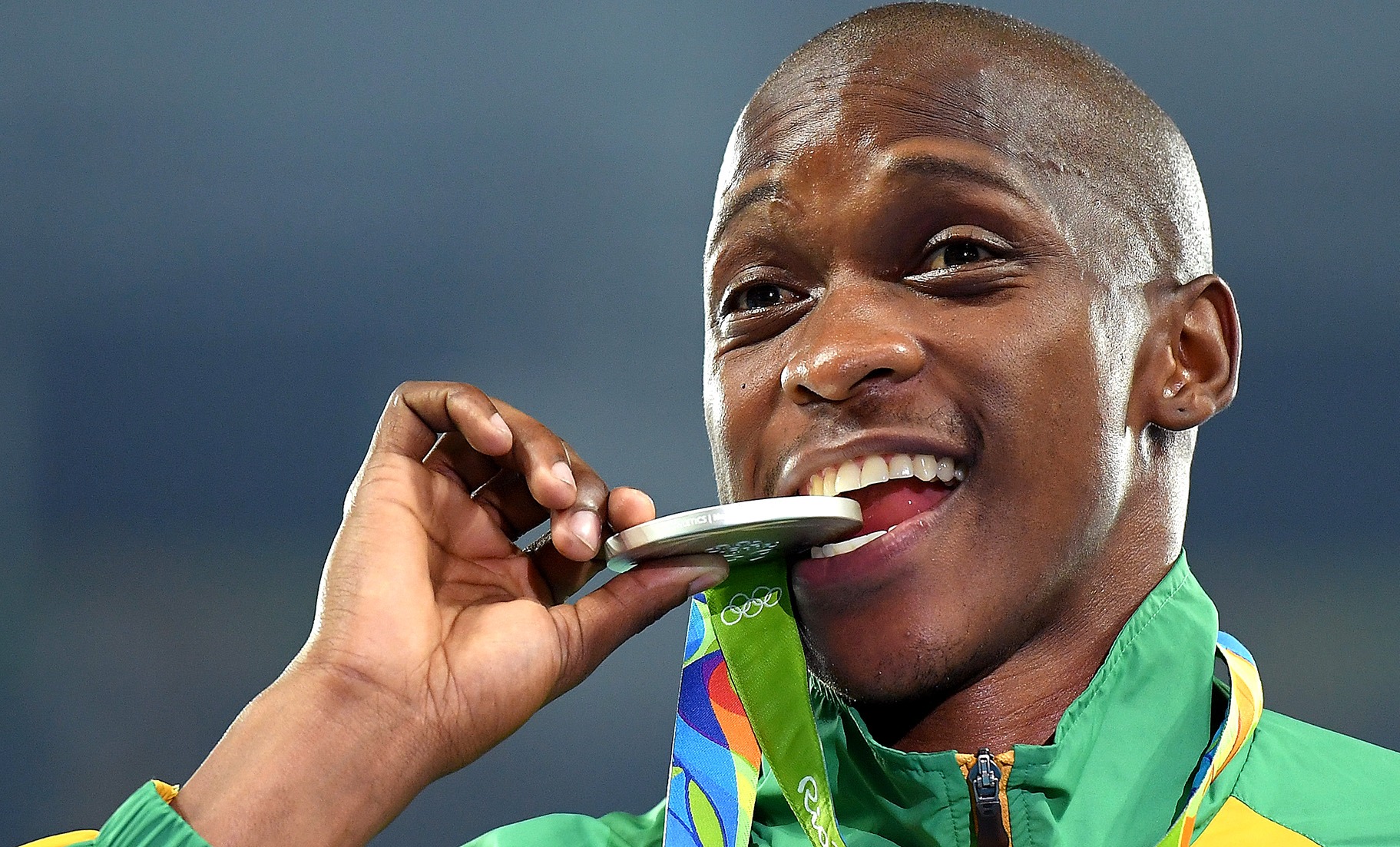
 Luvo Manyonga of South Africa poses with the silver medal for Men's Long Jump on Day 9 of the Rio 2016 Olympic Games at the Olympic Stadium on August 14, 2016 in Rio de Janeiro, Brazil. (Photo: Matthias Hangst / Getty Images)
 Roughly 75km south of the City of Gold, former Olympic long jump silver medallist Luvo Manyonga spends most of his days training at Hoërskool Transvalia's high performance centre in Vanderbijlpark.
Clad in green and gold, long-limbed and nimble, Manyonga joins his coach Herman Venske in his office for yet another media interview.
Nevertheless, he is beaming, because on Sunday, 22 March, Manyonga is set to return to a global championship stage for the first time in seven years, following a string of comeback meets in 2025 and a season-best 8.11m leap this year.
Considered one of the most promising long jumpers who seemed unstoppable at his peak, Manyonga last represented South Africa at the 2019 World Championships in Doha.
He is highly decorated, having won silver at the 2016 Rio Olympics and claiming gold at the 2017 World Championships in London, making him the first African long jump world champion.
At the 2018 World Indoor Championships in Birmingham, Manyonga added to his tally with silver. Weeks later, he claimed Commonwealth gold on the Gold Coast in Australia, setting a Games record. He is also a three-time Diamond League winner.
/file/attachments/orphans/LuvoGraphic_338091.jpg "A snapshot of major medals won by South African long jumper Luvo Manyonga, highlighting some of the defining moments of his career. (Graphic: Annemieke Thomaidis)")
But the story of Manyonga’s career is not only one of medals.
It is also one shaped by addiction and two career bans that broke the hearts of many South Africans and nearly ended it all.
Exposures and exploitations
Two figures in his youth helped shape Manyonga’s path.
Growing up in Mbekweni, Paarl, he spent his days playing “three sticks” – a street game involving running and jumping. It was there that a local triple jumper first noticed Manyonga’s raw talent and invited him to train at a nearby athletics track.
By 2009, his talent had caught the attention of Mario Smith, then a coach at Stellenbosch University, who began guiding Manyonga towards a professional career.
Still a teenager, Manyonga rose quickly, turning professional, earning money and attracting sponsorships. But with that rise came pressure he was ill-equipped to handle.
/file/attachments/orphans/GettyImages-926419644_792583.jpg "Luvo Manyonga in action during the 2018 World Indoor Championships in Birmingham. (Photo: Michael Steele / Getty Images for IAAF)")
“I got the fame at a young age,” Manyonga told Daily Maverick. “My professionalism in sport happened so quick without any adult help, nobody was there to assist me with all the pressure.”
His home environment offered little stability. His father was largely absent, and although his mother was loving and supportive, she could not provide the guidance his career demanded. Manyonga was pulled out of school before matriculating.
At the same time, he alleges, people, particularly those in management, began to take advantage of him, although he would not say who.
“That cycle of becoming a professional at a young age, you get exposed to money, you get exposed to sponsorship, you travel the world,” he said. “[But] there’s a lot of guys out there that just use these young kids for their own benefit and then at the end, they just drop them like that.”
Ultimately, Manyonga fell in with the wrong crowd and in order to escape and cope, he began using tik, a local form of crystal meth.
/file/attachments/orphans/GettyImages-589026524_246989.jpg "Luvo Manyonga has fallen, but he continues to get back up. (Photo: Cameron Spencer / Getty Images)")
‘I should have been dead’
His first ban came in 2012 after testing positive for the drug, resulting in an 18-month ban from the sport.
When Smith, his mentor, died in 2014 in a car accident on his way to see Manyonga, Manyonga spiralled further.
“I was the person. I decided to use the drugs,” said Manyonga, who has never shied away from taking responsibility for his choices. “Nobody forced me.”
Between 2020 and 2024, Manyonga served his second career suspension, this time for “whereabouts failures”, a violation of anti-doping protocols which requires athletes to be available for out-of-competition testing.
By then, his life had become unstable. He drifted between staying with family and spending periods on the street “like a hobo”, Manyonga’s manager Munya Maraire from World Wide Scholarships (WWS) told Daily Maverick.
He moved in and out of rehabilitation centres for years, unable to break the cycle, but the turning point came violently.
“My last time of use was when I got into an incident where I got beaten up by the community and couldn’t walk for a week. That’s when the penny dropped for me,” said Manyonga.
In December 2024, Manyonga completed his four-year ban, and in early 2025, an opportunity arrived.
Taking a chance on him, WWS, a sports management company, signed Manyonga. Maraire approached Venske about coaching him.
/file/attachments/orphans/DSC_0118_486520.jpg "Since the beginning of 2025, Herman Venske (right), former South African sprinter and now director of athletics at Hoërskool Transvalia, has taken a bold step, welcoming Luvo Manyonga (left) into his home to support his bid for a return to elite athletics. (Photo: Annemieke Thomaidis)")
“It took me about a month, a month-and-a-half to contemplate whether I should stick my head into it,” said Venske.
He eventually said yes, doing more than just coaching him: Venske took Manyonga into his home.
For the first time in years, a sense of structure and stability returned. Manyonga took responsibility. He was accountable for showing up and training, and through discipline and a strict diet, he even lost 16kg.
“He’s an exceptional young man, very smart,” said Venske, looking over at Manyonga with tears in his eyes. “When you coach him and you get to know him, then you also get feelings of anger. This guy did not even finish matric because they grabbed him out of school to use him for their own benefit.”
Looking back on those dark years, Manyonga is grateful to be alive with another chance to make South Africa proud.
“Everything that happened, I think it happened for a reason,” he said. “I’m glad that I’m still alive today because I think if that went on, I should have been dead or I should have been in prison, but it had to happen in that way. I’m so grateful that I have made it through those years.”
/file/attachments/orphans/Untitleddesign12_999042.jpg "South African long jumper Luvo Manyonga spends almost five hours a day training at Hoërskool Transvalia under the mentorship of Herman Venske, a former South African sprinter and now director of athletics at the high school. (Photo: Annemieke Thomaidis)")
Third time’s a charm
Before his selection for the upcoming Indoor World Championships in Poland, Manyonga has participated in several events.
Last year, the now 35-year-old competed at the South African National Championships in Potchefstroom, where he placed sixth with a jump of 7.68m.
A little less than a year later, he improved significantly when he jumped 8.11m at a US indoor meet in Arkansas. This jump placed him 17th on the world rankings and secured his selection for the South African team for Poland.
“My goal for this weekend is just to go collect what is mine,” said Manyonga. “A medal will be great, and that’s what I’m looking for. Whatever happens, it’s a process for me. I just came back, and I’m going to do my ultimate best.”
Manyonga competes in the long jump on 22 March at 8.12pm South African time, according to the World Athletics website. DM
Comments
Scroll down to load comments...