




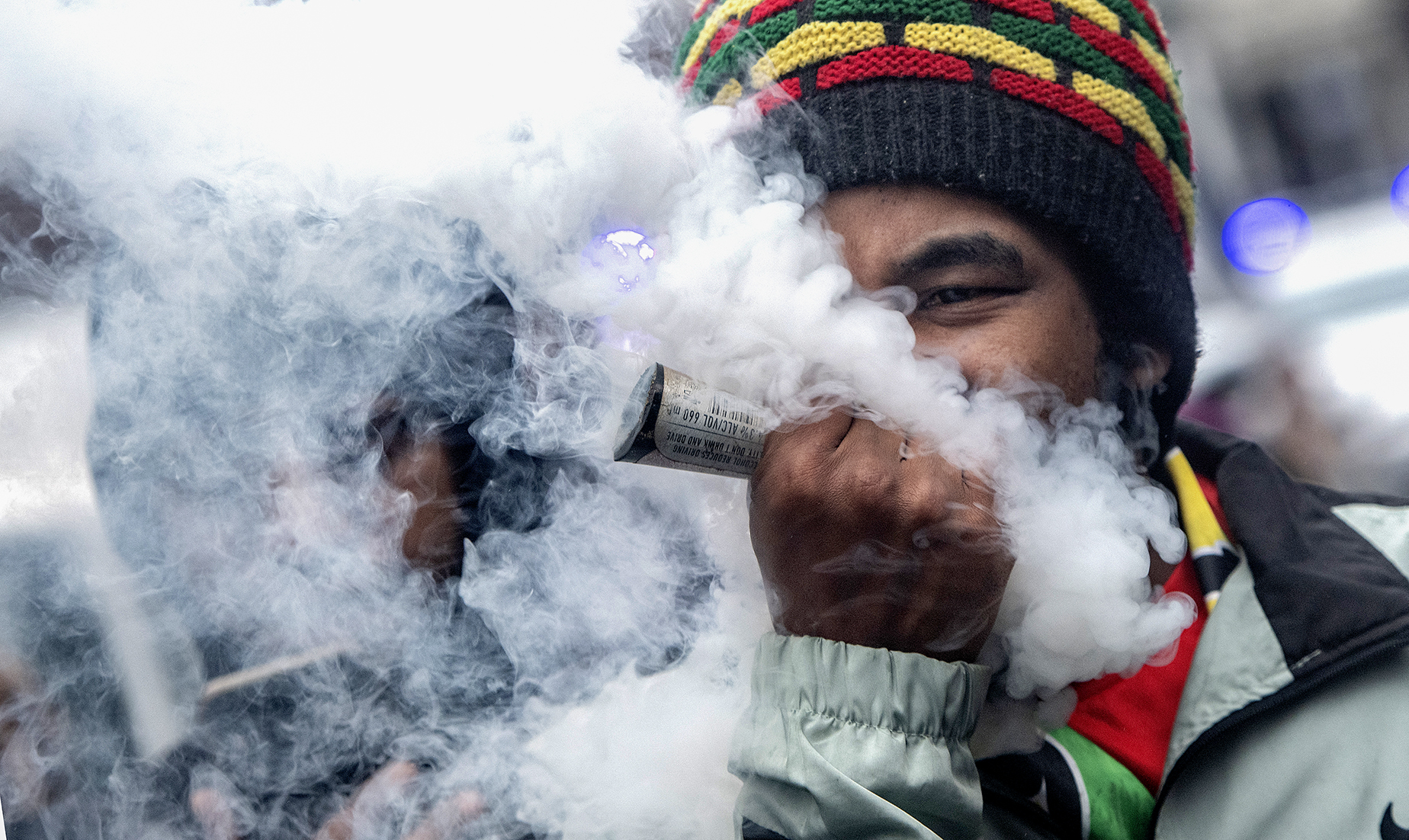
 Recreational cannabis products have again been excluded from the annual ‘sin tax’ hike. (Photo: Brenton Geach / Gallo Images)
 There are always three certainties in the annual Budget Speech delivered by the minister of finance.
The first is that economic growth projections are consistently over-optimistic, inevitably overshooting the actual results. In this case, Finance Minister Enoch Godongwana has forecast growth of 1.6% for 2026. The accuracy of this projection will only come fully to light next year.
The second is that projections for the debt-to-GDP ratio almost always get raised, in this case from 77.9% to 78.9% for the ceiling. And as is almost always the case — and this year is no exception — that is because economic growth undershot the forecast.
This trifecta of continuity is capped by the annual hikes in “sin taxes”, which the minister said in his speech “are unavoidable”.
Actually, they’re not unavoidable, and at least smokers, vapers and drinkers can console themselves over a puff and/or glass with the fact that the excise tax on these sinful products will only be increased in line with inflation, which is currently a moderate 3.5%.
But pot smokers can once again raise a bong to the Budget.
Through the dense cloud of smoke that hangs over South African pot policy, recreational cannabis products — the goods that people consume to get stoned — have once again been excluded from the “unavoidable” annual ritual of the rise in excise taxes on sinful stuff.
This is surely low-hanging fruit waiting to be plucked by a Treasury that needs every rand it can lay its hands on.
In my native Canada, government revenues in 2024 from the sale of legal cannabis products — including the recreational kind — exceeded that of beer and wine for the first time.
That would not be an inconceivable scenario here. If you have spent time in almost any mall in South Africa, you would have to be wilfully blind not to have noticed the proliferation of cannabis shops and kiosks.
In the space of just a few years, they have gone from zero to being a ubiquitous feature of the South African retail landscape.
I have drawn attention to this before, and while —full disclosure, as always — I am a recreational cannabis consumer, I remain both grateful and perplexed at how slow the government has been to grasp this source of revenue.
Read more: It's a fiscal sin that Treasury has no sin tax on cannabis products
A haze of uncertainty
Or perhaps this state of affairs is not so perplexing. As is the case in many other areas, government policy in South Africa is often shrouded in a haze of uncertainty that speaks to competing interests, political priorities, cadres trying to figure out how to get a cut, and, in some instances, is simply a lack of attention to the details around the matter.
“Cannabis products are not yet part of excisable products, meaning they are not liable to health taxes (so-called sin taxes),” the Treasury’s media unit told me last year.
“The legislative framework for cannabis is still broadly limited to medicinal use or ‘private use’ and has not yet attained commercial status for possible application of excise duties.”
I guess that depends on your definition of “commercial status”, because cannabis has certainly become commercialised on a large scale in South Africa. However, the legislative framework remains missing in action.
Cannabis has long been big business in South Africa, but it was confined to the informal sector when it was criminalised, with the proceeds generally only reaching the light after a good scrubbing, no doubt, in various laundromats.
The seeds of formal commercialisation were sown by the landmark Constitutional Court ruling in 2018 that effectively legalised the private cultivation and consumption of cannabis. This was followed by the Cannabis for Private Purposes Act that President Cyril Ramaphosa signed into law in 2024.
The many retail outlets openly selling the product in South Africa remain in a state of uncertain legal limbo, and the exemption of the goods they hawk from sin taxes is a consequence — one which should bring a smile to their faces and those of their customers, who tend to be a happy lot in the first place.
Earlier this month, the Ministry of Justice and Constitutional Development published draft regulations for public comment on the cannabis question and the 2024 Act.
Upper limits for possession, of 750 grams, and cultivation — no more than five plants — are on the menu. And there is a long and convoluted list of proposed regulations regarding the transportation of cannabis, which will leave many a cop seeking a “cool drink” dazed and confused.
But there is nothing about the commercial or retail sectors, which presumably is the remit of another ministry — one assumes Trade and Industry.
So it goes on.
This is a revenue stream that keeps flowing past the Treasury because of legislative inertia. And one upshot of an excise tax on recreational cannabis products is that hikes on the other “sinful” products could indeed be “avoidable” or at least less painful. DM