



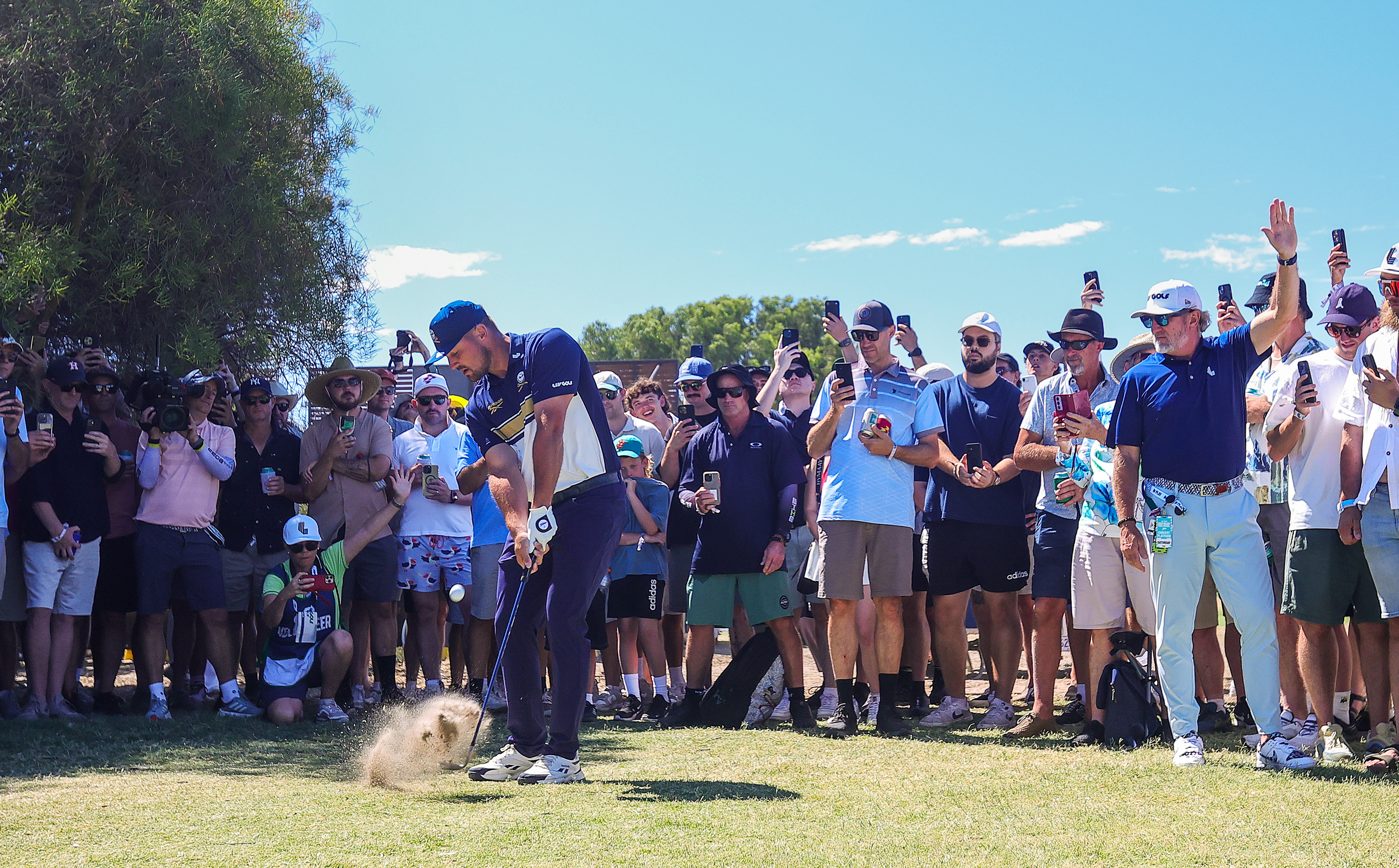
 Bryson DeChambeau on day three of LIV Adelaide at the Grange Golf Club in Australia on 14 February 2026. (Photo: Sarah Reed / Getty Images)
 It’s no longer “golf, but louder”; instead it’s more like “golf as we know it”. LIV Golf has moved away from its brash, “kick-the-door-down” approach into a new phase of growth and stability.
Underpinned by backing from the almost bottomless pit of Saudi Arabia’s sovereign Public Investment Fund (PIF), LIV could afford to pay huge fees if it wanted. But now in its fourth full League season (the inaugural 2022 season was only eight tournaments), LIV Golf, it seems, is maturing.
Scott O’Neil, its second chief executive, is less confrontational than his predecessor, Greg Norman. He also has a different mandate: to make LIV profitable and sustainable in its own right.
LIV’s initial approach was as a disruptor and it entered the golf market with the subtlety of a missile strike. Backed by billions of dollars, LIV recruited some of the biggest names in the sport – Bryson DeChambeau, Jon Rahm, Brooks Koepka, Phil Mickelson, Dustin Johnson, Cameron Smith, Patrick Reed and South Africa’s Louis Oosthuizen – to front the league. It also recruited dozens of other players and made them wealthier than they could have imagined.
The source of the money – Saudi Arabia – has been scrutinised, criticised and debated. And though the country still has a massive image crisis regarding human rights abuses, most of the world is doing business with Riyadh – from the US government and Formula One, to tennis and golf.
It seems LIV has conceded the US to the PGA Tour and now has its sights set on dominating the remainder of the golfing world.
“There is a pyramid in the US that the PGA has had the lead of... and there’s a pyramid in the world. And that’s the pyramid that we sit atop,” O’Neil told Daily Maverick on a recent whirlwind site visit to Steyn City, which will host the inaugural LIV Golf South Africa next month.
/file/attachments/2988/Scott-ONeil-1_593197.jpg "LIV Golf CEO Scott O’Neil. (Photo: Getty Images)")
LIV delivered a “spectacle” in Adelaide, Australia, last week and is tracking a sellout of 90,000 tickets in South Africa. O’Neil sees the local event not just as a tournament, but as a massive economic boost for the region. He even suggested his own team’s estimates were too low.
“I think the economic impact we’ll drive will be somewhere in the $40-million to $50-million range,” he said. “I think that’s very conservative. I’ve just argued with my team before... but they want to take a more conservative bent and view... We’ll be able to create one job in this market for every 13 tourists we bring in.”
O’Neil believes South Africa is the “perfect” market for LIV because it checks all four of its boxes for successful expansion. “It’s a world-class course. It’s a world-class resort. You’re in a city and a country that understands, loves and celebrates golf,” O’Neil said. “And we have a chance to come in and make a difference. This is as good as it gets for us.”
/file/dailymaverick/wp-content/uploads/2023/04/GettyImages-1481056354.jpg "Brooks Koepka drives from the 15th tee during the final round of the 2023 Masters Tournament at Augusta. (Photo: Christian Petersen / Getty Images)")
LIV’s global focus explains why the recent PGA Tour offers to “returning members”, which reportedly tempted Koepka and Reed to defect back to the PGA, failed to trigger a mass exodus. O’Neil dismisses the noise as “creative reporting” and points out that his players are “global citizens” who have embraced a lifestyle that the PGA Tour doesn’t offer.
New approach
The numbers 54 and 72 have defined the ideological rift in professional golf for the past four years. One represented the upstart disruptor, which was viewed as a three-day sprint; the other represented the weight of history, the four-day test of the PGA Tour and the Majors.
But as O’Neil settles into the league’s “third chapter”, he is making a move that would have been unthinkable during the era of open litigation: embracing the 72.
“We certainly want to be Netflix and not Blockbuster,” O’Neil said.
He framed his league not as an antagonist, but as an evolutionary organisation: “Whenever you [evolve], there’s going to be resistance. There are people who want the status quo. That’s okay. We don’t have a scarcity mindset here, we have a growth mindset.”
This growth mindset has led to the most significant operational shift in LIV’s short history: the move to a 72-hole format for the 2026 season. For a brand literally named after the Roman numeral for 54, the change feels seismic. “Sentiment seems to be that the biggest stage in the world is the Majors, and we need to do everything we can to best prepare [LIV players] for the Majors,” O’Neil said. “Let’s mirror the format. That makes complete intuitive sense to me.”
LIV altering its format only three years in could be seen as a “victory” of sorts for the existing golf establishment, but O’Neil is nothing if not pragmatic. Although the format shift serves the players, it also serves a higher political purpose. LIV’s exclusion from the Official World Golf Ranking (OWGR) has been its greatest Achilles heel.
/file/dailymaverick/wp-content/uploads/2022/09/GettyImages-1426371904.jpg "Trevor Immelman, pictured in 2022, is the chairperson of the Official World Golf Ranking. (Photo: Warren Little / Getty Images)")
By moving to 72 holes, O’Neil is removing the primary technical barrier to legitimacy. He speaks of OWGR chairperson Trevor Immelman – the South African former Masters winner – with a level of respect that signals a new era of diplomacy.
“Immelman has been quite a breath of fresh air,” O’Neil said. “He’s led with grace and passion. Having him lead was the opportunity for us to be recognised. It’s a first step.”
Immelman announced this month that the top 10 LIV players at each of its 14 events would earn OWGR points. Despite O’Neil’s personable comments about Immelman, LIV’s hierarchy was livid about the outcome. In an official statement in reaction to the OWGR announcement, LIV’s tone was far less conciliatory than O’Neil’s in person.
“Limiting points to only the top 10 finishers disproportionately harms players who consistently perform at a high level,” LIV’s statement read. “No other competitive tour or league in OWGR history has been subjected to such a restriction. We expect this is merely a first step towards a structure that fully and fairly serves the players, the fans and the future of the sport.”
Asset class
Despite limitless PIF funds, O’Neil is focused on LIV’s balance sheet. For the first time, LIV is moving away from being a 100% PIF-subsidised venture towards a traditional franchise model. LIV has officially engaged Citibank to facilitate the sale of between 10% and 20% minority stakes in its teams. The fanciful goal? To turn 13 “start-ups” into billion-dollar franchises.
O’Neil claims there is huge interest in investing in LIV Golf, which as chief executive, he has to say. But new sponsors such as Rolex, Salesforce and HSBC do back up this claim to an extent.
“I’m a buyer, not a seller right now,” O’Neil said. “But with this kind of [sponsorship] interest, we thought it prudent to go out and engage a bank and hopefully sell a couple of stakes [in the teams].”
The strategy is “local-global”. O’Neil wants a South African partner for Oosthuizen’s Southern Guards GC and an Australian partner for Cam Smith’s Ripper GC. This isn’t just about capital; it’s about “industrialising” the teams.
Asked about the sustainability of a league that has reportedly lost more than $1-billion since its inception, O’Neil didn’t flinch. He cited Amazon and Facebook as examples of hyper-growth companies that prioritised scale over immediate cash flow.
“We’re not busy fools; we’re building a business,” he said. “You can make any business cash flow positive – you just squeeze the expense side. But to grow at the rate and pace we anticipate, we’ve got to put more money in to get the top line growing faster.” DM
This story first appeared in our weekly DM168 newspaper, available countrywide for R35.
/file/attachments/2988/DM-20022026001CPTJHB_812973.jpg)
Comments
Scroll down to load comments...