




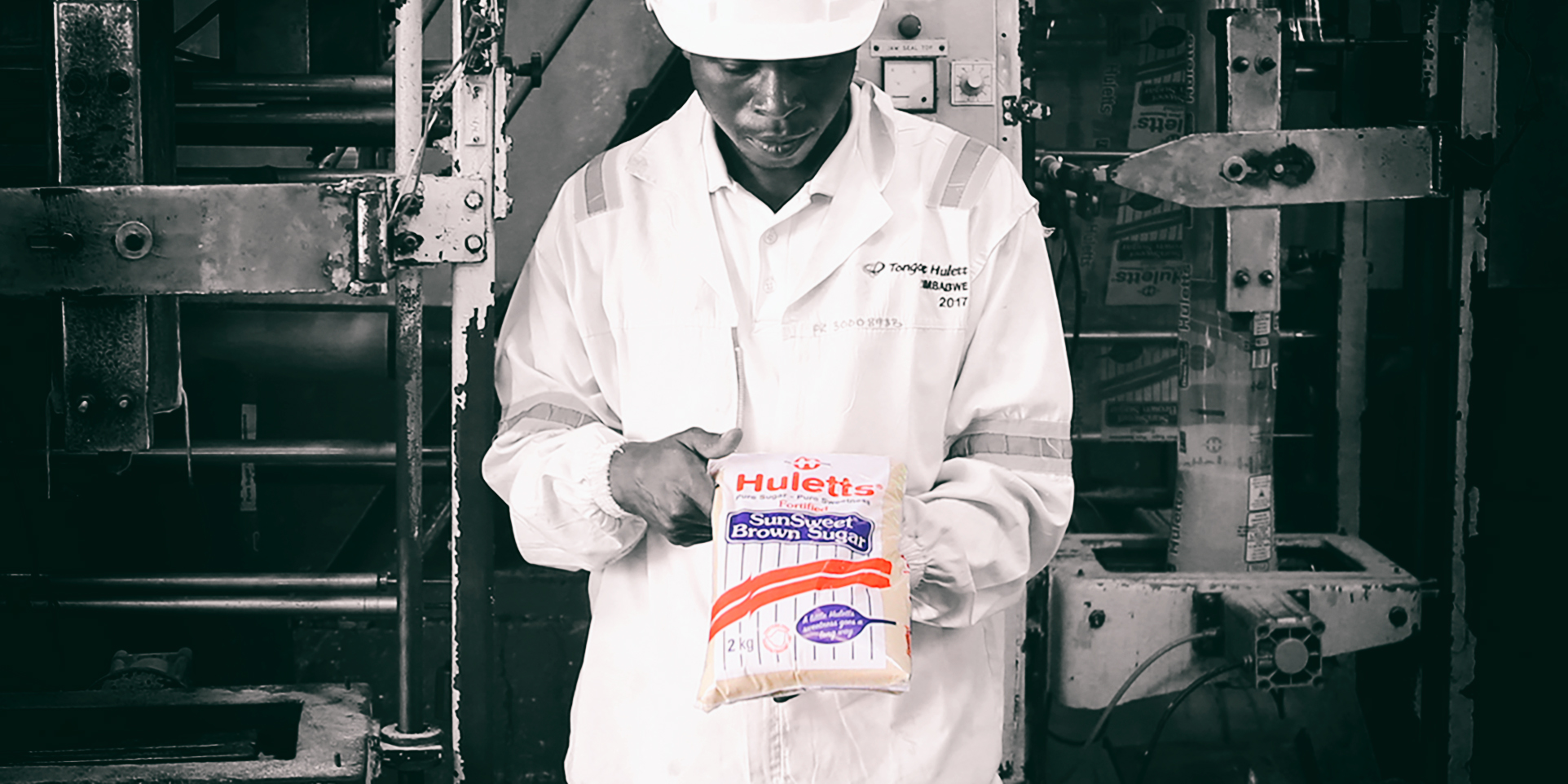
 Tongaat Hulett’s business rescue process, which has meandered through boardrooms and courtrooms since late 2022, hit a legal ceiling in December 2025. (Photo: Aaron Ufumeli / EPA-EFE)
 While the massive sugar mills of KwaZulu-Natal continue to churn, the legal and financial scaffolding holding up Tongaat Hulett Limited (THL) has undergone a substantive change.
The company’s business rescue process, which has meandered through boardrooms and courtrooms since late 2022, hit a legal ceiling in December 2025.
Although the Vision Group has successfully settled the company’s bank debts, a December ruling by the Supreme Court of Appeal (SCA) has stripped the business rescue practitioners (BRPs) of their ability to suspend statutory industry payments.
Read more: Sticky delays keep sugar giant Tongaat Hulett in limbo
The court found that these levies are requirements of law, not private contracts, meaning the shield used to protect the company’s cash flow does not apply — a liability the new owners must now factor into the final transfer.
The rescue is no longer searching for a solvent parent (that partner has been found in the Vision Group), but has morphed into a high-stakes compliance exercise. On 15 December 2025, the SCA dismissed THL’s attempt to suspend payments to the South African Sugar Association (Sasa), ruling that the sugar industry agreement was not a private contract but subordinate legislation.
This means the practitioners, who had hoped to treat the industry debts as negotiable contractual obligations, have been told by the highest authority that payments to Sasa are mandatory.
Judge John Smith clarified that because these levies were “liabilities imposed by statute”, they fell outside the scope of section 136(2) of the Companies Act. The ruling forces THL to treat Sasa as a regulatory authority rather than a standard creditor.
“The BRPs are reviewing the judgment and taking legal advice,” THL told Daily Maverick, adding that “the business rescue plan provides for the payment of the Sasa amount”.
Delays with IDC financing
The acquisition of THL by the Vision Group is legally advancing, but the final handover remains stuck in second gear. According to a statement released in June 2025 by THL, “Vision has now fully settled all outstanding obligations to the Lender Group as of 9 May 2025”.
This cleared a massive hurdle, effectively removing a consortium of commercial banks, including Absa, Nedbank and Investec, from the immediate line of creditors. They held the bulk of THL’s secured debt of approximately R8-billion.
However, “settled” does not mean the company is debt-free or that the rescue is complete. While the historical bank debt is resolved, the transfer of ownership remains contingent on the Industrial Development Corporation (IDC).
Read more: Tongaat Hulett granted interdict in battle over disputed land amid community claims and tensions
A December 2025 status report released by the BRPs confirms that the finish line has, once again, been pushed back. While the asset transaction — the sale of the physical sugar mills, refinery and subsidiary shares to Vision — is ongoing, the “refinancing of the Industrial Development Corporation (IDC) post-commencement finance facility” is “taking longer than originally anticipated”. Originally, Vision intended to convert debt into equity. However, due to shareholder opposition, the deal was restructured as a sale of assets.
This IDC facility was the financial lifeline that kept the company afloat, funding more than R1.4-billion in critical maintenance during the rescue process. A condition of the sale is that this funding facility must be “refinanced and migrated” from THL to Vision.
The BRPs noted in the report that Vision and the IDC were “continuing the structured process to resolve the outstanding matters as soon as possible”.
When asked about a specific date on when these negotiations might conclude, THL declined to provide a timeline, stating, “The BRPs continue to engage with both parties to finalise all matters related to the transaction.”
A wall of statutory debt
The SCA ruling is a new blow to the rescue’s balance sheet. THL maintained that it would not trigger a rewrite of the rescue strategy. The company also confirmed that the payout to other unsecured creditors will not be reduced to prioritise these statutory payments.
Sasa’s executive director, Sifiso Mhlaba, told Daily Maverick that they welcomed the ruling. “The most important aspect of the ruling is that it confirms and reaffirms the levy obligation by industry members,” he said. “This is crucial for the sustainability of the critical sector, which is the bedrock of rural economies in the provinces of KwaZulu-Natal and Mpumalanga.”
When addressing the judgment in their December 2025 status report, the BRPs did not rule out an amendment to the plan, stating only that they “are taking legal advice regarding any further steps” and that updates would be provided in due course.
Read more: Deals, delistings and lifelines reshape sugar, nicotine, chrome and iron
The legal dispute centred on the nature of the debt. The BRPs argued that the industry agreement was a consensus-based contract that could be paused to preserve cash. The SCA disagreed.
The court found that “agreement” implies mutual consent — a factor missing from government regulations. This confirms that THL is liable for unpaid redistribution payments and levies, a massive financial reality the new owners must incorporate into their long-term projections.
THL must now treat Sasa as a regulatory authority rather than a standard creditor. This distinction removes the BRPs’ ability to suspend the debt, as the court ruled that statutory obligations generally cannot be unilaterally set aside during business rescue.
“We now look forward to the finalisation of the THL business rescue, including the payment of the pre-commencement debt to Sasa in line with the business rescue plan,” said Mhlaba.
Monthly lifelines
Operationally, the business is safe from the banks but remains vulnerable to the market. According to the December 2025 status report, funding is currently approved “on a monthly basis”. The BRPs emphasised that receiving this funding on time was “critical to the successful outcome of the business rescue”.
/file/attachments/2987/Screenshot2026-02-02at125004_118447.png "Organogram: Tongaat Hulett Business Rescue Plan 2023")
External pressures are not helping. The BRPs warned in the same report that the company was “operating in a very challenging trading environment”, specifically citing a “sustained surge in sugar imports, especially from Eswatini”. This influx has placed pressure on local pricing and sales volumes, squeezing the margins of a business already fighting for its life.
RGS and operational stability
Adding to the noise is the Mozambican-based RGS Group Holdings, the rival bidder that refuses to fade away. According to a media release from the BRPs on 18 September 2025, the KZN Division of the High Court “struck RGS’s latest urgent interdict application off the court roll for lack of urgency” and ordered them to pay costs on the highest scale.
The BRPs characterised this as part of an “ongoing campaign to frustrate the successful business rescue process”.
“RGS has pursued a series of legal interventions since withdrawing its own business rescue proposal at the last minute before the creditors’ vote, following the Lender Group’s decision to conclude a transaction with Vision for the sale of their claims,” said THL. “It is unfortunate that ongoing vexatious litigation by RGS has created additional uncertainty and complexity.” RGS had not responded to Daily Maverick’s enquiries by the time of publication.
Read more: Tongaat Hulett BRPs rebuff ‘sweeter deal’ for sugar producer’s shareholders
Nevertheless, a November 2024 Stock Exchange News Service announcement confirmed that Part B of RGS’s application, which seeks to set aside the entire rescue plan, remains “pending for determination by the court at a later stage”.
Despite the courtroom drama, the mills are being prepped for the 2025/26 season. Over the past three years, THL has invested R1.45-billion in rehabilitation programmes. “The mills are fully operational and ready to process cane for the 2025/26 season,” the company confirmed.
To steer this transition, Gavin Dalgleish was appointed CEO in June 2025. Dalgleish is a sugar industry veteran who previously served as the managing director of Illovo Sugar Africa. Interestingly, he was appointed group CEO of the Vision Group in April 2025 and is expected to return to that role once the transaction is finalised.
Vision Group declined to respond to Daily Maverick’s questions, directing all queries to THL and the BRPs instead.
The BRPs are still pinning their hopes on a recovery, noting in their December 2025 status report that the sugar giant “stands a reasonable prospect of being rescued”. But the walls are closing in. With the SCA ruling that industry debts are a legal mandate rather than a line item to be paused, and the IDC refinancing stuck in a holding pattern, the scramble to finalise the Vision deal has intensified. DM