




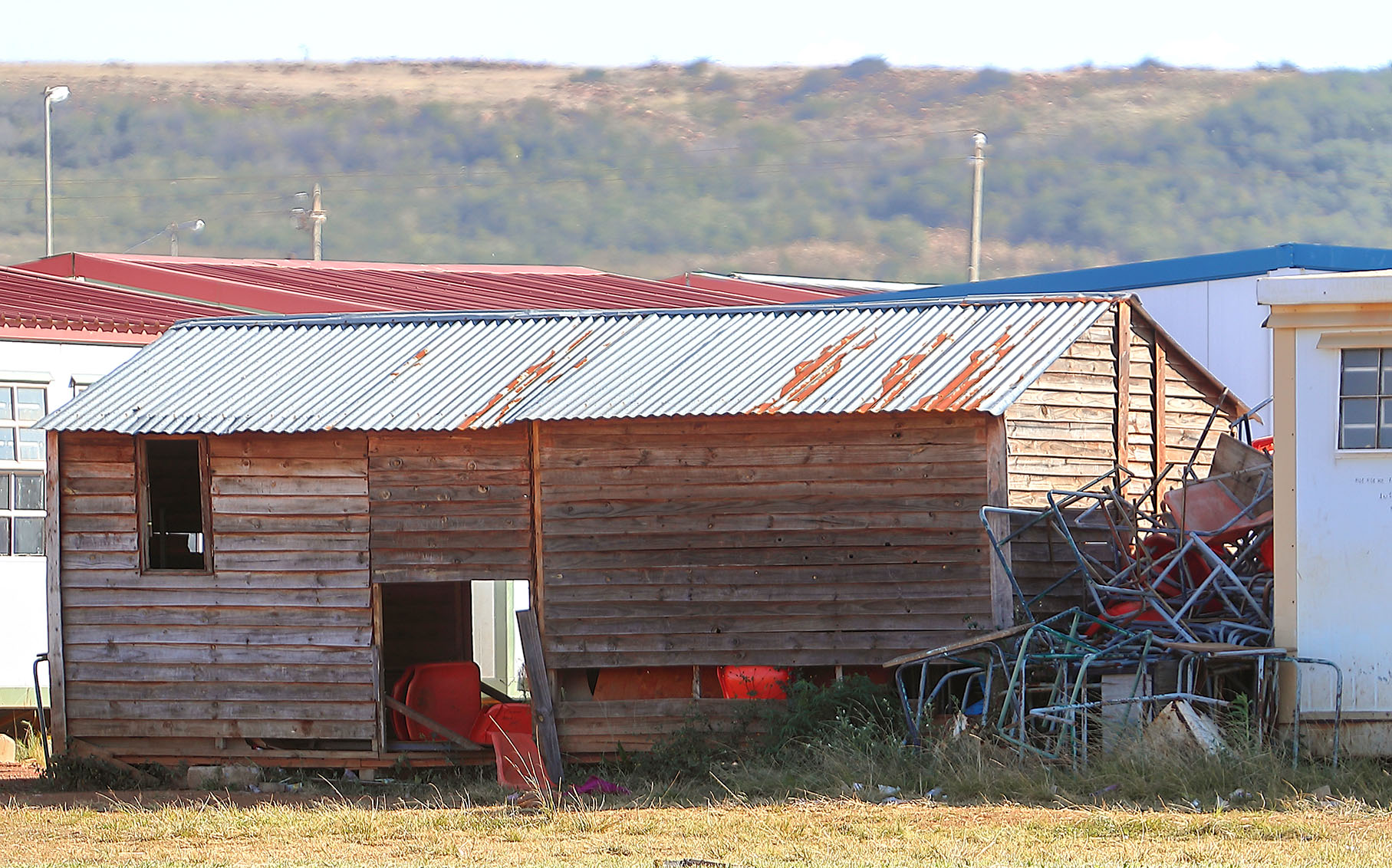
 A general view of the closed Finetown Secondary School on 23 May 2022 in Johannesburg, South Africa. Some parents demanded that the school be shut down, as learner overcrowding, classroom damage and reptiles such as snakes from nearby overgrown bushes were a concern. (Photo: Gallo Images / Fani Mahuntsi)
 With less than a month remaining, not a single project scheduled for delivery this year has been completed or formally handed over to the Gauteng Department of Education. This growing crisis threatens to exacerbate existing pressures on learners, teachers and school administrators in an education system already grappling with overcrowding and outdated facilities. This is according to the Democratic Alliance’s Shadow MEC for Infrastructure Development, Nico de Jager.
De Jager said several major school construction projects remained incomplete, despite repeated promises from the Gauteng Department of Infrastructure Development that all sites would be ready in time and handed over. While the department is still trying to streamline processes and address underperforming contractors, its own quarter two performance report shows troubling delays across several school projects that are essential for easing classroom overcrowding across the province.
Thubelihle Intermediate School in Soweto is only 35% complete, while Hoërskool Elsburg in Ekurhuleni stands at less than 50%. Schools intended for learners with special educational needs, such as Bafeti LSEN School in Mabopane, remain far behind schedule despite being designed to replace outdated and inadequate buildings that no longer meet learners’ needs.
Compounding matters, the department’s performance has regressed by 6%, achieving only 67% of last year’s outcomes. This decline is attributed to poor project management, inadequate planning, contractors abandoning sites and unqualified contractors unable to complete the work. The department continues to rely on recovery plans yet experiences the same persistent problems each quarter without visible improvement.
The Gauteng Infrastructure Financing Agency’s Schools Programme faces similar challenges. Several schools expected to open in the new year are still awaiting critical approvals, including Site Development Plans and Building Plans, preventing construction from progressing at the necessary pace. The financing agency itself notes that six priority schools are earmarked for completion by the end of the financial year; however, administrative delays threaten to derail this target.
The consequences of these failures are predictable and preventable. Learners risk being placed again in overcrowded classrooms or temporary structures, which undermines the quality of education and increases pressure on principals and teachers who are already overstretched. Learners with special needs will continue to be taught in unsuitable facilities because the government has failed to deliver on its commitments.
/file/dailymaverick/wp-content/uploads/2025/05/ED_542336.jpg "Learners carry a desk into a classroom at Kliptown Primary School in Soweto on 15 January 2025. (Photo: Sharon Seretlo / Gallo Images)")
Root cause of problem
Speaking to Daily Maverick, De Jager highlighted the deep-rooted issues plaguing school infrastructure projects in Gauteng. He pointed to administrative inefficiencies, poor contractor screening and underperformance as key factors behind the department’s failures.
“Only 67% of the allocated budget was utilised, and just 86% of invoices were paid within 30 days,” De Jager revealed. “Now, that in itself is a problem. It shows something is fundamentally wrong. The budget is allocated based on an Annual Performance Indicator (API), so you should be spending close to 100% if projects are progressing properly, but they’re only hitting 67%. We’ve never got a proper, real answer for this – it’s all down to inefficiencies,” he said.
A critical issue highlighted was the lack of proper contractor vetting.
“When awarding a tender, a contractor should deposit a bank guarantee to prove they’ll complete the work,” said De Jager. “This guarantee must be verified with the bank, but in the past we’ve found fake guarantees slipping through. That’s why screening contractors thoroughly is absolutely critical, and why blacklisting contractors who fail to deliver must be enforced. But there’s no central blacklist, and contractors who fail in one province simply pop up elsewhere. We’ve been calling for a government-wide blacklist to stop this.”
He also cited planning failures and improper approvals as major roadblocks.
“Schools require municipal approvals, environmental impact assessments, and building plans before construction begins,” he said. “But often the department starts building first, then tries to chase approvals and assessments later. We’ve seen schools built on unsuitable ground or floodplains. Such oversights have costly repercussions, including delays in issuing occupation certificates.”
Technical oversight and project management were severely lacking, De Jager emphasised.
“There aren’t enough qualified project managers to ensure projects meet deadlines, budgets, and quality standards. Contractors work too slowly or are obstructed by issues like construction mafias, but these risks should be accounted for during tendering.”
De Jager also slammed procurement and supply chain bottlenecks.
“This has been a longstanding issue because the department lacks proper tracking tools. Ideally, they should have a dashboard showing real-time progress and flagging any issues in procurement or supply chain immediately so they can be addressed.”
Read more: Financial crisis looms for quintile 5 schools in Gauteng after subsidies are cut
Department’s response and turnaround efforts
Theo Nkonki, spokesperson for the MEC of Gauteng’s Department of Infrastructure Development, shared insights into the department’s efforts to tackle longstanding project delays.
According to Nkonki: “The Department of Infrastructure Development is currently undertaking an internal review of its processes to reinforce accountability, strengthen coordination with client departments, and prevent a recurrence of delays experienced in projects.”
This initiative is part of the broader Department of Infrastructure Development’s Turnaround Strategy, which centres on the Project Readiness Matrix. By ensuring every project is “fully scoped, funded, authorised and ready for implementation before work begins”, the department aims to tighten control and guarantee projects are delivered on time, within budget and to the correct quality standards.
Nkonki emphasised that this systematic approach was designed to “eliminate bottlenecks, improve contractor performance and enhance public confidence in the province’s infrastructure pipeline”.
Highlighting progress on key projects, the department stated the following scheduled handover dates and claimed the following completion figures:
- Thubelihle Intermediate School (Soweto) is 80% complete, with handover expected by end-February 2026.
- Hoërskool Elsburg (Ekurhuleni) stands at 65% completion, targeting April 2026 for completion.
- Bafeti LSEN School (Mabopane) has reached 62% completion, with a planned finish on 27 February 2026. Notably, mobile units have been procured to ensure continued learning during construction.
“All three projects involve restoration and additions progressing in line with contractually approved programmes,” Nkonki said.
Regarding the department’s 67% Quarter Two performance figure, Nkonki clarified that it reflects a comparative measure versus the same period last financial year and “should not be interpreted as a regression in the current financial year’s performance trajectory”. Strengthened oversight, improved project management, and tighter stakeholder coordination supported ongoing advancement toward annual targets.
With an allocated budget of R2.8-billion for 2025/26, expenditure aligned with construction progress across multiple sites and certified works. Detailed financial reports would be presented through established budget reporting processes.
Several schools, including Rust Ter Vaal Secondary School, Nancefield Primary School, Dr WK du Plessis LSEN School and Bantu Bonke ECDC, are to be completed and ready for occupation between January and March 2026. These are key components of Gauteng’s back-to-school readiness plan and are currently undergoing finalisation and compliance assessments to ensure safe occupancy.
Read more: Gauteng’s R68bn education budget is insufficient to address key issues, warn experts
To address poor contractor performance, Nkonki noted the department “applies strict contractual remedies to underperforming or non-compliant contractors, including the imposition of penalties and terminations where justified”. The “A-Team” oversight model, deploying built-environment professionals from within Gauteng’s Department of Infrastructure Development, had significantly improved early detection of underperformance and technical risks, enabling timely corrective action.
The provincial Treasury supported the department via governance channels to tackle administrative delays and bolster performance assurance. All projects underwent rigorous audit, compliance and financial oversight to ensure that the public’s R2.8-billion investment delivered value.
On the verge of completion, Rust Ter Vaal Secondary School was in the final stages, with minor defects being addressed and Occupation Certificates being finalised, paving the way for a timely handover.
Nkonki described the recent Infrastructure Delivery Turnaround Strategy, launched by the MEC in August 2025, as a structured response to historic challenges. Built on five pillars – strengthening project preparation, improving supplier performance, tightening contract management, enhancing oversight via the A-Team, and institutionalising early warning and risk mitigation, this strategy embodied lessons learned across all project phases.
Looking forward, the department was exploring enhanced public transparency through progress dashboards and other reporting tools to keep citizens informed, Nkonki said. DM