
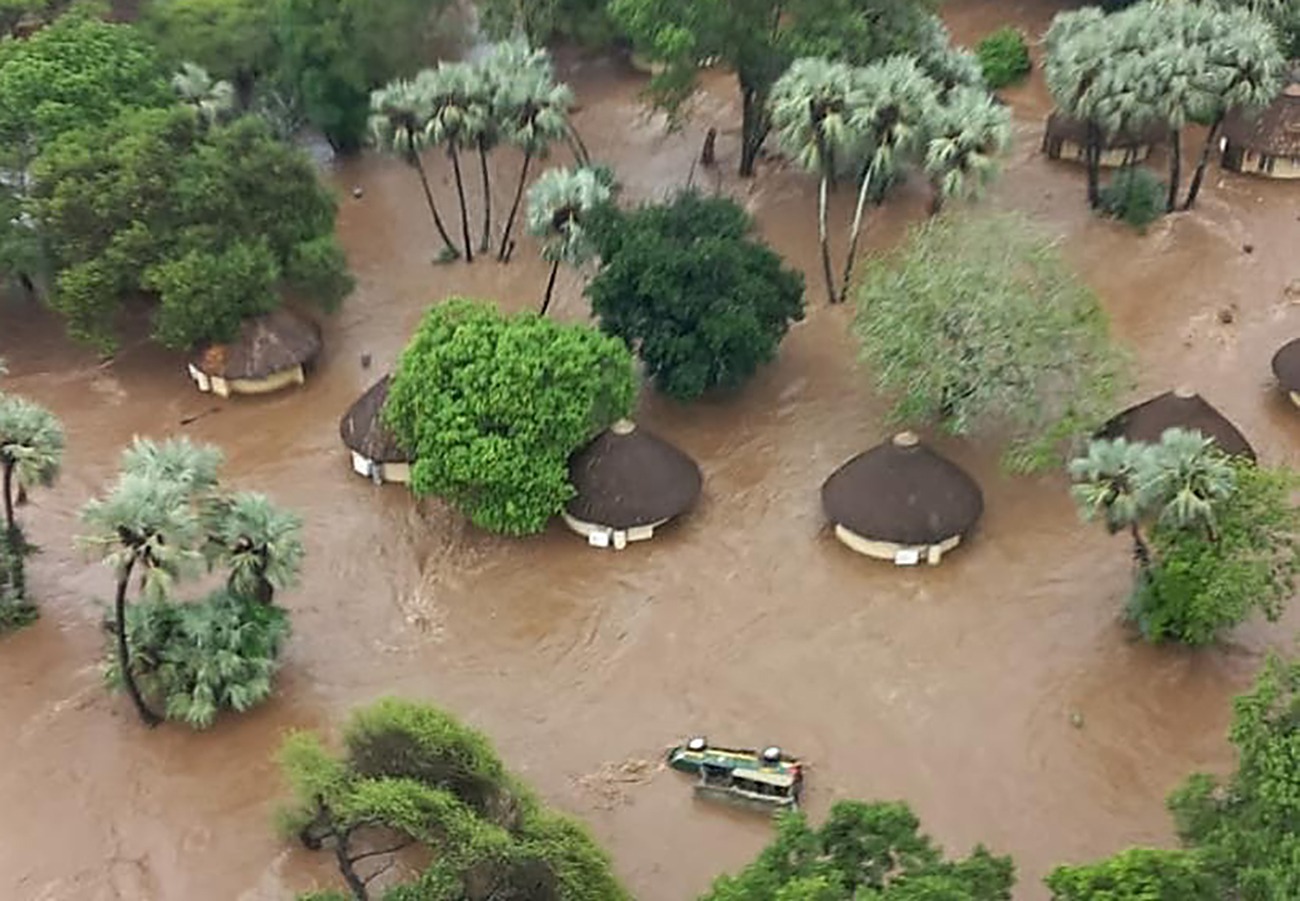
 An aerial view of the flooded Letaba Rest Camp. (Photo: SA National Defence Force)
 From management to rangers and pilots, South Africa’s most famous Big Five reserve, Kruger National Park, has called in all available hands to wrestle with the impact of persistent heavy rainfall across the Limpopo and Mpumalanga provinces.
Reynold Thakuli, spokesperson for Kruger National Park, described the situation as difficult for both staff and visitors.
Read more: Hoedspruit, gateway to Kruger, drenched as rivers swell, airport closes, tourists airlifted
“Some staff accommodation has flooded, but we have evacuated to various other rest camps,” Thakuli told Daily Maverick.
“We had day visitors who couldn’t leave due to water rising over the Crocodile Bridge, and they are now accommodated in the park,” Thakuli said, referring to an incident earlier this week in the southeast section near the Mozambique border.
“While all affected visitors were safely managed,” a statement by South African National Parks (SANParks) added: “The incident highlighted the risks posed by the ongoing weather conditions.”
Read more: Kruger National Park evacuates camps as severe weather warnings hit Limpopo and Mpumalanga
Thakuli said all staff continued to assist “where possible”.
He observed: “Animals are pretty adaptive and not too concerned. However, we are requesting communities around the park to report any sightings of animals outside the park and avoid areas with pools of water.”
SANParks confirmed that the extreme weather had forced several operational changes. Day visitors were temporarily halted from entering the park “until conditions improve”. Letaba Rest Camp, also in the southeast, was actively evacuating staff and guests as the Letaba River had encroached into the camp. Phalaborwa Gate would remain closed for at least 24 hours.
/file/attachments/orphans/02_530460.jpg "A bridge near Letaba camp. (Photo: X @SANParks)")
/file/attachments/orphans/WhatsAppImage2026-01-15at184821_771517.jpg "A low-level bridge over the Sabie River. (Photo: SA National Defence Force)")
/file/attachments/orphans/IMG_7806_838424.jpg "An aerial view of the flooding at Letaba. (Photo: X @SANParks)")
/file/attachments/orphans/IMG_7805_686073.jpg "Letaba camp has been severely impacted by the flooding. (Photo: X @SANParks)")
The Phalaborwa closure meant that — for the moment — there was no access into the park’s northern parts, SANParks said. It explained it was “mindful of the current strain on operational and emergency responses on resources during this period”.
The preventative measure aimed “to focus available resources on real emergencies, and ensuring the safety of guests, staff and surrounding communities, rather than avoidable incidents linked to non-essential travel within the park”.
The temporary restrictions would be “reviewed continuously” as weather and road conditions changed, the national parks agency said, which “sincerely apologises for the inconvenience caused by the persisting rainfall ... The safety of all visitors and staff remains our highest priority.”
The South African Weather Service said further possible heavy rain — which it estimated at between 100mm and 200mm over the next 24 to 48 hours — could increase flooding. A Red Level 10 warning was in place, highlighting the risk of fast-flowing rivers, flooding of roads and low-lying areas, and the potential displacement of communities.
Forecasts suggested conditions would improve from 19 January, said the national weather service, allowing river levels and saturated soils to recede. DM