



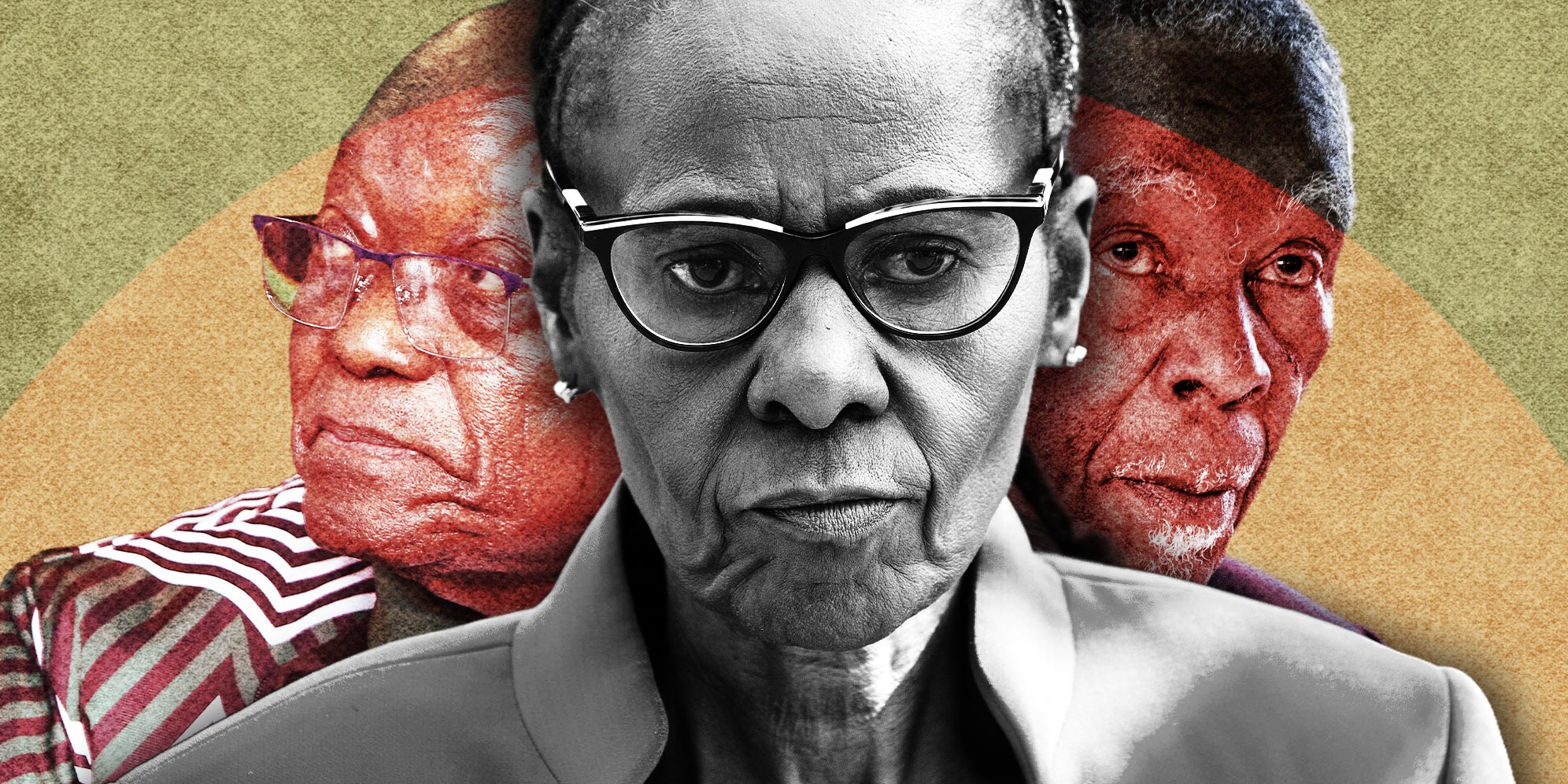
 Illustrative image: Retired Constitutional Court judge Sisi Khampepe (centre). (Photo: Alet Pretorius / Gallo Images) | Former president Jacob Zuma (left). (Photo: Siyabonga Sokhela / Gallo Images) | Former president Thabo Mbeki (right). (Photo: Per-Anders Pettersson / Gallo Images) | (By Daniella Lee Ming Yesca)
 In his opening address to the Khampepe Commission of Inquiry on Wednesday, 11 February, Advocate Howard Varney, for the families of victims of apartheid-era crimes, said former presidents Zuma and Mbeki were “under a moral obligation” to disclose what they knew about the matters that were being probed.
“We call on them to return to this inquiry,” he said.
Zuma and Mbeki previously brought applications, first for the recusal of evidence leader, Advocate Ishmael Semenya, and a second for retired Constitutional Court judge Sisi Khampepe to recuse herself. Both bids failed.
Mbeki’s complaint was supported by former ministers Ronnie Kasrils, Brigitte Mabandla, Thoko Didiza and Charles Nqakula.
Read more: Stalled apartheid-era prosecutions: Former presidents Zuma, Mbeki try to further delay the process
Zuma has, in the meantime, filed another application, this time with the high court, again seeking Khampepe’s recusal.
Mbeki has indicated that he aims to follow suit, Varney said.
“The families take the view that this eleventh-hour application is aimed at derailing the commissions proceedings,” he said.
Political obstruction
The inquiry was established in May 2025 by presidential proclamation to investigate, among other matters, political interference and obstruction in the post-Truth and Reconciliation Commission (TRC) prosecution of apartheid-era crimes.
It was under the threat of legal action that President Cyril Ramaphosa had “changed his mind” stating that he had wanted “closure for the families” and had reached an agreement with the applicants, the panel heard on Wednesday. The inquiry has been plagued by delays since its formation.
The approach to Ramaphosa was led by Lukhanyo Calata, son of Fort Calata, one of the Cradock Four murdered by apartheid security police in 1985.
Khampepe’s fellow commissioners are Judge Frans Kgomo and human rights lawyer, Advocate Andrea Gabriel.
Too little too late
Zuma and Mbeki owed it to the families of “those who laid down their lives for democratic South Africa to explain why they were denied justice, truth and closure”, Varney said.
However, he reminded the panel, that for some of the families the matter no longer had purpose as “cases are dead and buried. The damage has been done.”
He added that while the NPA under the tenure of advocates Shamila Batohi and her successor, Andy Mothibi, had “taken steps” to correct this, it was “too little too late”.
The bulk of cases could not be interrogated as perpetrators, witnesses and family members had since died.
“The cost to the families and South African society as a whole has been incalculable,” Varney said.
Full transparency
There had been “a massive denial of justice” and those who sought answers deserved nothing but “full, public and transparent” proceedings. Those who failed to cooperate should be compelled to answer to the inquiry, Varney said.
“The post-TRC period has been one of the most shameful times in South African history. The families have lost all faith in the institutions who are meant to uphold the rule of law,” Varney said.
Public confidence in these institutions could be restored by the commission, he added.
Mbeki and Zuma’s objections
While Mbeki was known to support apartheid-era prosecutions, ANC officials and Cabinet members were reportedly opposed to this, including Jackie Selebi, the former national police commissioner, who was one of the 37 ANC leaders refused amnesty by the TRC.
Selebi enjoyed Mabandla’s support as Minister of Justice at the time.
Zuma has argued that Khampepe, who has several degrees, including from Harvard, and was a Constitutional Court judge, should recuse herself as chair on three grounds:
First, that she was a member of the TRC and its Amnesty Committee and was also the Deputy National Director of Public Prosecutions (DNDPP) under Advocate Bulelani Ngcuka.
Then there was the alleged “secret advice” Khampepe had given to Advocate Semenya with regard to the application for his recusal and lastly because Khampepe had been a member of the Constitutional Court panel that had delivered adverse judgments against Zuma and she therefore harboured “personal animosity” towards him.
Varney on Wednesday said the families and the country needed to know whether an external hand had played a role in the delays in prosecutions and whether there had been a “secret” agreement between apartheid generals and ANC officials. DM