



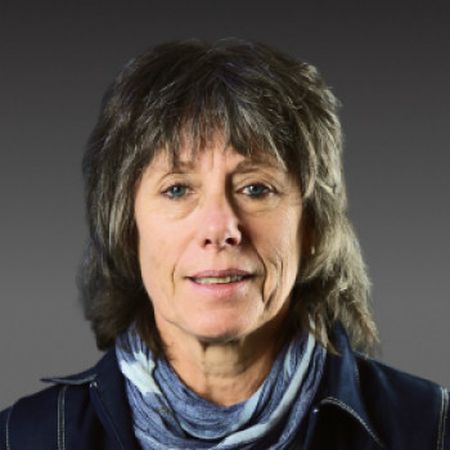
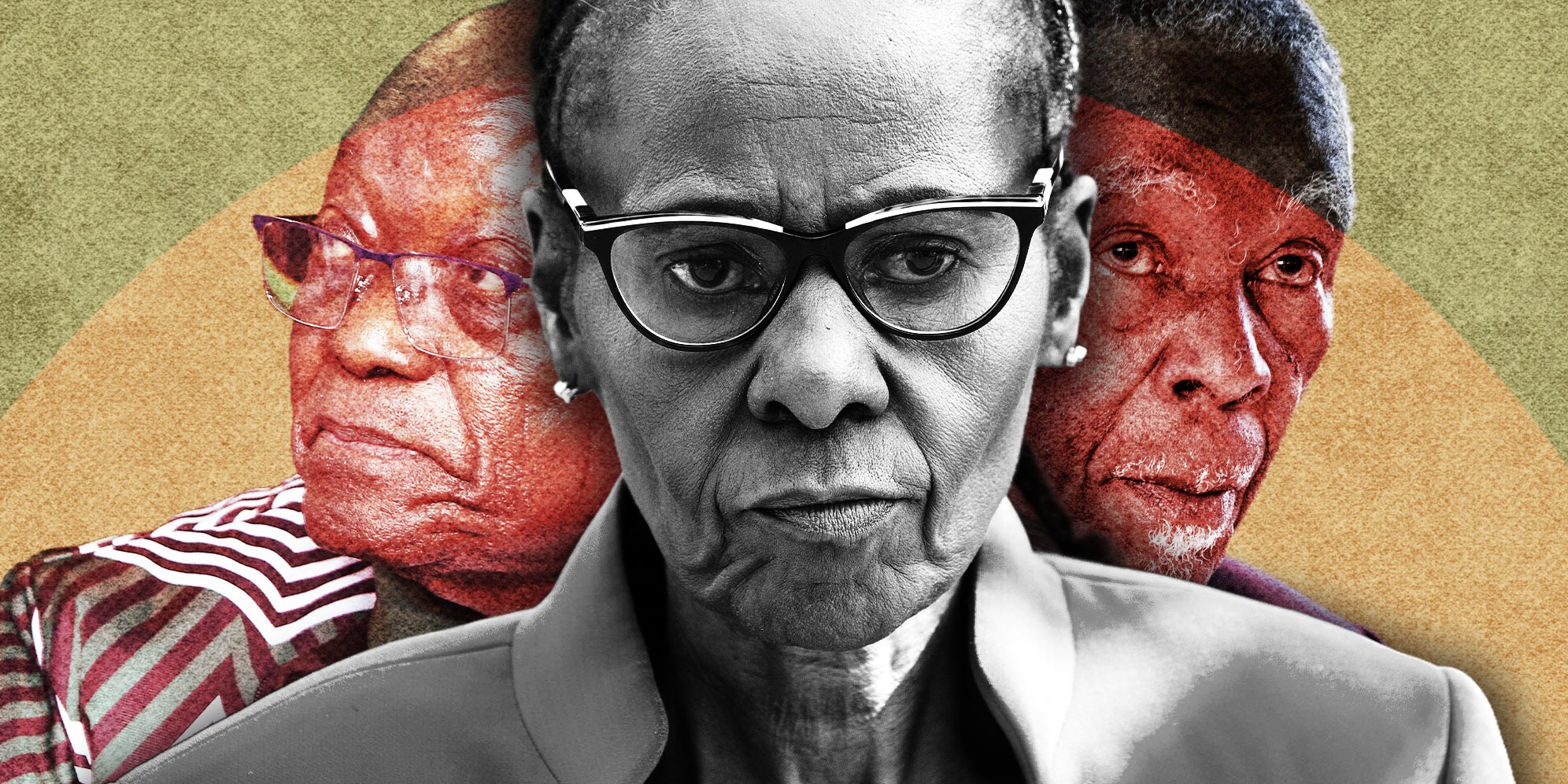
 Illustrative Image: Justice Sisi Khampepe (centre). (Photo: Gallo Images / Alet Pretorius) | Former president Jacob Zuma (left). (Photo: Gallo Images / Siyabonga Sokhela) | Former president Thabo Mbeki (right). (Photo: Gallo Images / Per-Anders Pettersson) | (By Daniella Lee Ming Yesca)
 /file/dailymaverick/wp-content/uploads/2025/10/label-analysis-2.jpg)
It appears that retired Constitutional Court Judge Sisi Khampepe, who chairs the groundbreaking inquiry into possible political interference in the stalling of apartheid-era prosecutions, might be under illegal surveillance.
How else to explain former president Jacob Zuma’s possession of private emails as well as WhatsApps, which he claims were sent from Khampepe to evidence leader, advocate Ishmael Semenya, supposedly offering advice to be passed on to advocate Vas Soni, who dealt with an earlier application by Zuma for Semenya’s recusal?
While Zuma claims the email was dated 5 November, the application for Semenya’s recusal took place only on 12 November, which would render the former president and leader of the uMkhonto weSizwe party a time traveller with incredible foresight.
Read more: Stalled apartheid-era prosecutions: Former presidents Zuma, Mbeki try to further delay the process
Meanwhile, Zuma, in a gesture of Trumpian legal logic, has chosen to “withhold” this vital evidence from the inquiry “for now”.
‘Ongoing investigations’
Advocate Dali Mpofu, representing Zuma in his application for Khampepe’s recusal, said this email would be provided “at some future point, to protect ongoing investigations and once safeguards have been guaranteed”.
However, advocate Howard Varney, on behalf of the victims, noted that Zuma’s “possession and securing of the alleged communication may very well have been illegal”. He said Zuma had not explained how he had obtained the alleged email.
He referred to relevant legislation in South Africa, the Regulation of Interception of Communications Act (RIC, which prohibits the monitoring of communications without consent or legal authorisation, with strict rules for law enforcement).
A landmark ruling was handed down by the Constitutional Court in February 2021 after investigative unit AmaBhungane launched a high court challenge in 2017, when it was discovered that calls between managing partner Sam Sole and Billy Downer, the prosecutor in the Arms Deal investigation into Zuma, had been intercepted.
Semenya argued that no secret communications had taken place and that any that had occurred had been “proper and necessary to assist the commission in establishing evidence and making factual findings”.
Judgment reserved
On Friday, Khampepe reserved judgment in Zuma and former president Thabo Mbeki’s application for her recusal. She sits alongside commissioners, Judge Frans Kgomo and human rights advocate Andrea Gabriel.
The inquiry was established in May 2025 by presidential proclamation to investigate, among other matters, political interference and obstruction in the post-TRC prosecution of apartheid-era crimes.
This occurred shortly after settlement discussions in April 2025 between President Cyril Ramaphosa and Lukhanyo Calata, son of Fort Calata, one of the “Cradock Four” murdered by apartheid security police in 1985.
Mbeki filed a separate application for recusal. Both statesmen have argued that Khampepe’s history with the TRC, its amnesty committee and the NPA could lead to potential institutional bias on her part.
Zuma has added that the fact that she was part of a Full Bench of Constitutional Court justices and had read out a scathing majority ruling that he should be jailed in July 2021 for contempt of court, also rendered her tainted.
Detention without trial
Mpofu on Friday described the former president’s incarceration that month as “detention without trial”.
This was followed by the worst violence and bloodshed across KwaZulu-Natal and Gauteng in living memory, resulting in more than 300 deaths and millions of rands lost to damaged infrastructure, vehicles and buildings.
In January 2024, South African Human Rights Commissioner Philile Ntuli found that the July “unrest” had been “an orchestrated event which required that individuals act with one voice to achieve its end” and that it had been fuelled by politics.
Mpofu told the inquiry on Friday that he, Mpofu, had been detained without trial in the apartheid years, and his client, Zuma, had only the best interests of the victims and families at heart, as he was also a “freedom fighter’.
“Anyone who even remotely had any sense of the amount of atrocity involved cannot, even for any selfish reasons, want to stop a process that goes to dig into that process,” he said.
Mpofu added that “yes, there is nobody more than president Zuma who would like this matter to be resolved. These are people who are freedom fighters themselves who want the outcome to be as clear and pure as it should be”.
Zuma’s shadow
Zuma’s involvement in the Truth and Reconciliation Commission (TRC) dates back to 1998, when he led, alongside Mbeki, “secret indemnity negotiations” with former SADF chief Constand Viljoen and other generals.
The meetings were to discuss criminal accountability for acts committed during the apartheid era and to find a “mutual indemnity mechanism” to prevent criminal prosecutions following the conclusion of the TRC.
The talks were initiated by President Nelson Mandela, who was represented by Mbeki and later, Zuma. The original intention had been to create an amnesty programme to cover political crimes that occurred between the Inkatha Freedom Party and the ANC in KwaZulu-Natal and the Highveld.
Over and above the eventual waiving of amnesty for several apartheid-era perpetrators, the TRC’s denial of amnesty to a “Group of 37’ – a collective of ANC leadership members – was because of their failure to meet the specific legal requirements of the TRC Act.
While the TRC initially granted a general amnesty, a court later overturned this as the TRC Act specifically required applicants to “indicate, in full, the specific offences for which they sought amnesty”.
Case No 2025-005254
Buried in the more than 1,000 pages of Rule 3.3 documents related to the historic Case No 2025-005245 – Calata and others vs the Government of South Africa and Others – is Zuma’s legacy in these early and “secret” post-apartheid talks.
After Mbeki had initiated contact with General Viljoen in 1998, his deputy in the ANC, Zuma, later went on to become a key government representative at these high-level talks. This continued after his appointment as South Africa’s deputy president in 1999.
The approach to Viljoen was “with the aim of discussing questions of criminal accountability arising from the past”. Viljoen, in turn, referred Zuma to SADF General Jan Geldenhuys, at the Contact Bureau (known in Afrikaans as the Kontak Buro).
In 2019, investigative journalist and author Michael Schmidt interviewed Major General Dirk Marais, former deputy chief of the army and the convenor of the Contact Bureau, about these talks.
Marais had shown the author an unsigned, handwritten letter prepared for the former Chiefs of the SADF in early 2004. Schmidt took a photograph of this letter, which is included in the court documents.
/file/attachments/2987/Screenshot2026-01-1772717PM_929827.png)
The letter was addressed to Zuma and recalls the initiation of the series of secret talks. The first meetings had been convened by Johannesburg businessman Jürgen Kögl, at his home.
The bottom line after seven years of talks, Marais told Schmidt, was “they don’t want us to be charged – and they don’t want them to be charged”.
/file/attachments/2987/Screenshot2026-01-1772730PM_151931.png)
Ghosts of the past
In 2009, German legal expert Ole Bubenzen published Post-TRC Prosecutions in South Africa: Accountability for Political Crimes after the Truth and Reconciliation Commission’s Amnesty Process”, the first in-depth and comprehensive analysis and evaluation of criminal prosecutions after the TRC’s amnesty process.
The first chapter of Bubenzen’s work is contained in the Rule 3.3 documents.
In this chapter, the writer relates how former police commissioner and head of the Foundation for Equality Before the Law (FEL), Johann van der Merwe, had informed him that former President FW de Klerk had assumed a central role in the consultations.
Since a general amnesty had not been politically or constitutionally feasible, FEL had proposed an indemnity procedure based on an admission of the crime or atrocity committed, but without the need to make full disclosure. The talks continued until 2004, without an agreement.
However, the approach proposed by FEL in relation to the “admission of crimes but no full disclosure” was later adopted by the Pardons Reference Group (PRG), established by Mbeki, under the Special Dispensation for Political Pardons in 2007.
The attack on the integrity of the Khampepe Inquiry and allegations of reasonable bias have further delayed this long walk to justice for those who are asking for the truth and accountability.
Zuma, Mbeki and the other senior ANC officials who have voiced their opposition will have an opportunity to clarify the motives for their decisions at this inquiry, broadcast live to the nation.
The troubled pregnancy that was to birth democratic South Africa in the early 1990s was fraught with complex compromises and “forgiveness”, all for the sake of the greater good at the time.
Thirty years on, South Africa is ready for the truth, and what better opportunity to finally lance the festering boil of the past and come clean than this commission? DM
Read more: Constitutional damage case