
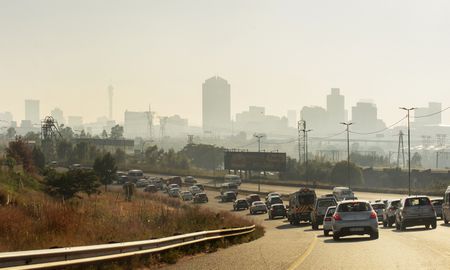
 For the second time in 2026, a sulphuric, rotten-egg smell has swept over parts of Johannesburg, leading to questions about air quality and public health. (Illustration: Kevin Momberg / Daily Maverick)
 A strong sulphur, or rotten-egg smell has hung over Johannesburg, sparking complaints of headaches, tight chests, fatigue and respiratory discomfort from the city’s residents.
In a statement issued on Wednesday, the City of Johannesburg said its monitoring stations in Buccleuch and Alexandra detected elevated levels of hydrogen sulphide (H₂S) and sulphur dioxide (SO₂), with hydrogen sulphide peaking at 36-37 parts per billion and sulphur dioxide reaching around 52 parts per billion.
According to the City, the levels were high enough to produce a noticeable odour, but remained close to background concentrations and below thresholds usually linked to significant short-term health risks.
“The ‘rotten-egg’ smell reported by residents is commonly associated with hydrogen sulphide,” said executive director of Environment and Infrastructure Services Dr Tebogo Modiba. He said technical teams continued to analyse dispersion patterns to determine the source.
/file/attachments/2987/unnamed6_211896.jpg "The ‘rotten egg’ smell over Johannesburg comes from Mpumalanga, says the City. (Photo: Luca Sola / AFP)")
In January, after the first bout of sulphur pollution of the year, the city attributed the rotten-egg smell to power stations and petrochemical operations within the Highveld Priority Area in Mpumalanga. However, the City has not identified the source of the latest incident beyond transboundary pollution that is moving from the Highveld (Mpumalanga), South Africa’s most polluted industrial zone, into Gauteng.
That assessment aligns with concerns raised by Centre for Environmental Rights attorney Ntombi Maphosa, who says weather patterns are probably transporting industrial pollution from the Highveld into Gauteng.
“The likely source is the Highveld, but the difficulty is that air pollution has multiple contributors. You have coal-fired power stations, petrochemical operations, mines, vehicle emissions and industrial activity all contributing at once,” Maphosa told Daily Maverick.
The Highveld hosts several Eskom coal-fired power stations and major operations by Sasol. However, Sasol has publicly denied responsibility for the recent sulphur pollution.
Responding to a query from Daily Maverick, Sasol said, “We can confirm that Secunda Operations is stable, with no operational incidents or abnormal process conditions that could have resulted in increased emissions or off‑site impacts. Available operational information indicates that all key plant systems have been functioning within normal parameters, and emissions monitoring shows levels well within the limits authorised in our atmospheric emissions licences.”
Sasol added that recent assessments, including data from Sasol-managed and independent monitoring stations, did not point to the plant exceeding applicable ambient air quality standards.
“While Sasol cannot comment on the source of odours reported in Johannesburg, we continue to monitor our operations and the regional ambient network closely,” the company said.
Maphosa said focusing on a single emitter risked obscuring the broader regulatory problem: South Africa already knows several major polluters exceed legal limits.
“What this smell highlights is not only pollution itself, but the difficulty government still has in properly monitoring and tracing pollution sources,” she said.
Air quality monitoring
Air quality is measured in several ways, including through ambient monitoring stations maintained by the South African Weather Service. However, as Daily Maverick has reported, many stations in Gauteng fail to operate consistently or deliver complete data.
“What we know is that many monitoring stations in vulnerable areas do not work properly, and in some municipalities there are not even dedicated air-quality officers,” Maphosa said.
Read more: Gauteng’s air quality monitoring choking with most stations offline in SA’s most polluted province
The second monitoring system is an internal model, which involves tracking emissions directly from industrial stacks at plants and analysing them against minimum emissions standards. However, the overall effectiveness of government oversight is questioned.
/file/dailymaverick/wp-content/uploads/2023/12/GettyImages-1252664086.jpg "The Eskom Kendal coal-fired power station in Mpumalanga. (Photo: Waldo Swiegers / Bloomberg via Getty Images)")
“With Eskom, we already know they are not within legal limits because they have been granted multiple leniencies by the government. That means emissions continue above what the law originally intended,” Maphosa said.
A question of public health
The City has advised residents to remain indoors during sulphur pollution episodes, avoid strenuous outdoor activity and monitor symptoms such as throat irritation, headaches, dizziness and fatigue, especially among children, the elderly and people with respiratory conditions.
Maphosa said those short-term symptoms were consistent with sulphur-related exposure, but repeated exposure carried far greater long-term risk.
“Respiratory illness is a major concern, especially for people with allergies, asthma or sinus conditions,” she said. “Long-term exposure can contribute to chronic disease, including heart disease, strokes and certain cancers.”
Communities in the Highveld, she said, had lived with those risks for decades.
“If Johannesburg residents are now feeling discomfort this strongly, it gives some indication of how severe exposure is for people living much closer to the source.”
The latest pollution spike also reignites questions raised in South Africa’s landmark Deadly Air litigation, where the court confirmed that air pollution above legal limits violated constitutional rights, including dignity, health, life and environmental wellbeing.
That ruling placed an immediate obligation on the government to strengthen monitoring and enforcement. But, according to Maphosa, implementation has remained uneven.
“There is still a disconnect between what courts have ordered and what happens in reality. The obligation exists, but governance and enforcement continue to lag,” she said. DM
Additional reporting by Ed Stoddard.