




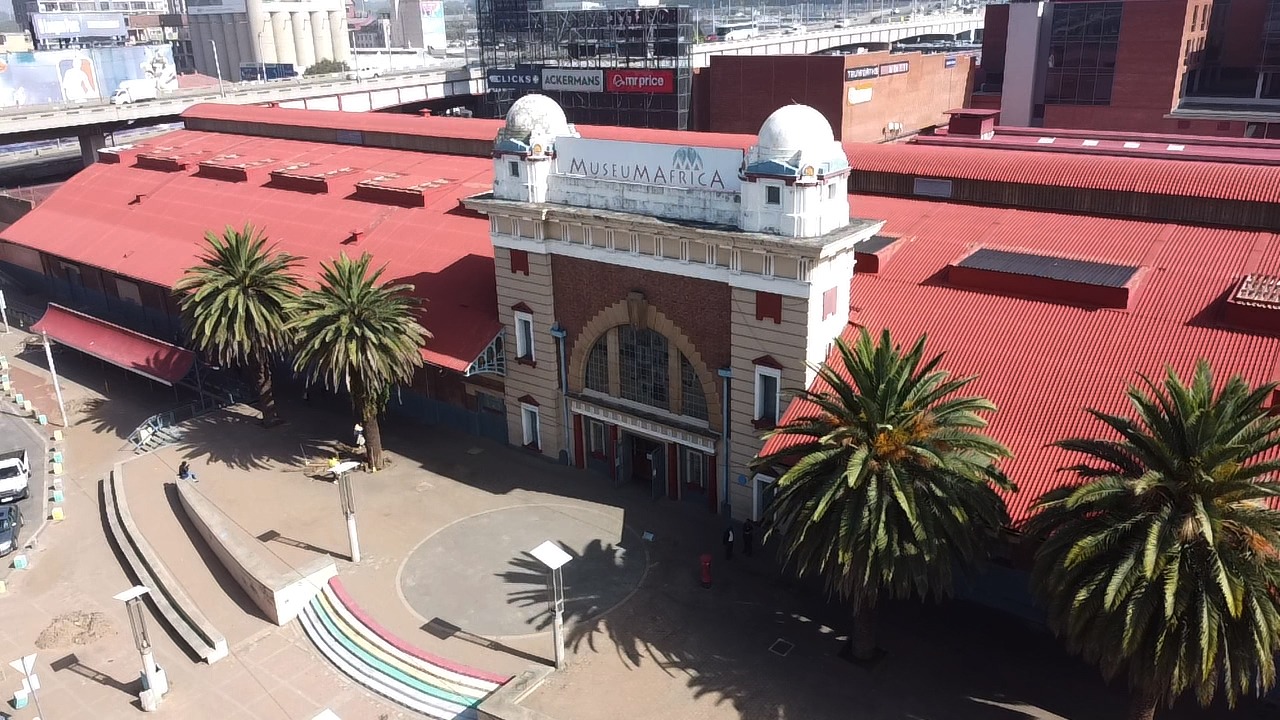
 An aerial photograph of Museum Africa’s rooftop in Newtown, Johannesburg on 10 March 2026. (Photo: Felix Dlangamadla)
 The City of Joburg has set aside R50-million to restore the Johannesburg Art Gallery (JAG), yet R23.6-million – nearly half that allocation – is being committed, not to repairing the century-old Lutyens-designed building in Joubert Park, but to temporary relocation, before a single artwork has been moved – and while formal heritage approval for the transfer remains pending.
In a statement released earlier this month, the City said “significant progress has been made in readying Museum Africa and the Pink Building to temporarily house the Johannesburg Art Gallery collection,” adding that the work focused on creating “secure, climate-controlled and professionally managed environments” to safeguard the artworks during refurbishment. The City further stated that the readiness measures were being undertaken “as per the requirements of Sahra [South African Heritage Resources Agency].”
However, Friends of JAG, the Johannesburg Heritage Foundation (JHF) and the Democratic Alliance have expressed grave concern about the suitability of the proposed relocation sites, arguing that the attic-level storage space at Museum Africa and the warehouse-style Pink Building do not meet international museum standards for climate stability, security and long-term conservation. They have also questioned whether sufficient environmental data, safety assurances and heritage approvals are in place before any relocation proceeds.
/file/attachments/orphans/JAG3_392107.jpg "Qualified architects, art specialists, museum technologists, storage experts and engineers, along with a comprehensive report by the Friends of JAG and the Johannesburg Heritage Foundation, believe that the Museum of Africa, in its current state, cannot safely house JAG’s vulnerable and invaluable artworks. (Photo: Leanne de Jager MPL)")
The relocation budget, disclosed to Daily Maverick by the City, includes R6.5-million for space planning and logistics and R17.1-million for upgrades at Museum Africa and the so-called Pink Building, a warehouse structure in Newtown adjacent to Museum Africa. Additional compliance works are under way at the Brixton Multipurpose Centre, although the City did not provide a separate figure for those upgrades.
The City has indicated that Museum Africa, the Pink Building and Brixton were identified as available municipal properties capable of being upgraded within existing timelines, allowing the collection to remain under City control during refurbishment.

‘Unfit for purpose’
Mayor Dada Morero’s R50-million announcement was widely reported – and welcomed by residents and art lovers – as a headline commitment to restoring one of Johannesburg’s most important cultural institutions.
Following an oversight inspection at Museum Africa, DA Gauteng spokesperson for Sport, Arts, Culture and Recreation, Leanne de Jager, described the upper-level storage area as “unfit for purpose, with critical flaws in security, climate control, unwanted water penetration and access”.
She characterised the move as “a reckless gamble with our cultural heritage” and called on the City to halt the relocation until the facilities comply with international standards.
Friends of JAG and the JHF agree, citing unsuitable conditions and safety risks, particularly in relation to the attic-level storage space at Museum Africa, after a group of experts visited the site in December.
“We have concerns about the conditions in the attic, especially safety, as it is close to the overhead freeway and there have been security problems in the past,” the groups said in a statement to Daily Maverick.
/file/attachments/orphans/2026-03-10-09-13-02-181copy_760791.jpg "An aerial photograph of Museum Africa’s rooftop in Newtown, Johannesburg on 10 March 2026. (Photo: Felix Dlangamadla)")
The two groups further argued that uninterrupted climate control is central to museum-grade storage, particularly in attic-level or warehouse-type spaces where temperature fluctuation and water ingress risks can be amplified.
The regulatory position also remains unresolved. Sahra confirmed that the relocation of the collection was still under review in terms of Section 9 of the National Heritage Resources Act.
Ben Mwasinga, Senior Manager: Heritage Compliance Management at Sahra, said the application for relocation following the October site visit is still “undergoing careful consideration”.
“Sahra did not inspect the Pink House or Brixton Recreation Centre,” Mwasinga confirmed.
He also confirmed that environmental commissioning data had not been submitted and was not required for the Section 9 review.
The City, however, says systems are being installed and tested before any relocation proceeds. Spokesperson Nthatisi Modingoane said the HVAC system at Museum Africa had been fully commissioned and accredited by the South African Refrigeration and Air Conditioning Contractors Association.
/file/attachments/orphans/MarketJAG_449143.jpg "Experts believe that the Museum of Africa, in its current state, cannot safely house JAG’s vulnerable and invaluable artworks. (Photo: Leanne de Jager MPL)")
Environmental stability testing is still under way and monitoring logs are not yet available. Load shedding simulation testing has not been conducted. A gas-based fire suppression system has been installed, but formal certification from the City’s Fire Department remains pending.
On backup power, Modingoane said alternative sources were not a statutory requirement.
“Whilst alternative sources of power are not a statutory requirement for museums, the City has been engaging with its power utility on various options of alternative sources of power,” he said.
No alternative power system has yet been installed at the identified sites.
The City said engineers had assessed the buildings and continued monitoring conditions, particularly during the rainy season. It also acknowledged delays in completing the temporary facilities, stating that feedback from stakeholders had been incorporated into the works.
Contract for refurbishment and relocation
Beyond the relocation itself, concerns have also been raised about how the refurbishment tender was structured and awarded.
Friends of JAG, JHF and several art conservation professionals argue that a heritage-specific tender should have been issued for a Grade II listed building housing one of Africa’s most significant municipal collections.
Instead, the contract was awarded to Lamela Consulting through a multidisciplinary professional services panel.
“The refurbishment of the Johannesburg Art Gallery was not issued as a standalone heritage-specific tender. Instead, it was procured as a multidisciplinary professional services appointment to respond to the full complexity of the project,” Modingoane said.
/file/dailymaverick/wp-content/uploads/2024/11/ED_535434.jpg "The Johannesburg Art Gallery during an oversight visit on 19 November 2024. (Photo: Gallo Images / Fani Mahuntsi)")
/file/dailymaverick/wp-content/uploads/2024/11/Bungled-renovated-interior-of-the-Meyer-Pienaar-extension-.jpeg "The award-winning Meyer-Pienaar gallery extension at JAG was ‘renovated’ under the watch of the Johannesburg Property Company in 2021. Copper roofs and vaulted ceilings were removed and a concrete slab was thrown over the space. Structural engineers later found structural damage to the building, and the project to restore it was never completed. The exhibition halls were declared unsafe for use. Building rubble is still visible. (Photo: Supplied)<br>")
According to the City, the evaluation covered 13 built-environment disciplines – including structural engineering, architecture, environmental systems, fire compliance, security and art conservation planning – with each discipline scored during the bid process.
Friends of JAG and JHF argue that placing heritage conservation as one component within a broader technical scoring matrix risks diluting its centrality in a restoration of this nature.
Lamela’s original consortium included a heritage academic, Professor Iain Clarke, based in the Netherlands, who later stepped down following public criticism of the project and his role within it. The City said his resignation was voluntary. Mayat Hart Architects & Heritage Consultants was subsequently appointed as the replacement heritage specialist.
Contractors preparing the temporary facilities – Ngutyana Construction for Museum Africa and the Pink Building, and Nkomaba Construction for Brixton – were appointed through competitive bidding in line with municipal supply chain regulations.
Asked whether contractors were required to demonstrate prior experience in constructing museum-grade art storage facilities, the City said there was no specific requirement within the Construction Industry Development Board framework mandating such experience. Instead, contractors were required to demonstrate appropriate general building grading.
Specialised storage systems, including art racking and conservation-aligned installations, are being delivered by appointed specialist providers working alongside the main contractors, said Modingoane.
Concerns over artworks on loan
Governance concerns have also been raised by Friends of JAG and JHF regarding loan procedures and institutional oversight, stating that clarity was required on whether all proper procedures and permissions were in place.
Previously, when questions were raised with the Art Gallery Committee about permissions relating to an unusually large loan to South Korea, it was suggested that the City had adopted a new loans policy overriding aspects of the Deed of Donation. JHF and Friends of JAG now question whether the Art Gallery Committee was properly constituted at the time approvals were granted and whether all governance requirements were met.
However, the City confirmed that 145 artworks were loaned to institutions in South Korea with approval from the City, the Art Gallery Committee and Sahra.
Officials from the City said no artworks were damaged during the loan period, though two paintings were affected during the return process after being held at an airport under unsuitable climate conditions. A conservation plan is under way, according to the City.
At a media preview during the G20, at least one of the 30 artworks displayed appeared visibly damaged, claim the two NGOs, though the City maintains that no permanent damage occurred as a result of the loan.
Regarding the Deed of Donation of the artworks by Lady Florence Phillips, the City said it remained operative and that loan approvals continued to follow the required governance framework, with domestic loans approved by the City and the Art Gallery Committee, and international loans additionally requiring Sahra approval.
Some of JAG’s most valuable pieces have found safe haven at other galleries. The artworks that were loaned to institutions in South Korea are on display at the Standard Bank Gallery. Another important part of the JAG collection will soon be exhibited at the Javett Art Centre at the University of Pretoria.
But for now, nearly half the value of the JAG’s headline refurbishment allocation has been committed to interim infrastructure. Heritage approval for relocation is still pending. Environmental monitoring data is not yet available. Backup power has not been installed. The majority of the collection – more than 9,000 works spanning over a century – remains in a building awaiting restoration while its temporary homes are still being prepared.
Amid the debate over costs, questions have also been raised about whether private sector funding was available as an alternative to the City-funded relocation.
JoziMyJozi suggested that private business had offered to assist with relocation costs. However, no formal funding commitment has been publicly documented, and the City has not indicated that any privately financed alternative relocation proposal was formally tabled or accepted. DM
Comments
Scroll down to load comments...