




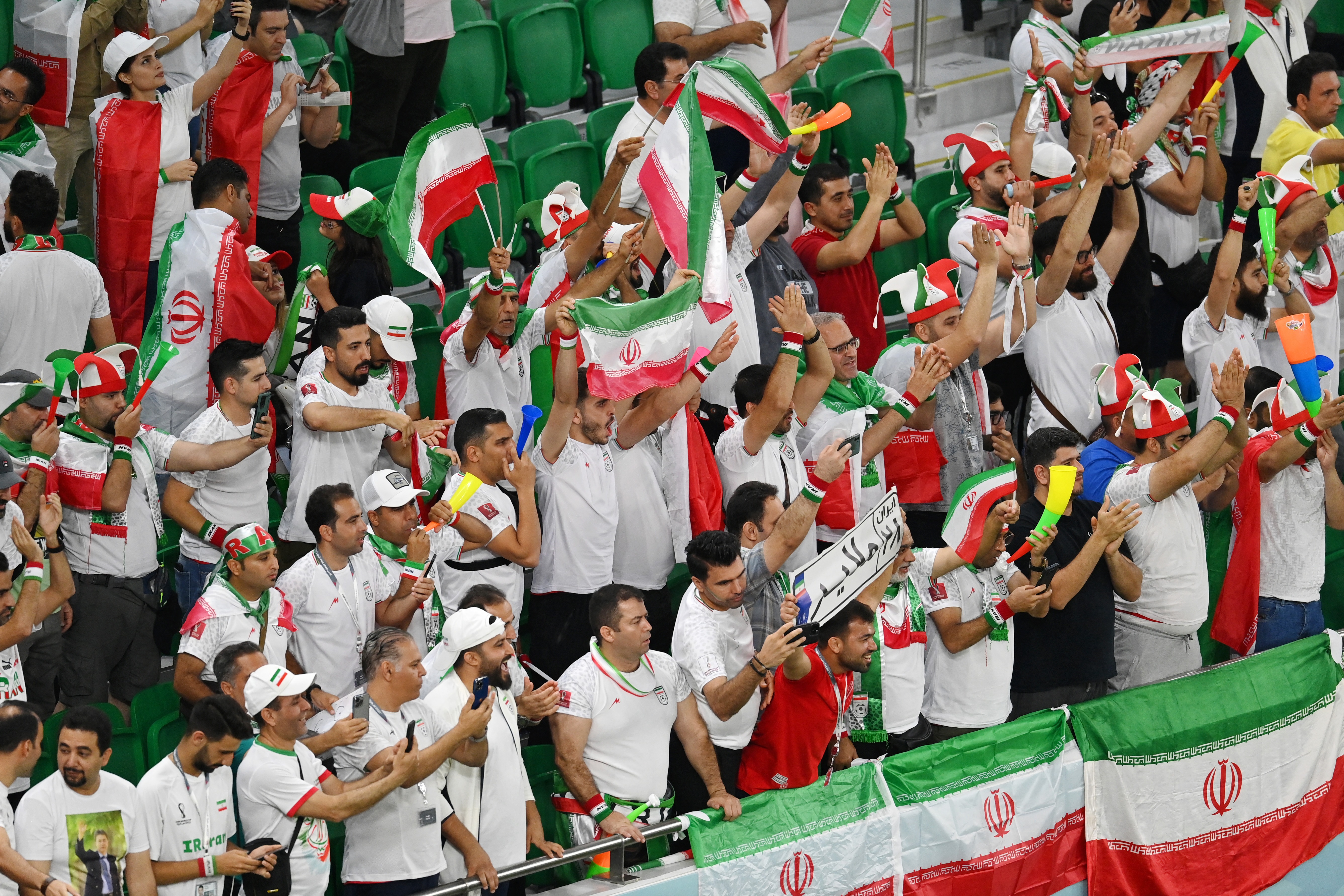
 Iran fans at the Fifa World Cup 2022 Group B match against the USA at Ahmad Bin Ali Stadium on 29 November, 2022 in Doha. (Photo: Claudio Villa/Getty Images)
Fifa is not an organisation that anyone would ever have much sympathy towards. It’s a money-making, tone-deaf beast that rules the world’s most popular game with about as much empathy as an actuary mulling over a spreadsheet.
But it faces a quagmire of potential legal battles and organisational gymnastics with the likely withdrawal of Iran from the showpiece tournament that starts on 11 June. And you almost feel sorry for them. Almost.
Comments this week, from both the Iranian Minister of Sport Ahmad Donyamali and US President Donald Trump, in keeping with actual daily events, have all but torpedoed Iran’s chances of appearing at the World Cup.
Due to the US/Israeli attacks on Iran, the Republic’s Supreme Leader Ayatollah Ali Khamenei was killed via air strikes, which sparked retaliation from Iranian missiles.
“Considering that this corrupt regime has assassinated our leader, under no circumstances can we participate in the World Cup,” Donyamali told Iranian state television on Wednesday.
“Our children are not safe and, fundamentally, such conditions for participation do not exist.
“Given the malicious actions they (US/Israel) have carried out against Iran, they have forced two wars on us over eight or nine months, and have killed and martyred thousands of our people. Therefore, we certainly cannot have such a presence.”
Trump’s tone
Trump struck a strangely conciliatory tone when speaking of the Iranian footballers a few days later, but suggested they stay away.
“The Iran national soccer team is welcome to the World Cup, but I really don’t believe it is appropriate that they be there, for their own life and safety,” Trump said in a post on Truth Social.
/file/attachments/orphans/GettyImages-2265658559_196362.jpg "US President Donald Trump has urged Iran not to take part at the 2026 World Cup. (Photo: Roberto Schmidt/Getty Images)")
The Iranian Football Association subsequently called for Fifa to strip the US of hosting rights for the World Cup, with games also taking place in Mexico and Canada.
It is highly unlikely that Fifa would go that far, and it’s equally unlikely that countries might opt to boycott the tournament in protest against what is an unprovoked war in Iran.
Not for the first time, it’s players who will suffer. The Iranian team, regardless of personal feelings about the ruling regime, qualified for the World Cup by right. And that is now likely to be stripped from them.
Sought asylum
The Iranian men’s teams’ situation is a piece of the greater geopolitical jigsaw, as is the plight of the Iranian women’s team who participated at the Women’s Asian Cup.
Earlier this week, Australia granted humanitarian visas to five Iranian women soccer players after they sought asylum, fearing persecution on their return home for their refusal to sing the national anthem at an Asia Cup match.
/file/attachments/orphans/GettyImages-2264901608_820943.jpg "Golnoosh Khosravi of Iran heads the ball from Amy Sayer of Australia in a clash during the 2026 Asian Cup at Gold Coast Stadium. (Photo: Albert Perez/Getty Images)")
With the potential withdrawal of Iran from the 2026 World Cup, Fifa and other federations have been scouring their regulations to see what can be done.
There are several options, all of which could come under legal challenge.
‘Sole discretion’
Article 6 of the Fifa 2026 World Cup regulations deals with participating teams.
Under clause 6.7, it states: “If any Participating Member Association withdraws and/or is excluded... Fifa shall decide on the matter at its sole discretion and take whatever action is deemed necessary.”
On the face of it, it seems simple enough. In familiar and clear dictatorial style, Fifa will have “sole discretion” about how to find a replacement should Iran, or any other nation for that matter, withdraw.
Article 6.2 of the regulations further adds that there are fines if a team withdraws fewer than 30 days before the tournament starts.
Iran, should it withdraw, would also be required to return its preparation funding, paid to the Association by Fifa, which is approximately $1.5-million.
Furthermore, Iran would forfeit its participation fee of more than $10-million. For any national football association, it’s a lot of money. For a small nation, in footballing terms, such as Iran, it’s a massive penalty.
While the regulations gives Fifa immense power to act quickly, “sole discretion” is often a lightning rod for legal challenges.
If Fifa chooses a replacement based on commercial appeal rather than sporting merit, excluded nations could argue at the Court of Arbitration for Sport (CAS) that the decision was arbitrary or violated the spirit of fair competition.
/file/attachments/orphans/GettyImages-2258929856_273129.jpg "Fifa President Gianni Infantino. (Photo: Alex Wong/Getty Images)")
Replacement Scenarios
Because the rules grant Fifa “sole discretion”, several competing scenarios are being debated.
One option is geographical merit. Historically, Fifa has tried to maintain continental balance. Since Iran is part of the Asian Confederation, the most logical replacements are Iraq (the highest-ranked Asian team currently in the inter-confederation playoffs) or the UAE.
If Iraq is promoted directly to fill Iran’s spot, it leaves a void in the inter-continental playoff bracket. Fifa might then have to allow the UAE to take Iraq’s place in that playoff.
/file/attachments/orphans/GettyImages-1451363456_681489.jpg "Lionel Messi lifts the Fifa World Cup trophy after Argentina won the 2022 tournament in Qatar. (Photo: Julian Finney/Getty Images)")
Iraq have some challenges of their own though.
The travel freeze in the Middle East caused by the conflict is impacting Iraq’s ability to get to Mexico and prepare for their match against either Bolivia or Suriname on 31 March.
Iraq coach Graham Arnold has proposed that Fifa postpone that fixture until closer to the finals, saying that would be fair to the Iraqis and allow the Iran situation to play out further.
“Let Bolivia play Suriname this month and then a week before the World Cup, we play the winner in the US – the winner of that game stays on and the loser goes home,” Arnold told the Australian Associated Press on Monday.
“In my opinion, it also gives Fifa more time to decide what Iran is going to do. If Iran withdraws, we go into the World Cup and it gives the UAE, who we beat in qualifying, the chance to prepare for either Bolivia or Suriname.”
The second scenario is that of global merit.” Fifa could use its discretion to invite the highest-ranked team that failed to qualify (potentially Italy, depending on their final playoff results).
Maximise revenue
This would maximise commercial revenue but would be seen as a betrayal of the qualification process and unfair to Asian nations.
The third scenario is a “playoff finalist” such as Bolivia or Suriname.
Fifa could simply award the spot to the runner-up of the inter-confederation playoffs. This would be the “cleanest” sporting solution but may not be decided until late March, leaving the replacement team very little time for logistics.
The fourth and most unlikely scenario is to have no replacement at all, reducing the tournament to a 47-team competition.
Fifa could leave Iran’s group (Group G: Belgium, Egypt, New Zealand) with only three teams. However, in a 48-team format where the best third-place teams advance, a three-team group creates a massive mathematical unfairness for the rest of the bracket.
/file/attachments/orphans/WhatsAppImage2026-03-13at113348_657749.jpeg "What could happen if Iran withdraws. (Source: Fifa regulations. Graphic: Daily Maverick - Gemini)")
Legal challenges
Whatever scenario Fifa chooses, and however well intentioned, it is almost certainly going to upset someone, somewhere.
If Fifa makes a choice outside of a strictly “next-in-line” sporting merit system, it will likely trigger a challenge at CAS.
Because Article 6.7 uses the term “sole discretion”, it could be legally vulnerable.
Opposing federations could argue that “discretion” must still be exercised reasonably and consistently with the “spirit of sporting merit”.
If Fifa passes over an Asian team to invite a European powerhouse such as Italy, the Asian Federation could sue, citing a violation of the “continental quota” system that governs the World Cup structure.
And ultimately, should they withdraw, Iran might argue that the situation was due to “force majeure” because of a state of war, due to the assassination of their leader.
Iran could potentially challenge the financial penalties and the “withdrawal” label itself to avoid being banned from the 2030 World Cup.
Whatever the outcome, the scenarios are not perfect and the World Cup is set to become a victim of the current global tensions. DM
Comments
Scroll down to load comments...