




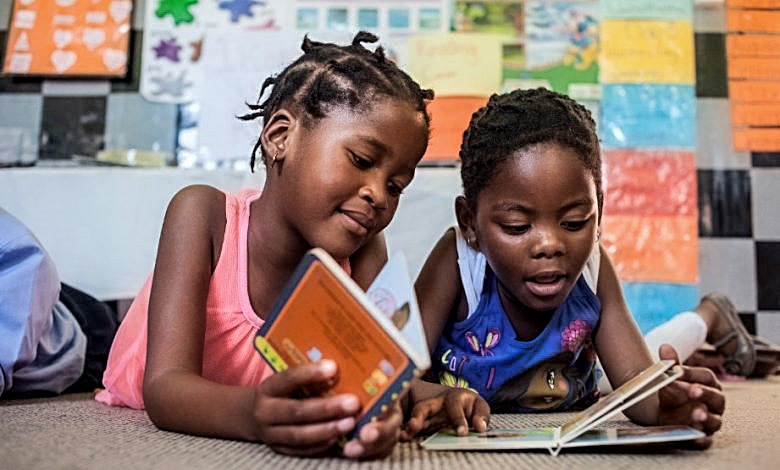
 Nal'ibali's approach to South Africa’s literacy crisis relies on making reading a joyful, shared experience rather than a lonely classroom drill. (Photo: Supplied / Nal'ibali)
 In apartheid-era South Africa’s Northern Cape, a small-town girl named Lorato Trok discovered the magic of literacy not in libraries, which her community of Kuruman lacked entirely, but in the mesmerising glow of bedtime tales. She wouldn’t glimpse her first school library until age 18, in high school.
“My mother was a master storyteller. That’s where I got my stories from, my mother and aunt. She made sure to tell us Setswana stories every night without fail, bringing them to life so beautifully. I fell in love with my language and fell in love with stories then. My aunt would dramatise the whole thing, it was beautiful. Even though we didn’t have physical books, my mother’s stories made me love literacy, and made me love children’s stories,” Trok says, her voice warming with memory.
That oral spark, forged in resource-scarce roots, propelled Trok’s two-decade career in early literacy, which has spanned publishing, teacher workshops, campaigns and translations across Africa and North America. Having joined Nal’ibali as executive director in May 2024, she now channels her expertise into a nationwide crusade for joyful readers.
/file/attachments/orphans/Untitled1111-1_473334.jpg "Nal’ibali Executive Director Lorato Trok credits her mother’s nightly Setswana stories for her love of literacy. Today, she heads Nal’ibali, championing reading for enjoyment across the country and the wider SADC region. (Photo: Supplied / Nal'ibali)")
Nal’ibali (isiXhosa for “here’s the story”) is SA’s national reading-for-enjoyment campaign, igniting passion for reading among children aged up to age 12, primarily in home languages. Launched to complement phonics-based classroom interventions, the nonprofit enhances the national curriculum by emphasising joy over rote learning.
Unlike traditional interventions focused solely on decoding words, Nal’ibali champions the magic of stories as gateways to comprehension and love. The campaign:
- Provides multilingual newspaper supplements bursting with folktales, parent tips and interactive prompts.
- Trains thousands of “story sparkers” to bring tales alive in schools, early childhood development (ECD) centres and homes.
- Runs more than 1,200 self-sustaining reading clubs equipped with story packs and facilitator guides.
Wordless picture books empower non-literate caregivers, often grandparents, to co-create narratives from vivid images, while children’s publishing anthologies turn primary schoolers into proud authors of home-language works.
/file/attachments/orphans/sa-good-news-brandsa-Family-time_982292.jpg "Nal’ibali’s wordless picture books empower caregivers to co-create vivid narratives with children, ensuring the rich tradition of oral storytelling thrives at home. (Photo: Supplied / Nal'ibali)")
Confronting the crisis with stories
SA’s literacy emergency is stark. A recently released reading panel report noted that only 30% of learners in grades 1 to 3 are reading at grade level in their home language. In some languages, up to 25% of Grade 3 learners cannot read a single word.
Across the system, 15% of Grade 3 learners scored zero on reading assessments – which means they are unable to decode even a single word by the end of their third year of formal schooling.
“Every study paints the same grim picture. It’s not new; it’s the persistent crisis gripping our classrooms,” Trok notes.
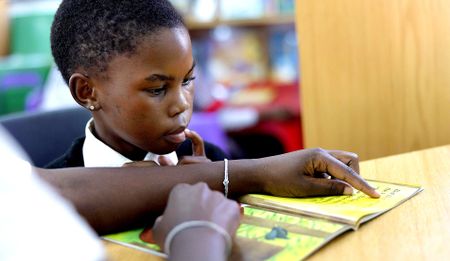
Nal’ibali steps boldly into this void where formal education often falters, extending beyond phonics drills to reach schools, ECD centres, and critically the 1.6-million children languishing outside preschools entirely, as flagged by the Department of Basic Education.
Strategic partnerships form the backbone, and through formal memoranda of understanding with national, provincial and district education departments Nal’ibali targets high-need, underserved areas with precision.
/file/attachments/orphans/IMG_0050_543432.jpg "With recent data showing 15% of Grade 3 learners cannot decode a single word, Nal’ibali's multilingual story packs and reading interventions are crucial tools in combating South Africa's deep-rooted literacy crisis. (Photo: Supplied / Nal’ibali)")
“We don’t just barge in,” Trok emphasises. “We collaborate to enhance what’s already there – no duplication, only amplification.”
This ensures resources flow where gaps yawn widest, from rural Eastern Cape outposts to urban Gauteng townships.
At the vanguard are Nal’ibali’s foot soldiers – about 800 story sparkers, literacy mentors and provincial coordinators who fan out across all nine provinces. Employing more than 1,000 people nationwide, these frontline warriors enter homes, classrooms and community spaces with infectious energy. During family literacy visits they’ve uncovered hidden barriers, such as hearing or visual impairments, and linked parents to experts and hospitals.
/file/attachments/orphans/abutifotoz-105_903715.jpg "A Nal’ibali story sparker brings a tale to life for young learners. The organisation employs hundreds of literacy mentors who visit homes, classrooms and community spaces to make reading a joyful experience, rather than just a rote classroom drill. (Photo: Supplied / Nal'ibali)")
“We’ve referred cases where parents had no clue. We look at the child holistically, not just stories, but real support blending joy with intervention,” Trok said.
From seed to self-sustaining bloom
Success stories bloom from Nal’ibali’s interventions, proving that joy can spark enduring change.
Take the Eastern Cape girl who joined a reading club in Grade 1.
“She loved it from day one,” Trok recalled. Now in high school, that same child runs her own club, promoting literacy in her home town.
“She told coordinators that if it wasn’t for Nal’ibali, she wouldn’t be here,” said Trok.
She added that this child was one of many who had their spark fanned through trained facilitators, reading club packs and Department of Basic Education-backed resources.
Publishing anthologies amplifies this magic. Nal’ibali has produced 50 collections of primary schoolers’ stories in home languages, including a seven-year-old’s short Sesotho tale from the Northern Cape.
In workshops, children learn to write, illustrate and see their work printed as anthologies.
“The pride in them when we hand over those books – it’s electric. We’re not doing it for vanity. We ignite so they regenerate, writing their own stories,” said Trok.
/file/attachments/orphans/abutifotoz-134_380326.jpg "Through Nal’ibali's publishing workshops, primary school learners are taught to write and illustrate their own home-language stories, resulting in 50 published anthologies of children’s work so far. (Photo: Supplied / Nal'ibali)")
These efforts ensure sustainability as reading clubs thrive post-Nal’ibali intervention, families embed storytelling routines, and children become advocates.
“We plant seeds wherever we go, so even without us the work lives on,” Trok affirmed. “A literate society thrives; without it, our country goes nowhere.”
From one tale to a legacy, Nal’ibali turns fleeting joy into generational bloom.
A continental vision
Trok envisions scaling beyond SA through Southern African Development Community (SADC) partnerships, exporting their model of joyful, home-language storytelling to neighbouring nations like Namibia, Botswana and Zambia.
“It’s a continent-wide challenge,” she says. “We’re committed to venturing into the SADC, planting self-sustaining seeds so our work endures. In 100 years, even without Nal’ibali, people will say: ‘This was built from those reading clubs and story sparkers.’”
This ambitious expansion draws directly from Nal’ibali’s track record of sustainability at home: reading clubs that flourish independently post-intervention, thanks to comprehensive training and resource packs; children’s publishing anthologies that transform young writers into lifelong advocates; and family literacy programmes embedding oral traditions so deeply they span generations.
Special projects already prove the model’s regional adaptability, as collaborations with the Trevor Noah Foundation infuse fun into cross-cutting themes like numeracy, climate change and cultural history through interactive, language-rooted narratives.
Trok dreams big: Nal’ibali-inspired hubs dotting the SADC landscape, where ancient oral traditions seamlessly blend with modern tools like audio stories, digital printables and community apps.
Her rallying cry is direct and inclusive.
“I want all South Africans to join. Visit nalibali.org to see our work: audio stories, printables, club guides. Donate R10 monthly, or even 50 cents, whatever you can commit. Volunteer as a story sparker, host a reading circle and amplify World Read Aloud Day. Fuel us to every corner, because literacy isn’t Nal’ibali’s alone; it’s everyone’s duty for a thriving society,” she said. DM