
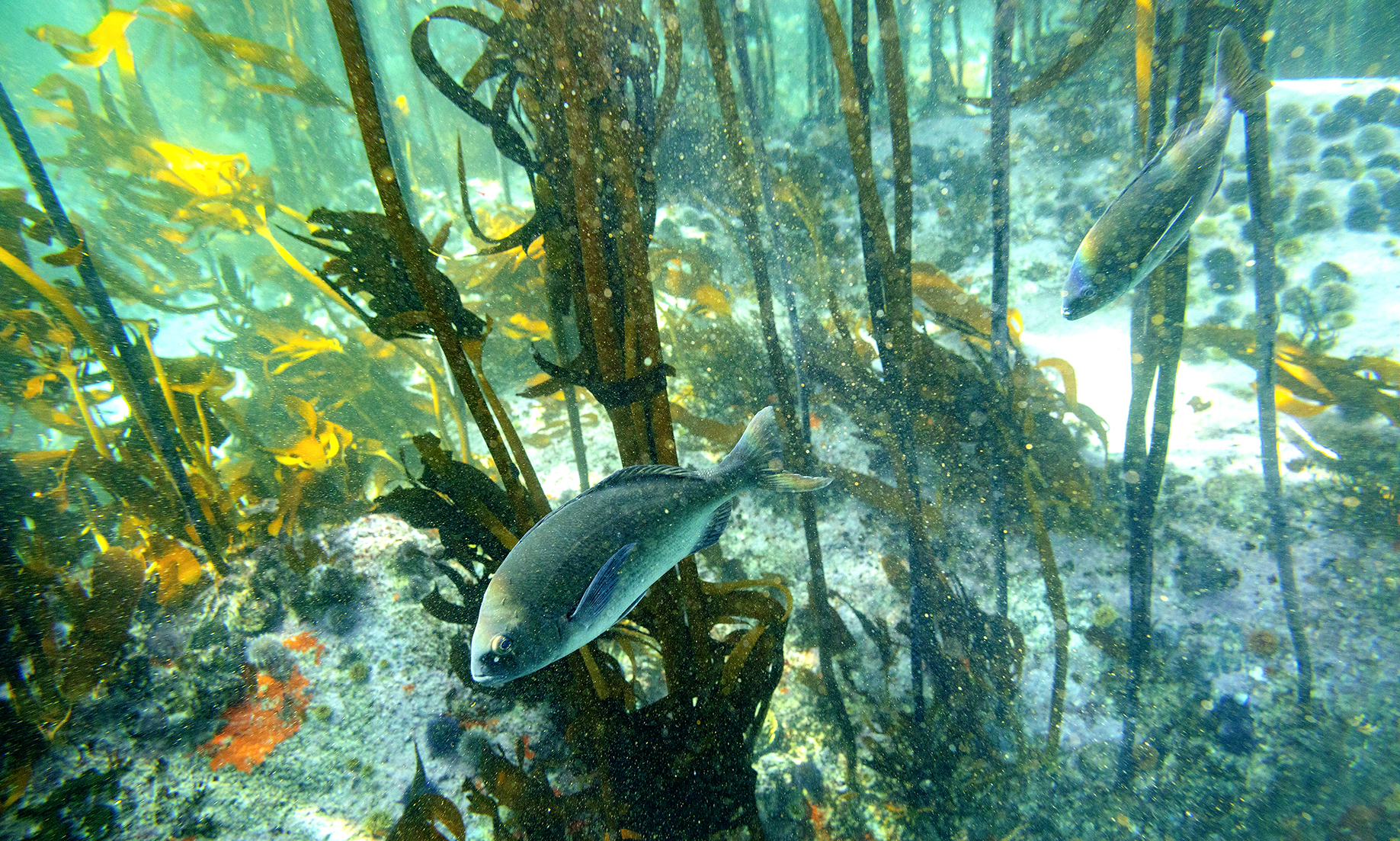
 Hottentot fish (Pachymetopon blochii) in a Marine Protected Area in the Indian Ocean along the False Bay coastline. (Photo: EPA-EFE / Nic Bothma)
 /file/attachments/2985/TroubledWaters_405609.jpg)
Stand on the cliffs of Cape Point and look out over the restless meeting of two oceans. The scene is timeless – gulls wheeling in the wind, waves folding over each other, the horizon stretching into an infinite blue. Yet beneath that beauty lies a story of human interference and fragile recovery. South Africa’s seas, once plundered with little restraint, are experiencing a cautious but determined movement toward restoration.
Marine Protected Areas – MPAs – are the frontline of that transformation. They’re the ocean’s equivalent of national parks: sanctuaries where fishing, mining and drilling are curtailed or banned, allowing ecosystems to recover. The results are beginning to show.
/file/attachments/2985/MPAzonesaroundSouthAfricaDFFE_759563_6ca7691e1eb2a9422a89dcc4bbc0d33c.jpg "MPA zones around South Africa. (Image: Department of Forestry, Fisheries and the Environment)")
South Africa’s first MPA was declared more than 50 years ago along the wild cliffs of Tsitsikamma. What began as a modest experiment has since become one of the country’s most significant environmental success stories. Today, 41 MPAs trace the country’s 3,000km coastline, covering more than 5% of its waters – from the icy Benguela Current on the west coast to the warm, eddying Agulhas on the east.
/file/attachments/2985/SubsistencefisherwithhisbaittinDFFE_514447_4305ec9da288ebf511d00c65e796b787.jpg "Subsistence fisher with his bait tin. (Photo: Rob Tarr)")
A comprehensive review led by Dr Stephen Kirkman examined more than 140 studies and found clear, consistent evidence: when MPAs are properly enforced, marine life rebounds dramatically. Fish populations grow denser and larger, reefs regenerate and once-depleted ecosystems regain balance. Fully protected “no-take” zones – areas closed to all extractive activity – were found to be the most effective.
Within these sanctuaries, biodiversity flourishes and nearby fisheries benefit as fish and larvae spill beyond the protected boundaries.
By 2019, South Africa had expanded its MPA network in a single historic act – 20 new or enlarged protected areas declared at once – bringing 87% of the country’s marine ecosystem types under some form of protection. It was a national turning point: an affirmation that the ocean, if given time and space, can heal.
Trouble on the horizon
But even the best-designed protections are only as strong as the rules that uphold them. In a 2025 study, marine biologist Fannie Shabangu and colleagues uncovered troubling evidence that parts of South Africa’s MPA network were being quietly violated.
The team had deployed sensitive acoustic instruments in two MPAs – Aliwal Shoal on the east coast and Childs Bank off the west – to record whale calls and ocean soundscapes. These sites were chosen precisely because they were meant to be safe from disturbance. Yet within months, the instruments disappeared or were hauled up mangled and broken.
/file/dailymaverick/wp-content/uploads/2025/01/tony-park-6-Bhanga-Nek-Picture-George-Hughes-Collection.jpg "The sandy beaches at Bhanga Nek in northern KwaZulu-Natal are a crucial nesting area for marine turtles. (Photo: George Hughes Collection)")
When the researchers examined satellite and vessel-tracking data, the pattern was unmistakable: licensed bottom-trawl vessels had crossed MPA boundaries and dragged heavy nets across the seabed. In one case, the acoustic recorder even captured the voices of the trawler’s crew moments before it was wrenched from the ocean floor.
The incidents showed not just ecological damage but also a governance gap. Despite the evidence, no formal investigation or sanction followed.
“It is gravely concerning that MPA regulations are contravened without any consequences,” the researchers wrote, warning that such violations undermined both conservation and public trust.
Still, the study provided something constructive – a new way to detect illegal fishing. By tracking the loss or damage of underwater instruments, scientists can now use data itself as evidence, offering a blueprint for better monitoring in remote or deep-sea MPAs.
/file/attachments/2985/BringinthedayscatchTravisDaniels_643451_6852ff5ea5af3ddd7e56db1e26f5d758.jpg "Fishermen bringing in the day's catch. (Photo: Travis Daniels)")
A treaty for the global ocean
While SA grapples with enforcement at home, a historic shift is taking place offshore. In September 2025, after decades of negotiation, the world’s nations ratified the High Seas Treaty, formally known as the United Nations Convention on the Law of the Sea on the Conservation and Sustainable Use of Marine Biological Diversity of Areas Beyond National Jurisdiction. SA is a signatory.
When Morocco became the 60th country to ratify the treaty, it crossed the threshold for activation. Within 120 days, the agreement would enter into force, legally binding its signatories – including SA – to a new era of collective stewardship over the two-thirds of the ocean that lies beyond national borders.
The treaty enables the creation of Marine Protected Areas in international waters, mandates environmental-impact assessments for activities such as deep-sea mining, establishes a benefit-sharing system for genetic resources discovered in the deep and ensures that developing nations receive the support they need in technology and monitoring.
“This historic moment,” said Rebecca Hubbard of the High Seas Alliance, “is the culmination of years of global diplomacy… a powerful testament to multilateralism.”
For South Africa, which depends on healthy oceans for food, climate regulation and coastal livelihoods, ratification is both a moral and strategic act. It aligns the nation’s domestic progress with a global framework of fairness and shared responsibility – a “blue commons” where the ocean is recognised as belonging to everyone and no one.
The big picture
The three stories – the recovery of South Africa’s MPAs, the exposure of illegal trawling and the ratification of the High Seas Treaty – form a single narrative of awakening. They show a world slowly learning to treat the ocean not as a frontier to be conquered, but as a living system that sustains life itself.
MPAs demonstrate that protection works, while Shabangu’s findings remind us that it only works if enforced, and the High Seas Treaty extends that same principle beyond borders, into waters once ruled by chaos and competition.
Together, they suggest that the tide may finally be turning – that our species, having pushed the ocean to the brink, is beginning to listen again to its quiet, immense logic. The science is clear: the sea heals itself when we let it. The law is catching up. What remains is for us to act with the consistency and courage the moment demands. DM
Tomorrow
Many nets, one ocean
Previously
Setting up the series: Untangling SA’s fishing industry
Mark Wiley: South Africa’s vanishing fish
Tim Reddell: Steering Viking Fishing through SA’s troubled waters
Deon van Zyl: ‘We’re crippled by government inefficiency’
Doug Butterworth: Seafood’s balancing act and the science of sustainable catch limits
Colin Attwood: Counting the uncountable and the science of tracking fish
Kobus Poggenpoel: ‘These traditions will die with my generation’
Travis Daniels: at one with the sea