
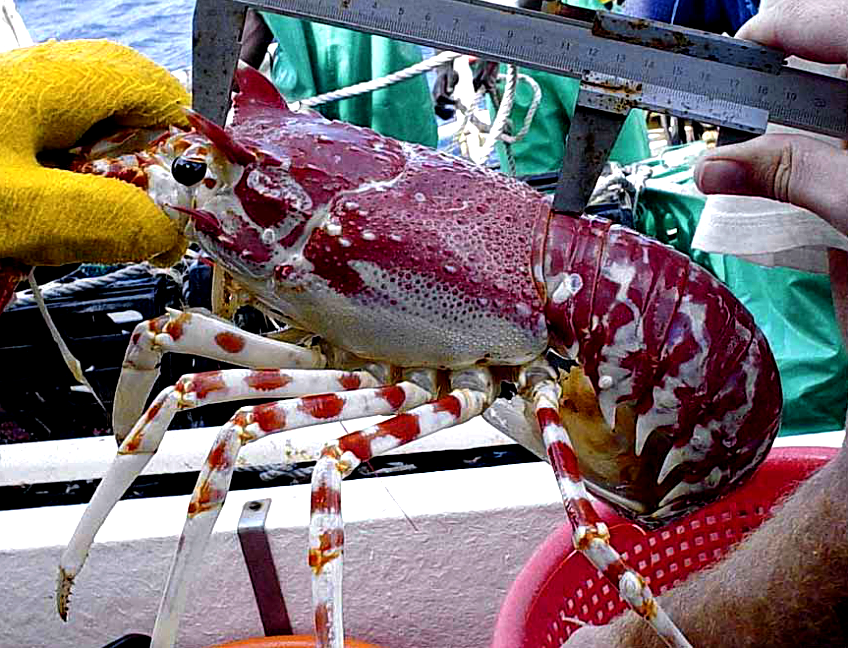
 Measuring a lobster for allowable size. (Photo: Department of Forestry, Fisheries and the Environment)
 /file/attachments/2985/TroubledWaters_405609.jpg)
Colin Attwood is a professor in the Department of Biological Sciences at the University of Cape Town. He has dedicated his career to understanding fish population dynamics, developing scientific methods to measure fish stocks and advising on the design and monitoring of marine protected areas (MPAs). His work bridges ecology and fisheries management, helping to ensure that South Africa’s ocean resources remain healthy and productive for future generations.
-----
Let’s start with the big question: how on Earth do you count fish?
(Laughs) You don’t – not literally. The ocean is far too vast and fish are constantly moving. What we do is collect clues from multiple sources and put them together, like building a giant jigsaw puzzle where a few pieces are missing. If you have enough pieces, you can still see the picture.
We use several methods. Divers swim along fixed transects and record every fish they see, estimating the size and species. We also use baited remote underwater video systems (BRUVs) – underwater cameras with bait that attract fish into view. When we review the footage, we count the maximum number of fish of each species seen in a single frame, which gives us a consistent metric.
For species that live deeper or are too shy to be counted by divers, we use sonar – acoustic surveys that “ping” schools of fish and reveal how many there are. Then there are tag-and-release studies, which let us follow individual fish and learn about how far they move, how quickly they grow and how long they survive.
All of these pieces come together to give us a picture of whether fish numbers are going up, down, or holding steady. The important thing isn’t the exact number – it’s the trend over time.
/file/attachments/2985/ProfColinAttwood_834619_795aeef2062ebdd90e833e3f33b46a11.jpg "Professor Colin Attwood. (Photo: Don Pinnock)")
So you’re looking at the bigger picture rather than trying to get an exact count?
Exactly. Think of it as taking the pulse of an ecosystem. A single reading doesn’t tell you much, but if you measure it regularly, you start to see patterns. Are we seeing more juveniles, which means successful breeding? Are we still seeing enough older, larger fish, which are the ones producing most of the eggs?
Those clues help us decide whether a fishery is in good shape or whether we need to step in with management measures before we reach a crisis point.
MPAs are one of your main focus areas. Why are they so important?
MPAs are like savings accounts for the ocean. They allow fish populations to grow, mature and reproduce without the constant pressure of fishing. Larger fish produce exponentially more eggs – a big female might produce 10 times as many eggs as a smaller one. By protecting these “big breeders”, MPAs can help replenish fish populations outside their boundaries.
And MPAs are not just about fish. They protect entire ecosystems – corals, sponges, kelp forests – everything that makes up a healthy ocean. They also give us an incredibly valuable scientific reference. If we only study fished areas, we don’t know what “normal” looks like. MPAs let us compare and ask: what would this reef look like if we left it alone?
/file/attachments/2985/MPA-poster-SAAMBR_972157.jpg)
How do you measure whether an MPA is working?
We monitor fish populations both inside and outside the MPA over time. If the MPA is doing its job, we should see more fish inside, and they should be larger and older than the ones outside. That’s a sign that the population is rebuilding.
But this takes patience. Some species take years to show a difference – for slow-growing fish it might be a decade before you see a big change. And enforcement is absolutely crucial. If you don’t enforce the rules, the MPA becomes a “paper park” – protected in name only. It’s like sweeping a floor but leaving one corner full of dust – you can’t say you’ve really cleaned until you do the whole job.
Some fishers are understandably worried about losing access to fishing grounds. How do you respond to that?
It’s an important concern, and it’s one we need to address openly. MPAs do take certain areas off the table for fishing, but the idea is to rebuild stocks so that future catches are bigger and more reliable.
When designed well, MPAs create what we call a “spillover effect”. Fish populations grow so much inside the protected area that fish move over the boundaries into places where fishing is allowed. That can actually boost catches just outside the MPA.
The key is involving fishers in the planning process. When they have a say in where MPAs go and how they are managed, compliance improves and everyone benefits.
/file/dailymaverick/wp-content/uploads/2025/09/10917223.jpg "Hottentot fish (Pachymetopon blochii) in a marine protected area in the Indian Ocean along the False Bay coastline on 28 July 2022. (Photo: EPA-EFE / Nic Bothma)")
Have you seen this work in practice?
Yes, and it’s one of the most encouraging parts of my job. In South Africa, we’ve seen species like red roman and galjoen make strong recoveries inside no-take MPAs. These were heavily overfished species, but inside protected areas they are more abundant and larger on average. Those bigger fish produce many more eggs, which helps rebuild the population along the coast.
And we’re not unique – studies all over the world have shown that well-managed MPAs can double or even triple fish biomass in just a decade. It’s one of the clearest examples we have of conservation paying off.
Climate change is a huge issue for everyone right now. How is it affecting your work and South Africa’s fish populations?
Climate change is reshaping the playing field. Ocean temperatures are rising, currents are changing, and the timing of upwelling events – which bring nutrients to the surface – is shifting. Some species are moving southward to stay in cooler water, which affects fishers who rely on predictable seasonal catches.
For scientists and managers, this means we can’t treat our MPAs and quotas as set in stone. We need to keep monitoring and be ready to adapt. A protected area that was perfect for one species 20 years ago might not protect it 20 years from now if its range has shifted.
Long-term monitoring is critical here. It gives us the early warning signs we need to adjust management strategies before problems become crises.
What are the biggest challenges right now for marine conservation in South Africa?
Enforcement capacity is a big one. Expanding the MPA network was a major achievement, but every new MPA needs patrols, monitoring and community engagement. That takes funding and political will.
Poaching is another ongoing issue – even small amounts of illegal fishing can undo years of recovery for slow-growing species. And of course, climate change is the backdrop to everything now. It means we need to think in a more dynamic way about management.
Why should the average person care about all of this?
Because healthy oceans benefit everyone – whether you eat fish or not. Oceans feed millions of people, support jobs, protect shorelines and even help regulate our climate by absorbing carbon.
If we manage our resources well – using good science, well-placed MPAs and effective enforcement – we can have thriving fisheries and thriving ecosystems. It’s not an either/or choice. When we get the puzzle pieces lined up, everyone wins.
What keeps you inspired to do this work?
Seeing recovery happen. When you dive on a reef that was depleted 10 years ago and now see shoals of fish again, it’s like seeing a forest come back to life. That transformation is incredibly rewarding.
I’m also inspired by students and young scientists. They bring fresh energy and innovative ideas, and they really care about leaving the ocean in better shape than they found it. That gives me hope that we can tackle these challenges. DM
Tomorrow:
Kobus Poggenpoel: “These traditions will die with my generation”
Previously
Setting up the series: Untangling South Africa’s fishing industry
Mark Wiley: South Africa’s vanishing fish
Tim Reddell: Steering Viking Fishing through South Africa’s troubled waters
Deon van Zyl: “We’re crippled by government inefficiency”
Doug Butterworth: seafood’s balancing act and the science of sustainable catch limits