




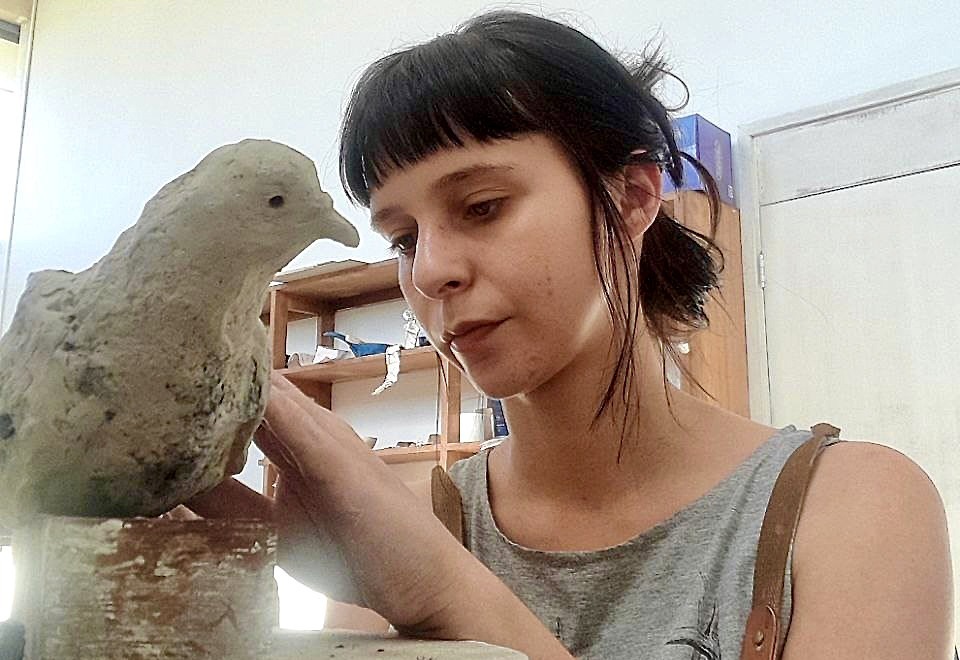
 Taryn Jade works on Peripheral Pigeon in studio. Her art exhibition, which speaks to urban decay, is in the Nelson Mandela Metropolitan Art Museum’s Arts HallI which has been partially closed since 2025 following electrical damage and flooding in the basement. (Photo: Supplied / Nelson Mandela University)
 Inside a municipal museum hall closed by electrical damage and flooding, a Nelson Mandela University master’s exhibition is asking an uncomfortable question: what happens when the spaces that hold a city’s cultural life begin to crumble?
The Gqeberha museum is still waiting for repairs, but this young creative decided not to wait with it.
Sum Nil, a multimedia exhibition by Taryn Jade, is installed in the Arts Hall of the Nelson Mandela Metropolitan Art Museum on Park Drive, a hall that has been partly closed since July 2025 following electrical damage and flooding in the basement.
For Jade, who developed the exhibition as part of her master’s research in visual art at the university, the setting became something close to confirmation.
“It just felt very affirming that even in art spaces the conversation was relevant,” she said. “It wasn’t only external to that zone.”
/file/attachments/orphans/JadeSumNil_764936.jpg "Taryn Jade presents her Notice of Artistic Intention in the style of an official public notice. (Photo: Gillian McAinsh)")
The space, in theory, is still closed to the public, although the research underpinning the work was supported by the National Research Foundation and the Nelson Mandela University Postgraduate Research Scholarship. That tension between official closure and lived creative practice is not incidental.
The exhibition title draws on the Latin sum nil, meaning “I am nothing”, but uses that phrase as a challenge rather than a defeat. Her supervisors, art Professor Vulindlela Nyoni and philosophy Professor Andrea Hurst, describe the framework as drawing on a Nietzschean account of nihilism: “Nothing is given from on high. If you want value in the world, you have to create it yourself. The exhibition gives viewers nothing except the responsibility to respond.”
For Jade, the provocation is precisely the point. “The idea of saying ‘I am nothing’ asks the viewer: do you really think it is nothing? Because it always has the potential to become something.”
That potential takes physical form throughout the Arts Hall. The cracked surface of an empty suit, wrapped around an armature of rusted steel, maps something between a body and a city in collapse. In the darkened basement, against the white noise of an extractor fan, an egg made of asphalt collected from roadworks rubble in Central rests in an ornate beadwork nest.
/file/attachments/orphans/JadeStructuralIntegrity_254689.jpg "The artwork Structural Integrity shows an empty suit, full of cracks, signifying not only a body but also a city hollowed out by neglect. The work is on display in the Nelson Mandela Metropolitan Art Museum’s Arts Hall. (Photo: Gillian McAinsh)")
Jade’s materials throughout carry the weight of local history: steel for the region’s automotive industry, wool for the harbour’s export past, ceramics for the Eastern Cape’s long tradition of clay production, and asphalt lifted directly from the city’s own potholes and construction debris.
Even the manganese ore is a Gqeberha reference; its trucks are blamed for destroying streets and the windblown ore dust for polluting the sea air.
Birds appear throughout the exhibition, and their presence is deliberate. “There is something really poetic about pigeons to me,” Jade says. “They’re also called doves so it’s all a matter of symbolism and perception.” They speak to the full variety of urban dwellers living in Gqeberha and carry a quiet warning about the biases people bring with them: “You might be a pest in someone else’s eyes, or you might be a symbol of true peace and freedom.”
Knitted elements, made collaboratively with friends and family, run around the basement installation, Knot Nothing, alongside sounds that draw visitors deeper into the space.
“I didn’t want my voice to be the only one speaking about dereliction or the state of the city. I’m just adding to that conversation,” Jade said, and that instinct extends to the artists she has placed in dialogue with her own work.
/file/attachments/orphans/KnotNothing_withTarynJadewalkingdownthebasementstairs_Photocredit-FanjanCombrink_180066.jpeg "The artist descends into the basement of the Arts Hall which features her installation, Knot Nothing. (Photo: Fanjan Combrink)")
Art museum pieces by George Pemba and Fred Page showing parts of old Port Elizabeth appear alongside newer works by Tim Hopwood, Mxolisi Dolla Sapeta and Joff, and pop culture voices including Shitty City PE, Twiza and Boiling Point.
Museum director Emma O’Brien describes the collaboration as a negotiation born of crisis. Professor Nyoni asked if she might consider the unusual request of permitting a postgraduate student to exhibit at the museum.
“The building was vulnerable. We were short-staffed and dealing with repairs. But suddenly, within that moment, art was being made,” O’Brien said.
There was a condition, however: Jade had to work with pieces from the museum’s permanent collection. “These artists tell a story about a city over a vast period of time but, through Taryn’s lens, in secondary commentary, she is bringing them back to life again, saying, I see you, I see myself, I see the city.”
Visitors are invited to contribute to the exhibition, with the wall at the entrance asking: what does a good future in Gqeberha require? Handwritten responses, among them “good governance”, “Ubuntu”, and “promises made are promises kept”, already cover the marble surface above it.
/file/attachments/orphans/JadeGoodFuture1_781865.jpg "Visitors to the Sum Nil exhibition are asked to respond to the question: what does a good future in Gqeberha require? (Photo: Gillian McAinsh)")
“If you expect art to fix everything, you’ll be disappointed,” Jade said. “But it can create the moment where people decide to care.”
Jade said the decision to stage the exhibition in a municipal museum rather than a university gallery was itself a statement: “If I put everything I’m talking about in too clean or private a space, then am I actually participating in the city I’m making art about?”
Jade will lead a walkabout of Sum Nil on Saturday, 28 March at 10am. Entry is free. The exhibition runs until 18 May 2026, open weekdays from 9am to 4pm and Saturdays from 9.30am to 12.30pm. Selected works are for sale. Nelson Mandela Metropolitan Art Museum, Park Drive, Gqeberha. DM
Comments
Scroll down to load comments...